*New Repertoire Discoveries for Singers:
An Interview with Michael Kaye*
by Maria Nockin
Did you ever wonder why that last Tales of Hoffmann you sang had all those photocopied sheets added in? Or why the version of "Butterfly" you learned a few years ago isn't the version you're doing this year? Blame Michael Kaye and other musicologists, who are diligently uncovering authentic music faster than publishers can print it! Here's some news teachers and recitalists can use.
MN: So you are one of the guilty parties responsible for making it impossible for singers to learn "the definitive Hoffmann!" Do you apply for grants so that you can work on finding lost music?
MK: Normally that work is done under an umbrella of academia, but I had to find other ways. I was a member of the musical staff at the Met when I began working on the Hoffmann publication project. For the many years during which I established my edition of the Tales of Hoffmann, I had to seek my own funding, but it's very difficult to ask for a grant for yourself.
Fortunately, Gordon Getty, Frederick R. Koch, Paula Heil Fisher and the late Francis Goelett (a great lover of contemporary music and French opera, who donated the funding for many new productions of French works at the Metropolitan Opera) were among the generous private sponsors of my work. First recordings of previously unpublished music by important composers, and financial advances from publishers, sometimes can help subsidize the preparation of the music for performance.
There are also grants, endowments and fellowships that provide funding for this type of research. If you want to do this sort of thing, you can investigate lists of foundations and what they will fund.
MN: Singers and teachers are always looking for new and interesting repertoire for recitals.
MK: Thanks to Larry and Leon Galison, and Clark McAlister, at Masters Music Publications, Puccini Rediscovered is a continuation of the results of my Puccini studies. Commentaries, translations and annotations supplement these new editions of printed music. The songs in the first volume are: "Beata viscera," "La primavera," "Ad una morta!" "Ave Maria Leopolda," "Casa mia, casa mia" and "Sogno d'or."
MN: Can you tell me a little about each song?
MK: Puccini probably composed "Beata viscera" in 1875, when his sister, Iginia, took her first vows as a nun. The text, found in the Gospel of St. Luke, is from the Roman Catholic Christmas liturgy.
This is the first publication of "La primavera, Canzonetta," a song about which very little is known, except that it is a very beautiful piece in the style of the Bellini and Verdi songs. It reminds me of portions of Falstaff.
"Ad una morta!" is a very important song that is one of my favorites. In this first publication of the final version, we find a piece that was crucial to Puccini's early development. It is a very emotional song originally composed, according to the manuscripts, for mezzo-soprano or baritone, so here we have an authentic piece Puccini wrote for those voices! In fact, Puccini's non-operatic songs are well suited to several voice categories, depending on the key [in which] one chooses to perform them.
"Ave Maria Leopolda" is by no means a religious song. It's a musical salutation to the wife of Leopoldo Mugnone, a conductor who had performed many of Puccini's operas. Only the vocal line was available, in a letter Puccini wrote to Mugnone. I provided it with a piano accompaniment so one can sing it in recital.
"Casa mia, casa mia" is a rather brief but charming song Puccini wrote in 1908, when he was trying to sell his villa at Boscolungo Abetone. Since a friend of his was publishing a magazine called La Casa, he gave him the song in exchange for advertising.
The lullaby "Sogno d'or," written in 1912 for the Christmas issue of a popular Italian magazine, eventually proved to be the basis for the wonderful quartet in La rondine. In The Unknown Puccini, I also published the second version of the "Rondine" quartet, in which Prunier is a baritone and there are no interjections from the chorus. In terms of choosing excerpts from opera to perform on special occasions, I think it's as fine as the "Rigoletto Quartet" or even the quartet at the end of Cosi fan tutte.
Speaking about musical toasts, Angela Gheorghiu and Anton Coppola have just made a recording for EMI of my edition of Tigrana's "Brindisi" ("La coppa e' simbol della vita"), from the first version of Edgar. This is also the first time this music has ever been recorded. While Tigrana is known as a mezzo-soprano role, Puccini originally wrote it for a soprano. These are just a few examples of the music comprised in the Rediscovered Puccini volumes of arias and ensembles from Puccini's operas, in alternate, revised, and abandoned versions, being issued by Masters Music Publications.
MN: For which book did you win the Luigi Illica Prize?
MK: I won it for The Unknown Puccini. It's awarded annually in Italy to performers or other people who have made significant contributions to Puccini studies. I received it in recognition of the first publication of many of these songs, and for correcting a large quantity of erroneous information in the literature pertaining to Puccini's life and works.
MN: What are your thoughts on the songs in the first book, The Unknown Puccini?
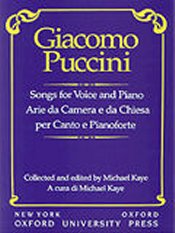
MK: All of these pieces are welcome additions to the Italian repertoire, even if they are not equal to the finest works by Schubert, Schumann, Fauré or Debussy. Many young singers who are not yet ready to do Puccini's operatic roles can sing his songs and learn a great deal about the style. He composed the lullaby "E l'uccellino" for the infant son of a friend who died shortly before the baby was born. The music for "Morire?" was later used as an entrance aria for Ruggero in the second version of La rondine. The mattinata "Sole e amore" anticipates the great Act III quartet in La bohème. Renata Scotto often sang it in her recitals and on recordings. Once, in a review of a Scotto solo recital in Washington, a critic reported that she sang "the quartet from La bohème" very beautifully. I guess he didn't read his program notes very well that night.
"Mentìa l'avviso" was a student composition to a text by Felice Romani that later became Des Grieux's aria: "Donna non vidi mai" in Manon Lescaut.
"A te" is a love song in the classic tradition of Gluck. At first it reminds me of that composer's "O, del mio dolce ardor," but it ends with music that evokes Tosca. In "Storiella d'amore," we find elements of Mimì from La bohème, and parts of Edgar, but it's actually Puccini's setting of the story of Paolo and Francesca reading together, with a comic twist. The text is by Antonio Ghislanzoni, best known for having versified the prose draft of the libretto of Verdi's Aida.
"Salve Regina," also to a text by Ghislanzoni, became the prayer in Puccini's first opera Le Villi. "Avanti Urania!" was written for the christening of a very large steamship belonging to the Marchese Carlo Ginori-Lisci, to whom Puccini dedicated La bohème. Ginori-Lisci gave the composer the land at Torre del Lago where Puccini built a home. That was where he loved to hunt and fish, and his song "Inno a Diana" is a tribute to hunters and their patron saint.
The composer's granddaughter, Simonetta Puccini, does a lot to encourage Puccini studies. We have lectured together and shared some wonderful experiences. I will never forget the day that she left me alone in Puccini's studio at the villa in Torre del Lago when she went out to do some errands, or the times we visited the house in Viareggio, in which he composed Turandot. [The villa is now a museum well worth visiting, as well as Puccini's tomb.] I just wish that Puccini had not spent so much time writing letters when he could have been filling more pages with his music.
"Inno a Roma" is a festival hymn for a large chorus and baritone, performed for the first time under very unusual circumstances. "Terra e mare" is Puccini's most sophisticated song. It evokes Italianate images of long rows of poplar trees bent by the wind, and the sound they make, as the poet dreams of the roaring of the sea.
"Canto d'anime" was written in 1904, on a commission from the Gramophone Typewriter Company, expressly to be issued as a recording by Ida Giacomelli. With its text by Luigi Illica, it boasts a soaring melody that in some ways resembles what would become Rinuccio's "Firenze è come un albero fiorito" in Gianni Schicchi. Other passages in "Canto d'anime" evoke music Puccini composed for Madama Butterfly.
MN: How did you come to reconstruct the various versions of Madama Butterfly?
MK: I did that for the Vox recording made in Budapest, which includes the major versions of the opera. With that set of CDs you can listen to each of the versions Puccini wrote. Since this is the opera's centenary, I am publishing a centennial edition of all the versions. They are performing my reconstruction of the Brescia version of "Butterfly" this fall for the first time in Tokyo, in a co-production with the Puccini Festival at Torre del Lago.
MN: Were you working on your definitive edition of the Tales of Hoffmann all this time?
MK: Yes! All told, I worked on that for more than 15 years! I identified more than 350 previously unknown autograph pages of Offenbach manuscripts and restored them to the score. My edition takes into consideration all of the sources in public and private collections in the USA and abroad. It is in the repertory of more than 20 theaters in Europe, and there are two recordings of it. One is on Phillips, with Jessye Norman, Sophie von Otter, Samuel Ramey and Jeffrey Tate. The other is on Erato, with Roberto Alagna, Natalie Dessay and Kent Nagano.
I hope more American opera companies will choose to offer their artists and audiences the opportunity to experience Offenbach's achievements in his posthumous masterpiece with productions based on the new edition.
MN: What CDs are available of the Puccini songs?
MK: Placido Domingo has recorded all the songs from the Oxford book, The Unknown Puccini. Kiri Te-Kanawa, Jose Carerras and Vinson Cole have also done some of them. Roberta Alexander is another singer who has recorded some of these works. Denyce Graves uses some of them in her recitals, too.
Decca has issued a new disc entitled "Puccini Discoveries", conducted by Riccardo Chailly. It contains an interesting performance of my edition of the "Salve Regina," sung by Chiara Taigi, and the first recording of the "Vexilla Regis Prodeunt" sung by a two-part male chorus, as Puccini intended, that is, a Passiontide processional hymn which Puccini wrote for the small church at Bagni di Lucca. It was recorded earlier as a duet, by Placido Domingo and Justino Diaz, with Julius Rudel playing an organ.
MN: If a singer would like to do research on Puccini's works for opera or recital, what would a good resource be?
MK: The Puccini catalogue is the culmination of years of research by Dieter Schickling: a 466-page catalogue of all presently identified manuscripts and editions of Puccini's works, reflecting the present high standards of Puccini scholarship, without precluding the possibility of further discoveries. Dieter wrote it in German, but it was decided that Bärenreiter would publish it in English. I contributed to the research, collaborated with Dieter, and am listed with him as the co-author of the English translation.
For more information, contact Michael Kaye via the Internet: operatic@erols.com.
Maria Nockin writes on vocal music for several publications including Pro Opera of Mexico and www.operajaponica.org.
This article originally appeared in the October 2004 issue of CLASSICAL SINGER and is reproduced here by permission of CLASSICAL SINGER. CLASSICAL SINGER is available on the web at http://www.classicalsinger.com.
A reprint of this article in its entirety, including photographs and a sample lecture-recital program, may be found here.