Recently in Recordings

Italian Opera at the Liceu

The Gran Teatre del Liceu in Barcelona, after suffering a calamitous fire in the early 1990s, reopened in 1999, lovingly restored. TDK has released a series of DVDs from the Liceu since that date, providing ample evidence of the world...

MAHLER: Das Lied von der Erde

Premiered posthumously, the symphonic song-cycle Das Lied von der Erde by Gustav Mahler (1860-1911) remains one of his defining works because of its synthesis of song and symphony, two genres he pursued throughout his career.

J. S. Bach, arr. Robert Schumann. Johannes Passion.

In 1851 during his first season as music director in Düsseldorf, Robert Schumann presented a performance of Bach’s St. John Passion, and unsurprisingly adapted the score both to nineteenth-century taste and nineteenth-century practicalities.

DE LALANDE: Les Folies de Cardenio.

The centrality of dance at the French court helped bring grace, order, and political allegory into the characteristic prominence they enjoyed during the reigns of Louis XIV and Louis XV; theatre presentations of all stripes were infused with choreographic diversions.

SIBELIUS: Symphonies 1-7

In tandem with the recently released set of Sir Simon Rattle’s recordings of Mahler’s symphonies on EMI Classics, the set of the complete symphonies by Jean Sibelius merits attention.

Wagner: Orchestral Hightlights from the Operas

As much as Richard Wagner espoused opera reform in his theoretical writings by bringing to his works for the stage a closer unity between music and text, his actual means of doing so at times involved the use of orchestral forces that sometimes overwhelmed the sung word.

Italian opera on Gala

The budget label Gala purveys live performances both historic and relatively recent; of the three discussed here, the La Scala Fedora dates back to 1931, while the Attila comes from a 1987 La Fenice performance.

Echo de Paris: Parisian Love Songs 1610-1660

National styles of music in the seventeenth century were often distinctive, and in the case of French and Italian music, famously so.

MAHLER: Symphonies 1-10

With its recent release of Mahler’s symphonies conducted by Sir Simon Rattle, EMI Classics makes available in a single place an outstanding contribution to the composer’s discography.

WAGNER: Parsifal

This DVD records and commemorates a 1981 production of Parsifal in its Bayreuth lair, and the singers of 1981 are as fine as recollection might paint them.

Historic opera performances in Russian on Gala

Once the custom of the world's opera houses was to translate great operas into the language of each respective country.

Deutsche Grammophon budget opera sets

Repackaging older recordings having become the primary focus of a classical recording company's business, Deutsche Grammophon budgeted some funds for art direction for its budget series called "Opera House" (although that appellation only appears in a link found on the back inside cover of the sets' booklets).

STRAUSS: Der Rosenkavalier

Of Rosenkavaliers on DVD, the classics tend to be lovingly detailed productions, going back to the film of Herbert von Karajan leading an exemplary cast, with Elizabeth Schwarzkopf's iconic Marschallin.

Lamentazioni per la Settimana Santa

Despite an unsurprising degree of conservatism in liturgical music, devotional life in Rome often found ways of taking advantage of modern musical style.

Castradiva

“Her fioritura is priceless, breathtaking, and effortless.”

“One Foot in Eden Still, I Stand”: Choral Music by Nicholas Maw.

The English composer Nicholas Maw has been a major voice since the 1960's, with a wide range of works that include the 2002 opera, "Sophie’s Choice," a violin concerto for Joshua Bell (1993), and the monumentally-scaled orchestral work, "Odyssey" (1972-87).

MOZART: Requiem (Neukomm ed.)

As is often the case, last works that remain incomplete at the time of a composer’s death, are quick to invoke controversy and conspiracy theories.

ROUSSEAU: Le Devin du Village

This is a valuable new recording of a work that is only rarely heard, but was widely influential and wildly popular during the eighteenth century. Philosophe Jean-Jacques Rousseau wrote both the libretto and the music, with mixed success.

Les Élémens

This disc is well worth the price for the first track alone: the opening measures of Jean-Féry Rebel’s “Cahos,” (Chaos), written in 1737 or 1738, may cause you to wonder if you accidentally left a Stockhausen or Ligeti disc in the changer.

Jan Neckers on Recently Reissued Historicals: December 2007

This recording made half a century ago will not be anyone’s first choice unless one is a die-hard fan of one of the principal singers; neither of them belonging to the absolute top in their profession.

OPERA TODAY ARCHIVES »

Recordings

Carl Maria von Weber: Oberon
11 Jun 2005

WEBER: Oberon

In a certain sense, each of Carl Maria von Weber's final three operas: Der Freischütz, Euryanthe, and Oberon belongs to a different genre. Freischütz — the only one of these three that still in any way forms a part of the repertoire — builds on the folk-like traditions of the Singspiel, while Euryanthe is more closely related to the grand operas that were to become so important in the 1830s and 1840s.

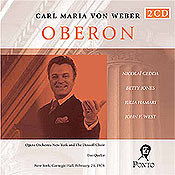
Carl Maria von Weber: Oberon

John F. West, Shirley Love, Betty Jones, Julia Hamari, Nicolaï Gedda, Richard Clark, Carmen Balthrop, Opera Orchestra New York and The Dessoff Choir, Eve Queler (cond.)
New York, Carnegie Hall, February 23, 1978
Bonus tracks

Ponto PO-1030 [2CDs]


Oberon is an example of the Märchenoper, evoking on one hand the orientalism of Die Entführung aus dem Serail and on the other the fairy-tale fantasy of Die Zauberflöte. The opera even includes a chorus in which a chorus of slaves involuntarily dances to the music of a magic horn, much like Monastatos and his minions involuntarily dance to the music of Papageno's bells.

The opera contains a great deal of magnificent music, and is perhaps best known for the imaginative and coloristic musical gestures through which Weber creates the image of a fantastic medieval/Oriental world. Although the opera was frequently performed in the early and mid nineteenth century, it eventually fell out of the repertoire, in part because of insoluble problems with the plot. Weber wrote the opera for London, and the libretto (in English, by Planché) is a nearly incomprehensible mishmash of elements derived from Wieland's late eighteenth-century epic poem Oberon. There have been many attempts to overcome the inadequacies of the libretto: most of these have involved the composition of new recitatives to replace the original dialogue, or the insertion of various pieces from some of Weber's other operas. This recording dispenses with all of the added recitatives (and the dialogues as well), so that the opera appears as a series of largely disconnected musical numbers. This is probably a net gain for the work as a whole, for it has the effect of focusing attention on Weber's imaginative and coloristic music.

Even though the original language of the opera was English, Weber's Oberon has had far more performances in German, and that is the language in which the performances recorded on this set are sung. The main part of the set is a live recording of a concert performance from 1978, in which Eve Queler conducted the Opera Orchestra of New York. The set also includes five "bonus tracks" from a 1972 recording conducted by Rafael Kubelik (with Renè Kollo in the lead tenor role)

The OONY recording has all the advantages and drawbacks that go along with live performance. It is a record of what was surely an extraordinary evening, and in certain numbers (such as the third-act Rondo for the tenor "Ich juble in Gluck und Hoffnung neu!") the recording has the energy and excitement that is too often absent from studio sessions. But there are also distracting coughs during the overture, and (more importantly) a certain veiled quality to much of the orchestral sound. While the brass instruments that shine forth brightly (a big advantage in an opera that features a magic horn), the strings often sound muddy and distant. The Dessoff Choir sounds as if they are singing in another room -- it is nearly impossible to make out their words. The recording engineer had difficulties getting the levels right, and there is occasional distortion in the louder sections. Nevertheless, there is a great deal of beautiful singing and playing here, and the recording should be of great interest not only to specialists, but to all opera lovers.

One of the principal attractions for record collectors will be the presence of Nicolai Gedda in the lead tenor role of Hüon -- the role, incidentally, with which he made his Paris Opera debut in 1954. His rendition of the great first-act aria "Von Jugend auf in dem Kampfgefild" is stirring and spectacular, alternating between heroism and transfigured tenderness. But Gedda's singing is by no means faultless. Like the role of Max in Der Freischütz, Hüon is often treated as part of the Heldentenor Fach; indeed, both of these roles are highly dramatic and declamatory. But in contrast to Wagner, Weber writes a great deal of coloratura for his dramatic tenors, and here is where Gedda's approach leaves something to be desired. The voice often sounds as if it is under too much pressure, and the florid passages are consequently labored. In this recording, Gedda is at his best when he sings pianissimo, as in the second-act prayer "Vater! Hör mich fleh'n zu dir!"

Another interpretation of the lead tenor role appears in the bonus tracks at the end of this set, one of which is Kollo's 1972 recording of "Von Jugend auf in dem Kampfgefild." Kollo's approach is distinctively German: the sound is highly compressed and strongly articulated from the throat, and this reviewer preferred Gedda's more Italianate vocal style.

The OONY recording also features the soprano Betty Jones in the role of Rezia. Jones's voice is clearly enormous, and her upper range is remarkably free and clear. She is at her best in the aria "Ozean, du Ungeheurer!" (probably the most famous part of the score). Her performance is unfortunately marred by occasionally pitch problems, and a tendency to let her vibrato get out of control. This reviewer preferred the taught and muscular soprano sound of Ursula Schröder-Feinen, whose 1972 performance the famous "Ocean aria" appears as one of the "bonus tracks" in this set.

This recording should be of interest to many different audiences: for opera enthusiasts interested in the recording of particular voices, for those who are curious about the development of German opera (or at least, opera by German composers!) between Mozart and Wagner, and for those who have followed Eve Queler's remarkable career. But it is this reviewer's hope that the set will also reach a broader audience. The opera deserves a more prominent place in the repertoire, and the release of this set will hopefully draw attention to a forgotten corner of operatic history.


Dr. Stephen Meyer
Syracuse University
Send to a friend

Send a link to this article to a friend with an optional message.

Friend's Email Address: (required)

Your Email Address: (required)

Message (optional):