Subscribe to
Opera Today

Receive articles and news via RSS feeds or email subscription.


Recently in Recordings

Le Monde Reviews Lamento

Cela arrive rarement, le souffle coupé dès les premières notes. Une minute entière à retenir sa respiration dans une apnée d’émotion totale pour recevoir la première phrase du Lamento pour contralto, de Johann Christoph Bach, d’après les Lamentations de Jérémie, son ascension douloureuse, ornée de sanglots, puis les deux accords d’une longue plainte instrumentale, avant l’entrée, magique, de la voix de Magdalena Kozena. “Ach, dass ich Wassers g’nug hätte.” “Ah, si ma tête était remplie d’eau, si mes yeux étaient une source de larmes.” L’insouciance a été jusqu’alors votre lot ? Vous, toi, nous tous, pécheurs, allons connaître ce que pèse le lourd fardeau de nos iniquités – et la récompense de cette connaissance : 7 minutes 22 d’une pure splendeur musicale.

MOZART: Le Nozze di Figaro

Recorded in Tokyo on October 23, 1963, this live recording of Nozze di Figaro boasts fine sound, a top cast, and the leadership of a conductor of great skill and experience. The label, Ponto, has joined the ranks of such other companies as Opera D’oro and Gala in making available broadcast and in-house recordings at affordable prices. Sometimes these releases are not even worth the modest price asked for; this one may well have more to offer than higher-priced studio sets. After a slightly hesitant first few moments, the sound quality settles down and becomes admirably strong and well defined. There is relatively little stage noise, the voices have a natural presence without being too forwardly placed, and Böhm’s orchestral control can be relished. His may be an old-fashioned reading, but it never lags or lacks for humor or beauty. The audience can be heard laughing from time to time at the stage antics; applause only interferes with the musical pleasures at the end of Non piu andrai, when unrestrained clapping covers a bit of Böhm’s ironically happy martial send-off.

WAGNER: Tristan und Isolde

Elsewhere on Opera Today readers can find a recent review of a live recording of Mozart’s Le Nozze di Figaro from the Ponto label, a company that has joined the ranks of Opera D’oro and Gala in offering, at budget price, live recordings of various provenance. At their best, as with that Nozze, these recordings offer in acceptable sound (sometimes better) performances of such quality they rival their more expensive competitors. At less than the best, however, even the budget price becomes exorbitant. This Tristan und Isolde, recorded on January 25, 1967, unfortunately belongs to the latter category. Unless one has a strong personal reason for wanting a keepsake of this company or the artists involved, the recording is unlikely to please most listeners. The primary reason is the sound. While not unlistenable, the recording is clearly an “in-house” affair, and probably from an audience member, as some of the coughing is more up-front than the singing. Worse, during the climax, some audience members are whispering as Isolde enters the Leibestod. One would love for a Jon Vickers to have been present to yell out, “Stop your damn whispering!”

BOLCOM: Songs of Innocence and of Experience

William Bolcom is arguably the preeminent American opera composer of today. His third commission for Lyric Opera of Chicago, A Wedding, recently opened to mostly positive reviews. His previous work in the form, A View from the Bridge, had a successful run at the Metropolitan Opera following its premiere in Chicago.

VERDI: Il Trovatore

Il Trovatore Giuseppe Verdi, music and Salvatore Cammarano and Leone Emanuele Bardare, libretto TDK DVUS-CLOPIT Raina Kabaivanska (Leonora) Fiorenza Cossotto (Azucena) Plácido Domingo (Manrico) Piero Cappuccilli (Conte di Luna) José van Dam (Ferrando) Maria Venuti (Inez) Heinz Zednik (Ruiz) Karl...

BACH: Matthäus-Passion

On an accompanying CD and in the liner notes, interviewer Klaus J. Schönmetzler asks conductor Enoch zu Guttenberg, “Why another St. Matthew Passion?” This is a fair question considering the glut of recordings ranging from the overtly romantic to the idealized “authentic” (and mostly fast) Baroque editions. To his credit, Guttenberg responds to this question by acknowledging an aversion to interpreting Bach overly Romantically while desiring a Baroque sensibility. As a theologian, zu Guttenberg understands an undeniable conviction in Bach’s theology, particularly in the chorales, which he acknowledges can lead to a more Romantic interpretation. Zu Guttenberg’s attempt to capture this devotion coupled with the reality of twenty-first century instruments and performers, produces a St. Matthew stuck in a mediocre middle ground between a Baroque “ideal” and a Romantic interpretation.

Lamento with Magdalena Ko

The imposing figure of Johann Sebastian Bach has loomed large for Magdalena Koená throughout her career. It was her first disc of Bach arias on Deutsche Grammophon’s Archiv label that brought the golden-voiced mezzo to the attention of the music world as early as 1997. Word then quickly went round that Magdalena was the perfect choice for Bach recordings. ”This disc that started my international career also was my introduction to the great Baroque conductors, including the wonderful scholar and musician Reinhard Goebel, with whom I’ve worked on my new disc, Lamento.” Although the title may suggest wailing and gnashing of teeth, this is a sublime and eclectic mixture of music by J. S. Bach, his relations and contemporaries. ”There’s a very optimistic feeling to this CD,” says Koená. ”Although all these pieces are about how horrible it is on this earth, they are really celebrating how great it will be afterwards. There’s a message of hope throughout.”

Gramophone Reviews Le Comte Ory

Colour, wit and life abound with a star turn from the Rossini tenor of the moment Comte Ory Le Comte Ory is the first great French-language comic opera. A late work (Paris, 1828), sensuous, witty and exquisitely crafted, it has...

Bullfrog Films' Don Giovanni: Leporello’s Revenge

Don Giovanni: Leporello's Revenge Mozart's opera presented from the point of view of Don Giovanni's servant, Leporello. 55 minutes Color / Stereo Copyright Date: 2000 ISBN: 1-56029-885-5 Mozart's Don Giovanni is arguably one of his most complex, politically controversial, and...

Le Monde Reviews Verdi's Falstaff from Andante

Deux "Falstaff", à vingt ans d'écart LE MONDE | 27.12.04 | 14h05 Les amateurs d'opéra ont, généralement, un fort penchant pour l'écoute comparée des interprétations. L'éditeur Andante les comblera. Dans un somptueux livre-CD (224 pages avec notice et livret en...

ROSSINI: Zelmira

Zelmira Gioachino Rossini, music and Andrea Leone Tortola, libretto ORC 27 Scottish Chamber Orchestra Maurizio Benini, conductor Besides its Opera in English series on Chandos, Peter Moore's Foundation has sponsored the recording of many a fine bel canto rarity on...

AMOR: Richard Strauss — Opera Scenes and Lieder

French soprano Natalie Dessay sings three roles, all quite different in character and personality -- from Zerbinetta in "Ariadne" to Zdenka in "Arabella" and Sophie in "Rosenkavalier." It is a delicious way to sample the pleasures of this great singer....

RAUTAVAARA: The House of the Sun

The House of the Sun Einojuhani Rautavaara, music and libretto Ondine 1032-2D Oulu Symphony orchestra Mikko Franck, conductor The recording company Ondine, based in Helsinki, has built itself an international reputation, at least arguably, by dedicating itself to the works...

VERDI: A Masked Ball

A Masked Ball Giuseppe Verdi, music and Antonio Somma, libretto English translation by Amanda Holden Chandos 3116 (2) London Philharmonic Orchestra David Parry, conductor In an era where major record companies seldom produce complete opera sets (and those they do...

STRAUSS: Der Liebe der Danae

STRAUSS Der Liebe der Danae, op. 83 * Ulrich Windfuhr, cond; Franz Grundheber (Jupiter); Manuela Uhl (Danae); Hans-Jürgen Schöpflin (Mercury); Robert Chafin (Midas); Paul McNamara (Pollux); Cornelia Zach (Xanthe, Europa); Daniel Behle, Martin Fleitmann, Simon Pauly, Hans Georg Ahrens (Vier...

Myto Releases Spontini's Agnese di Hohenstaufen

SPONTINI: Agnese di Hohenstaufen Lucille Udovick (Agnese), Dorothy Dow (Irmengarda), Franco Corelli (Enrico il Palatino), Francesco Albanese (Filippo), Enzo Mascherini (Re di Francia), Anselmo Colzani (Enrico il Leone), Gian Giacomo Guelfi (L'Imperatore); Florence Teatro Communale/ Vittorio Gui Myto 42084 [2CD]...

Myto Releases Ernani

VERDI:Ernani with Giovanna d'Arco excerpts Georgio Merighi (Ernani), Piero Cappuccilli (Don Carlo), Augusto Ferrin (De Silva), Mara Zampieri (Elvira) Trieste Teatro Communale/ MolinariPradelli; Mara Zampieri (Giovanna), Renato Francesconi (Carlo), Ettore Nova (Giacomo) San Remo Symphony/ Buenza-Delil Myto 41288 [2CD] 148...

Myto Releases Otello

VERDI: Otello Mario del Monaco (Otello), Renata Tebaldi (Desdemona), Leonard Warren (Iago); La Scala/ Antonio Votto Myto 41083 [2CD] 140 minutes Tebaldi and Del Monaco twice recorded Otello together in the studio, and we've reviewed a number of bootlegs starring...

ARG Reviews Mercadante's Emma d'Antiochia

MERCADANTE: Emma d'Antiochia Nelly Miricioiu (Emma), Maria Costanza Nocentini (Adelia), Bruce Ford (Ruggiero), Roberto Servile (Corrado); Geoffrey Mitchell Choir, London Philharmonic/ David Parry Opera Rara 26 [3CD] 183 minutes I have long been on a campaign to revive the works...

Fanfare Reviews Jenufa

JANáCEK Jenufa * Charles Mackerras, cond; Janice Watson (Jenufa), Josephine Barstow (The Kostelnicka), Nigel Robson (Laca), Peter Wedd (Steva), Neale Davies (Foreman); Welsh Natl Op O & Ch * CHANDOS 3106 (2 CDs: 121: 11) There is so much to...

OPERA TODAY ARCHIVES »

Recordings

Gustav Mahler: Das Lied von der Erde.
06 Feb 2008

MAHLER: Das Lied von der Erde

Premiered posthumously, the symphonic song-cycle Das Lied von der Erde by Gustav Mahler (1860-1911) remains one of his defining works because of its synthesis of song and symphony, two genres he pursued throughout his career.

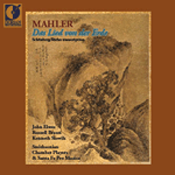
Gustav Mahler: Das Lied von der Erde.

John Elwes, tenor, Russel Braun, baritone, Smithsonian Chamber Players and the Santa Fe Pro Music, Kenneth Slowik, conductor.

Dorian DOR-90322 [CD]

$19.99  Click to buy

Composed between 1907-9, Das Lied von der Erde was not performed in the composer’s lifetime, but was given its premiere in November 1911, several months after Mahler’s death in May of that year. While Bruno Walter conducted the premiere in Munich, other performances followed soon afterward, including those led by Mahler’s colleague Willem Mengelberg, as well some partially documented ones with reduced orchestration at Arnold Schoenberg’s Verein für musikalische Privataufführungen (Society for the Private Performance of Music) that existed between 1918-21, as indicated in the notes that Kenneth Slowik contributed to the present recording. Yet while Anton Webern is credited with the reduction of Das Lied von der Erde at the Verein, only an annotated score by Schoenberg with some notes toward a reduction the score has survived. Dating from 1921, Schoenberg’s score remains a connection to that earlier time, with present recording based on the completion of the reduction that the composer Rainer Riehn (b. 1941) prepared in 1983 from the fragmentary annotated score that Schoenberg left.

Riehn’s efforts capture the chamber-music style that was characteristic of Schoenberg’s Verein. From the outset the lush sounds of Mahler’s orchestral score give way to thinner textures that present the work in the absolutely essential textures and basic timbres. The transparent lines give a sense of the work that clarifies, if not sharpens, the textures that Mahler used to support his text. As much as the essential musical elements are present, the timbres that Mahler used in this work give way to a small ensemble that consists of a flute (doubling on piccolo); oboe (doubling on English horn); clarinet (E-flat, B-flat, and bass); bassoon; horn, two violins, viola, cello, bass, harmonium (doubling on celesta); piano, and percussion (two players). In capturing the sense of the reductions that Schoenberg, Webern, Berg, and their colleagues pursued, Riehn attempted the daunting task of capturing Mahler’s style within a chamber idiom. It is essentially akin to trying to convey the sense of Seurat’s Grand Jatte in miniature, and while the effort can be extended, the result can never be exactly the same as the original effort. Nevertheless, in standing between the two authentic versions by Mahler, that is, his orchestral score and the version for voice and piano, the Schoenberg-Riehn score merits attention for various reasons, including the way it reflects the reception of the work.

Mahler’s score for voice and piano suggests through the idiom more conventional Lieder, and it remains for the imagination of the audience to invoke some of the timbres that the composer brought to the orchestrated version. Yet in both the version with keyboard accompaniment and Riehn’s reduction, it is possible for the audience to concentrate on the vocal parts. While there are a number of highly successful recordings, Mahler’s orchestral score puts demands on singers, who may not always meet the demands of singing with such a full ensemble. The first and fifth songs, for example, can challenge even the most adept tenors because of the tessitura and the amplitude of various passages. Likewise, the lower voice (alto or baritone) must execute a sometimes dense text in the fourth song. With either a piano accompaniment or the Schoenberg-Riehn version, the singers can concentrate on the text and thus convey its meaning readily to the audience.

Thus, John Elwes, who is known for his performances of eighteenth-century opera or nineteenth-century Lieder, meets the challenge of the songs for tenor. From the opening of the first song “Das Trinklied vom Jammer der Erde,” Elwes uses his focused tone to convey the text clearly. While the placement of the microphones sometimes captures the singer’s articulations, those details soon fade into the interpretation that Elwes brings to the music. While it is, perhaps, easier to sing with the smaller ensemble, that does not negate the requisite intensity that the work demands. Thus, the increasingly arching phrases of the first song need to build gradually, and Elwes executes that aspect of the music well. His sometimes a piacere presentation of certain lines seems to allow him to bring out the longer lines that are part of this song, in particular, and yet recur in others.

Russell Braun, an operatic baritone who is known both to American and international audiences, is also respected for his work in solo recitals. This combination of venues seems to suite him well for performing Das Lied von der Erde. From a practical viewpoint, his solidly dark lower register is appropriate for the work, while his upper range makes some of the more extended passages seem completely comfortable. Although the part is customarily sung by an alto, Mahler’s score does not specify genders for either the lower or upper vocal parts. Rather than imitate an alto, a baritone succeeds well by approaching Das Lied von der Erde with a full voice, as Braun does well in “Der Einsame im Herbst.” The telling song is the final one, “Der Abschied,”which is in itself as long as the five songs preceding it combined. Any singer approaching this song faces what is essentially an approximately thirty-minute soliloquy which is interspersed with several interludes. Comprised of two texts (found on facing pages of the original edition of Bethge’s Die chinesische Flöte), the song involves various twilight images in which the speaker calls to mind a dear friend, who is absent. Yet moving from the absent friend, the speaker reflects on his own journey and the prospect of existence as a series of eternities. Without the trappings of philosophy, the text evokes ideas associated with Schopenhauer, while the music creates a sense of eternity that is possible only in sounds, as the piece ends with unresolved sonorities that create an unforgettable context for the repetitions of “ewig” that conclude the piece. Braun succeeds well in giving engaging voice to this piece, and his interpretation deserves attention for its poignancy.

At times the scoring of “Der Abschied” in this version reminds listeners of its distance from Mahler’s score. Various passages seem close to the chamber-music like sonorities that are already part of Mahler’s score, but sometimes the use of piano shifts the timbre enough to call attention to the difference. Nevertheless, the fine interpretation of “Der Abschied” by Braun and Slowik stands out in this performance of the work. Those interested in Das Lied von der Erde may find some insights in this version of work because of the reduced scoring. At the same time, this version also represents the reduction that was cultivated by Schoenberg and his circle for several important years in the early twentieth century.

James L. Zychowicz
Madison, WI
Send to a friend

Send a link to this article to a friend with an optional message.

Friend's Email Address: (required)

Your Email Address: (required)

Message (optional):