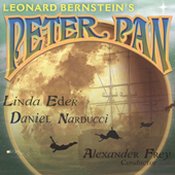
After some searching, he found an entire score composed by Bernstein that nearly no one knew existed. While songs by Bernstein were retained for the production (Bernstein did his own lyrics), his incidental music was replaced by the music of Alec Wilder, and much of it had never been heard, recorded, or, in some cases, even orchestrated. This welcome, and mostly excellent, recording is the result of Frey's seven years of musicological digging in search of this score. For those of us familiar with the already extant songs, as well as those of us for whom Bernstein's work in general is a national treasure, the recording is a wonderful gift. Frey has restored the entire score from manuscript materials and other sources; they have been completely orchestrated; and Bernstein's interpretation of the classic J. M. Barrie tale is at long last available.
For those used to the better known musical version of the story that originally featured Mary Martin on Broadway and, perhaps even more famously, on television, this take on the story holds some surprises. It is recognizably Bernstein from top to finish, to be sure. But how he responds to the story and characters is often fascinating.
Take, for instance, the opening music. The Prelude to Act 1, in which we are musically introduced to the Darling family, is Bernstein at his gentlest. The music surrounds us (and the Darlings) with a safe and homey musical environment - gently orchestrated, melodically simple, harmonically straightforward. The sense of security is complete, although it is, of course, about to be upended by the shadowless boy who flies into the room. Apart from a lullaby sung by Wendy, to which I'll return momentarily, the rest of the act consists of incidental music: "Peter's Tears," in which Peter expresses his dismay at having lost his shadow; "Shadow Dance," in which he celebrates Wendy's having re-attached it with a metrically delightful romp; and two pieces of flying music that accompany Peter, Tink, and the Darling children out the window and on to Neverland. If the flying music sounds a little generic, it's probably because we have grown used to similar music in any number of John Williams scores, from Superman (whose flying music borrowed blatantly from Richard Strauss) to E.T.
The rest of the incidental music is appropriately evocative and charming, and the orchestrations are warmly expressive. Several fight sequences are full of rhythmic and thematic interest, and one of Bernstein's scene changes (track 12) sounds wonderfully like something Darius Milhaud meant to write but never got around to. There is a terrific Bernstein moment in the sequence "Tinkerbell Sick / Tink Lives!" I won't ruin it for listeners in the know, but suffice it to say that Tinkerbell would feel a bit disoriented if she revived and found herself, musically at least, in a completely different musical.
While a few of the incidental pieces are extended - the penultimate scene change (track 26) is a gorgeous orchestral version of the song "Build My House," for example, and at least one of the fights is of relatively substantial length - most of them are quite short. They provide the exact mood for the moment and disappear, just as they should. Without anything in between them, however, they sometimes don't register.
As we already know, Bernstein also wrote several songs for Peter Pan, and they are all gems. The songs are for Wendy, Captain Hook, the pirates, and the mermaids. Peter Pan does not sing, presumably because Jean Arthur, the star, did not.
Linda Eder is unafraid of Wendy's deceptive simplicity, as well as that of her music, and she gives a vocal characterization completely free of affectation. There is no sense of an adult playing down to a child's level: Eder is childlike without being childish, and she uses straight tones with great effect. She also knows when not to use them. Her "Who Am I?", a lullaby Wendy sings to her brothers before Peter arrives, is simple in all the right ways. Only afterwards do we realize the artistry of song and singer. The song "Peter Peter" is a strange charmer. Wendy is telling Peter how much she cares for him, according to the booklet notes, but the words are unusually physical: "I want to feel your touch," "I long for it [the touch of Peter] night and day," etc. Eder sings these lyrics with both innocence and sincerity, and the result dispels what on the page is somewhat disconcerting. Only on "Dream With Me," a song cut from the show, does Eder go astray. Instead of maintaining the wonderful character that she has established - and the wonderful, straightforward vocal embodiment of it - Eder changes styles and suddenly sounds all grown up. It's as if Wendy is having a cabaret moment while singing Peter to sleep. Mind you, this Linda Eder, so it's a very nice cabaret moment, but it somehow seems inappropriate in context and less motivated. But the only comment I can make about Eder's performance of "Build My House" is thank you. She sings it the way I have always hoped to hear it sung.
Alas, Daniel Narducci seems rather out of his element here. Whereas Eder seems to have made acting choices and sung accordingly (exception noted), Narducci doesn't seem to have made any choices at all. Captain Hook is the stuff of character men, and Narducci appears to be a leading man with a nice if unmemorable baritone voice. I'm afraid he invests Hook with nothing. The performance doesn't work as villainy and it doesn't work as comedy. It's just bland. The singer seems unaware of the actor's opportunities. To hear Narducci say "Split my infinitives, but 'tis my hour of triumph!" - a line a good character actor could turn into a one-act play - is to realize the missed opportunities throughout. Bad casting, which is especially unfortunate because Hook has some wonderful material, from a extended "Soliloquy" to a "Plank Round" with the pirates, both of which provide an actor with great opportunities.
The sound of the disc is outstanding. The booklet includes all the lyrics to the songs, biographies, and notes by Frey and David Felsenfeld, the latter of which get off track a few times: is Candide really a mostly-forgotten show? Jule Styne and Comden and Green wrote additional material for the other, more famous Peter Pan — the original score was by Moose Charlap and Carolyn Leigh, who Felsenfeld does not even mention. Etc. But overall the notes are useful. The vocal ensemble sings well, the Ambrose Chamber Orchestra plays with the right combination of warmth and crisp rhythmic awareness, and Alexander Frey, whose labor of love all this is, leads the proceedings with an unmistakable joy. While this is a trifle, it is a trifle by Bernstein, and the results are an important contribution to the literature. Grateful kudos to Mr. Frey.
Jim Lovensheimer, Ph.D.
Blair School of Music, Vanderbilt University