Subscribe to
Opera Today

Receive articles and news via RSS feeds or email subscription.


twitter_logo[1].gif


9780521746472.png

Recently in Reviews

Death in Venice by ENO

‘Beauty is the one form of spirituality that we experience through the senses.’ In Thomas Mann’s, Death in Venice, Plato’s axiom stirs the hopes of the aging, intellectually stale poet, Gustav von Aschenbach, that he may rekindle his creativity.

Adding Movie Magic to The Magic Flute

What better way for Masonic brothers, Wolfgang Amadeus Mozart and Emmanuel Shikaneder to disseminate Masonic virtues, than through the most popular musical entertainment of their age, a happy ending folktale that features a dragon, enchanting flutes and bells, mixed-up parentage, and a beautiful young princess in distress?

Madama Butterfly, Opera Holland Park

There is a sense in which it all began in London, Puccini having been seized in 1900 with the idea of an opera on this subject after watching David Belasco’s play here.

An Evening of Zarzuela and Latin American Music at Los Angeles Opera

The tenor that the audience most wanted to hear, Plácido Domingo, opened the vocal program with “Junto al puente de la peña” (Next to the rock bridge) from La Canción del Olvido (The song of Oblivion) by José Serrano. He sounded rested and his voice soared majestically over the orchestra.

Così fan tutte in San Francisco

Tucked away somewhere in the San Francisco Opera warehouse was an old John Cox production of Così fan tutte from Monte Carlo. Well, not that old by current standards at San Francisco Opera.

Rossini Maometto Secondo Garsington Opera at Wormsley

Rossini's Maometto Secondo is a major coup for Garsington Opera at Wormsley, confirming its status as the leading specialist Rossini house in Britain. Maometto Secondo is a masterpiece, yet rarely performed because it's formidably difficult to sing. It's a saga with some of the most intense music Rossini ever wrote, expressing a drama so powerful that one can understand why early audiences needed "happy endings" to water down its impact

Peter Grimes in Concert

I suppose it was inevitable that, in this Britten Centenary year, the 66th Aldeburgh Festival would open with Peter Grimes.

Die Entführung aus dem Serail, Garsington Opera at Wormsley

Die Entführung aus dem Serail at Garsington Opera at Wormsley isn’t Mozart as you’d expect but it’s true to the spirit of Mozart who loved witty, madcap japes.

Le nozze di Figaro, Glyndebourne

What a pity! On a glorious — well, by recent English standards — summer’s day, there can be few more beautiful English countryside settings than Glyndebourne, with the added bonus, as alas much of the audience appears to understand it, of an opera house attached.

Queens, Heroines and Ladykillers

Described by one critic as “cosmically gifted”, during her tragically short career, American mezzo-soprano Lorraine Hunt Lieberson amazed and delighted audiences with the spellbinding beauty of her singing and the astonishing honesty of her performances.

L’Incoronazione di Poppea from Virgin Classics

Since its first performance at the Teatro Santi Giovanni e Paolo during Venice’s 1643 Carnevale, Monteverdi’s L’Incoronazione di Poppea has been one of the most important milestones in the genesis of modern opera despite its 250 years of unmerited obscurity. 

Alzira by Chelsea Opera Group

“I wrote it almost without noticing.” So Verdi declared when reminded of his eighth — and perhaps least frequently performed, opera, Alzira. One might say that, since he composed the work, no-one else has much noticed either.

Les Contes d’Hoffmann in San Francisco

Just when you thought the protagonist was Hoffmann! Who, rather what stole the show?

La Tosca in Los Angeles

When is verismo verily veristic? Or what is a virginal girl dressed in communion white doing in the two murderous acts of the Los Angeles Opera’s current production of Tosca? And why does she sing the shepherd's song?

Saverio Mercadante: I due Figaro

Though 2013 is the bicentennial of the births of Giuseppe Verdi and Richard Wagner, the releases of Cecilia Bartoli’s recording of Bellini’s Norma on DECCA, a new studio recording of Donizetti’s Caterina Cornaro from Opera Rara, and this première recording of Saverio Mercadante’s forgotten I due Figaro, suggest that this is the start of a summer of bel canto.

Lohengrin, Welsh National Opera

Wagner’s Lohengrin is not an unfamiliar visitor to the UK thanks, in the main, to Elijah Moshinsky’s perennial production at Covent Garden.

Philip Glass: The Perfect American

Philip Glass's The Perfect American at the ENO in London is a visual treat, but the libretto is mind-numbingly anodyne.

Christian Thielemann’s Der Ring des Nibelungen

Recording Richard Wagner’s Der Ring des Nibelungen is for a record label equivalent to a climber reaching the summit of Mount Everest: it is the zenith from which a label surveys its position among its rivals and appreciates an achievement that can define its reputation for a generation. 

Cecilia Bartoli as Norma

Few people who love opera in general and bel canto in particular have never heard the comment made by Lilli Lehmann, veteran of the inaugural Ring at Bayreuth in 1876, that singing all three of Wagner’s Brünnhildes—in Die Walküre, Siegfried, and Götterdämmerung, respectively, all of which she sang to great acclaim—pales in comparison with singing the title rôle in Bellini’s Norma

Jonathan Dove’s Mansfield Park

Jonathan Dove's Mansfield Park, with libretto by his regular collaborator Alasdair Middleton, has the remarkable distinction of being the first completed operatic adaptation of any Jane Austen novel to be staged.

OPERA TODAY ARCHIVES »

Reviews

Albert Lortzing: Der Waffenschmied
07 Aug 2005

LORTZING: Der Waffenschmied

Nineteenth-century German opera before Wagner is rarely performed in the United States, although it is still quite popular in Germany. While works by Spohr, Marschner, and Lortzing, among others, are very much a part of the repertory in many German houses, they are virtually unknown in America, and none of the above-mentioned composers is even mentioned in the index of the new seventh edition of the Burkholder-Grout-Palisca A History of Western Music. This new recording of Lortzing's Der Waffenschmied (The Armorer [of Worms]) suggests not only why this work is still performed. It also suggests that American audiences are missing out on a delightful body of work for the lyric stage. From Lortzing's relatively better-known works, such as Zar und Zimmermann or Der Wildschuetz, to works by Marschner, such as Der Vampyr, nineteenth-century German opera with spoken dialogue is often highly entertaining and musically satisfying, if one is not anticipating work of great gravitas. And who is always in the mood for Tristan und Isolde, masterpiece that it is?

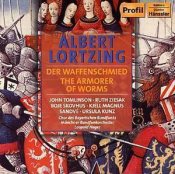
Albert Lortzing: Der Waffenschmied

John Tomlinson, Ruth Ziesak, Boje Skovhus, Kjell Magnus Sandve, Ursula Kunz et al. The Bavarian Broadcast Chorus and the Broadcast Orchestra of Munich conducted by Leopold Hager.

Profil PH04081 [2CDs]


Lortzing was, as John Warrack has noted, "the most inventive composer of opera with spoken dialogue in mid-19th-century Germany," and his skills are evident in this wonderful performance. While Lortzing knew well the masters who preceded him - we can frequently hear traces of Mozart, Beethoven, Weber, and others, as well as French opera-comique and Italian buffa, in this and other scores - his approach and results were individual. Perhaps guided by a theatrical instinct cultivated by years spent acting, singing, and conducting for the stage, Lortzing was a fine craftsman and, by Der Waffenschmied, excellent orchestrator whose entertainments continue to please a wide range of German audiences.

The accompanying essay by Juergen Schlaeder — Marie Praeder provided the sometimes awkward translation — addresses Lortzing's praise of middle-class values in the work. While Count von Liebenau is of the elite class, for instance, it is under the disguise of an apprentice armorer that he wins the love of Marie, the daughter of Stadinger, the master armorer of the title. Stadinger is the character who embodies the steady middle-class values upheld in the work, and when, near the opera's end, he sings of what Schlaeder refers to as "the restoration of traditional ideas of morality," it is in a strophic folk-like song that would have appealed to the middle-class audience for the whom the work was intended. (The work premiered in Vienna's Theater an der Wien in 1846, however, and, as Warrack points out, the Viennese audience was less taken with the "homely and very German humor" than subsequent German audiences have been.) Sir John Tomlinson, a very highly regarded Wagnerian specialist, brings a remarkable vocal presence to this folk-like Lied, as Lortzing calls it, as well as a fine sense of character and style throughout. It's rather like Hans Sachs lite, and it's more than rather nice.

The other standout vocal performance is by soprano Ruth Ziesak as Marie. While she may fall short of the exceptional insight and warmth that the late Lucia Popp brought to this kind of role (and everything else she sang), she comes close to it. The voice is rich and expressive, and Ziesak's performance of the aria that closes the Act 1 finale is a highlight of the recording. She also scores with the opening of Act 3, another extended aria for Marie, as she does in her duets with the Count (Boje Skovhus) and in the ensembles.

It is in the ensembles that Lortzing shines. The second act sextet is quite well written. It begins with an extended unison passage that blossoms into a passage reminiscent of Mozart; after this, its comic sensibility grows as the ensemble begins to sound more and more like refugees from Rossini. After the sextet, a duet for Stadinger and Georg, the Count's squire disguised as another apprentice, further demonstrates Lortzing's familiarity with the Italian buffa style: under Georg's lilting melody, Stadinger, the bass, sings a patter section, and the whole segment recalls Rossini's Figaro and Almaviva's Act 1 duet at the end of The Barber of Seville. The chorus is exceptionally good throughout, providing a subtlety and richness that at times surpasses the material. Its performance of "Wie herrlich ist's im Gruenen," a delightful chorus in Act 2, is particularly satisfying, both in how it's written and in how it's performed. The finales to each act are also especially effective.

The CD's sound is above average, although the louder ensemble passages suffer a bit. Overall, however, the engineering serves the work well. The booklet, in German and English, provides the essay mentioned above, an exploration of Lortzing's life and the work in terms of their demonstration of middle class values and perspectives. It provides next to nothing in terms of plot synopsis, however, although it does provide a breakdown of the tracks by title, character, and classification (aria, chorus, sextet, etc.).

I probably should have mentioned at the beginning of this review that I am a bit of a fan of this genre - my CD collection includes several works by each of the composers mentioned above, and while I have never seen any of them performed, I have no problem imagining why they remain popular in Germany. They are delightful, stage-worthy, and, at times, exuberant, works with much to offer. This recording would serve as a fine introduction to nineteenth-century German opera after von Weber and before Wagner. It is certainly a welcome addition to my collection.

Jim Lovensheimer, Ph.D.
Blair School of Music, Vanderbilt University
Send to a friend

Send a link to this article to a friend with an optional message.

Friend's Email Address: (required)

Your Email Address: (required)

Message (optional):