Manon Lescaut is a morality tale not dissimilar in purport to The Canterbury Tales or The Divine Comedy. The story is narrated by M. de Renoncour as related to him by Des Grieux.
[The public] will see, in M. Des Grieux’s conduct, a terrible example of the power of the passions. The portrait I have to paint is of a young man who, in his blindness, rejects happiness in order to plunge voluntarily into the uttermost depths of misfortune; who, possessing all the qualities that mark him out for brilliance and distinction, prefers, from choice, a life of obscurity and vagrancy to the advantages of fortune and nature; who foresees his own misfortunes without having the will to avoid them; who feels and is oppressed by them, without benefiting from the remedies that are continually offered him and which could at any moment end them; in short, an ambiguous character, a mixture of virtues and vices, a perpetual contrast between good impulses and bad actions.
While Des Grieux is the supposed subject of the story, it is Manon Lescaut who dominates it inasmuch as she is Des Grieux’s obsession. Yet at no point does Manon speak with her own voice; and, indeed, de Renoncour has but one brief encounter with Manon in Pacy when she is amongst a group of prostitutes being escorted to Le Havre for shipment to America — sentenced to “transportation” as the judges of the Old Bailey would phrase it.
Among the dozen prostitutes who stood chained together about the waist in groups of six, there as one whose air and cast of feature were so little in keeping with her present condition that in any other situation I would have taken her for a person of the first rank. Her sad expression and the filthy state of her linen and dress detracted so little from her beauty that the sight of her filled me with respect and compassion.
It is here that de Renoncour meets Des Grieux, who has followed the group since they left Paris. Taking pity on him, de Renoncour gives Des Grieux money that enables him to accompany his mistress to Le Havre.
Two years pass before de Renoncour meets Des Grieux again, at which juncture Des Grieux tells him his story. It begins at an inn in Amiens. Des Grieux is 17 years of age studying philosophy with a view toward going into the Church or becoming a knight of the Order of Malta, a religious and military order whose members take vows of chastity and obedience. By chance he sees a carriage arrive from whence Manon and her escort, an elderly man, disembark. “[I]nflamed all of a sudden to the point of rapture,” Des Grieux approaches. In the course of their conversation, he learns that Manon has been sent to Amiens to become a num, “no doubt,” according to Des Grieux, “to check that predisposition to pleasure which had already declared itself, and which has since been the cause of all her misfortunes and of mine.” He protests such tyranny and convinces her to escape. Being “of humble birth herself,” she was, of course, “flattered to have made the conquest of such a lover.”
They flee to Paris where they take a furnished apartment. Several weeks pass before Des Grieux notices that Manon has new and expensive sets of clothing. He soon suspects that their landlord is the benefactor. At dinner one evening, he sees Manon weeping. Then there is a knock at the door. Manon slips into the dressing-room and shuts herself in. Des Grieux answers the door and is immediately seized by three of his father’s footmen. He is taken to a carriage where his older brother is waiting and then promptly taken to the family home in Saint Denis. There he is imprisoned for several months to cure him of his passion for Manon.
In time, Des Grieux resolves to become a priest. With his friend, Tiberge, he returns to Paris to attend seminary at Saint-Sulpice. Nearly a year later he makes his first public exercise in disputation at the Sorbonne. He is called to a private apartment upon his return to Saint-Sulpice. Manon is there. She had attended the disputation. She expresses her remorse and in due course convinces him to leave Saint-Sulpice and join her. She will leave the landlord his furniture but take the jewels and nearly 60,000 francs that she has accumulated over the past two years.
They take a home in Chaillot but Manon insists that they also take an apartment in Paris. There he meets Lescaut’s brother, a guardsman, who “took upon himself to invite all his friends to our house in Chaillot and entertain them at our expense.” One day the maidservant arrives to inform him that the house in Chaillot has burned. Des Grieux goes to Chaillot and finds that the chest with their money has disappeared.
Facing poverty, Des Grieux turns to Lescaut for assistance. He advises Des Grieux to take up gambling and, with a loan arranged by his friend, Tiberge, Des Grieux does so with success. His success is short-lived when his servants steal all of their funds. Lescaut, Des Grieux and Manon then concoct a scheme to deceive a wealthy voluptuary (“G... M...”) of money and jewels using Manon as bait. The scheme succeeds in Manon being taken to the Hôpital and Des Grieux being imprisoned in Saint-Lazare.
While in prison, Des Grieux plots his escape with the aid of Lescaut. He uses a priest he has befriended as a human shield; but, he nevertheless manages to kill the jail porter in the process. Then again with Lescaut’s assistance, they rescue Manon through trickery and bribery. But, without warning, an enemy of Lescaut recognizes him and kills him.
Manon and Des Grieux move on to Chaillot where they are able to enjoy a few weeks of idle domesticity. An Italian prince notices Manon, but he is rejected. However, Manon soon takes up with the son of G... M... and returns to Paris as his mistress to partake of his wealth. Des Grieux pursues her and plots to have young G... M... waylaid so that he can spend a night with her. This plot proves disastrous. While both Manon and Des Grieux are sent to prison, Des Grieux is freed through the intercessions of his father. Manon is to be “shut up for the rest of her days, or sent to America.”
Des Grieux and Manon reach Le Havre. Des Grieux laments:
Although mine was the cruellest of fates, I found felicity in her glance and in the certainty of being loved by her. It is true I had lost everything that other men prize; but I ruled Manon’s heart, which was the only prize I cared about.
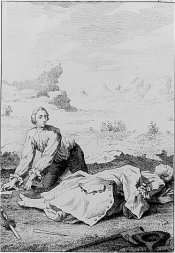
He expects a letter from Tiberge to be waiting for him in Le Havre with funds to secure Manon’s freedom; but, it has not yet arrived. Des Grieux sells what possessions he has and boards the ship to America with Manon. When they arrive in New Orleans, they are presented to the Governor, whose friendship they cultivated “assiduously.” Des Grieux eventually petitions the Governor for permission to marry Manon. To Des Grieux’s surprise, permission is refused. The Governor has other plans for Manon — he plans to give her to his nephew. Des Grieux thereupon confronts the Governor’s nephew. They “cross swords,” apparently resulting in the latter’s death. Des Grieux and Manon flee the city. After reaching five miles from the city, they collapse from exhaustion. At daybreak, Des Grieux discovers that Manon is dying. She expires later that day. He buries her lifeless body so that it would not be “exposed to the ravages of wild beasts.” He collapses on Manon’s grave.
Des Grieux is found there and brought back to the city. The Governor’s nephew, it seems, was not killed, not even dangerously wounded. The nobility of Des Grieux’s soul impresses the Governor. Des Grieux becomes a new man:
Heaven, after chastizing me so severely, intended that I should benefit from my punishments and misfortunes. It lightened my darkness, and reawakened in me ideas worthy of my birth and education.
Tiberge arrives in New Orleans several weeks later. They return to France, where Des Grieux intends to make his “way to the house of a gentleman-in-waiting to my parents, only a few miles outside the town.”
[Note: All quotations are taken from Abbé Prévost, Manon Lescaut, trans. Angela Scholar (Oxford and New York: Oxford University Press, 2004)]