Subscribe to
Opera Today

Receive articles and news via RSS feeds or email subscription.


twitter_logo[1].gif


UCP_9780226043425.gif

Recently in Reviews

Domingo Conducts Holdridge’s New Opera Dulce Rosa

Dulce Rosa, a brand new opera, had its world premiere Friday night, May 17, 2013 at the Broad Stage in Santa Monica, California. It was produced by Los Angeles Opera, but staged in the smaller theater.

Verdi’s Falstaff at Glyndebourne

Richard Jones’ 2009 production of Verdi’s Falstaff translates the action from the first Elizabethan age to the start of the second.

Gareth John, Wigmore Hall

Baritone Gareth John is rapidly accumulating a war-chest of honours. Winner of the 2013 Kathleen Ferrier Award, he recently won the Royal Academy of Music Patrons’ Award and was presented the Silver Medal by the Worshipful Company of Musicians.

La bohème at ENO

This second revival of Jonathan Miller’s La bohème was the first time I had caught the production.

Rolando Villazón: Verdi (International Opera Stars Series 2013)

It’s Verdi’s bicentenary year and Rolando Villazón has two new CDs to plug — titled somewhat confusingly, ‘Villazón: Verdi’ and ‘Villazón’s Verdi’, the latter a ‘personal selection’ of favourite numbers performed by stars of the past and present.

Brahms Third in San Francisco

Nicola Luisotti and the San Francisco Opera Orchestra climbed out of the War Memorial pit, braved the wind whipped bay and held spellbound an audience at Cal Performances’ Zellerbach Auditorium at UC Berkeley.

Ariane et Barbe-Bleue on Blu-Ray

Paul Dukas’ Ariane et Barbe-Bleue, first heard in 1907, once seemed important. Arturo Toscanini conducted the Met premiere in 1911 with Farrar and later arranged some of its music for a 1947 recording with his NBC Symphony.

Glyndebourne: Ariadne auf Naxos

Utterly mad but absolutely right — Richard Strauss’s Ariadne auf Naxos started the Glyndebourne 2013 season with an explosion. Strauss could hardly have made his intentions more clear. Ariadne auf Naxos is not “about” Greek myth so much as a satire on art and the way art is made.

Wozzeck at ENO

“Man is an abyss. It makes one dizzy to look into it.” So utters Georg Büchner’s Woyzeck, repeating what was also a recurring motif in the playwright’s own letters.

Mulhouse: Rare Britten Well Done

National Opera Company of the Rhine has marked this year’s Benjamin Britten celebration with a remarkably compelling, often gripping new production of the seldom-seen Owen Wingrave.

Frankfurt's Intriguing Idomeneo

Once upon a time, Frankfurt Opera had the baddest ass reputation in Germany as “the” cutting edge producer of must-see opera.

Rigoletto at Lyric Opera of Chicago

Productions of Giuseppe Verdi’s Rigoletto can serve as a vehicle for individual singers to make a strong impression and become afterward associated with specific roles in the opera.

Britten Sinfonia with Ian Bostridge

Just in case we were not aware that the evening’s programme was ‘themed’, the Britten Sinfonia designed a visual accompaniment to their musical exploration of night, sleep and dreams.

Aida, Manitoba Opera

Poor Aida! She never seems to have anything go her way.

Superlative singing: Don Carlo, Royal Opera House

Is it possible to upstage Jonas Kaufmann? Kaufmann was brilliant in this Verdi Don Carlo at the Royal Opera House, London, but the rest of the cast was so good that he was but first among equals. Don Carlo is a vehicle for stars, but this time the stars were everyone on stage and in the pit. Even the solo arias, glorious as they are, grow organically out of perfect ensemble. This was a performance that brought out the true beauty of Verdi's music.

Sarah Connolly: French Song at Wigmore Hall

The big names were absent: Duparc, D’Indy, Debussy, Ravel … and while Fauré, Chausson, Roussel and several members of Les Six put in an appearance, in less than familiar guises, this survey of French song of the early 20th century and interwar years deliberately took us on a journey through infrequently travelled terrain.

Rare restoration: Handel’s Esther 1720

Composed between 1718 and 1720, Handel’s Esther is sometimes described as the ‘first English Oratorio’, but is in fact a hybrid form, mixing elements of oratorio, masque, pastoral and opera.

The Damnation of Faust, London

Hector Berlioz's légende dramatique, La Damnation de Faust, exists somewhere between cantata and opera. Berlioz's flexible attitude to dramatic form made the piece unworkable on the stages of early 19th century Paris and his music is so vivid that you wonder whether the piece needs staging at all.

Elizabeth Connell Memorial Concert, St John's Smith Square

St. John’s Smith Square was the site of Elizabeth Connell’s final London concert, intended as a farewell to London on her moving to Australia. It was rendered ultimately final by her unexpected death.

Aida with all the Trimmings, Even a Blue Silk Elephant!

With the building of the Suez Canal, Egypt became more interesting to Western Europeans. Khedive Ismail Pasha wanted a hymn by Verdi for the opening of a new opera house in Cairo, but the composer said he did not write occasional pieces.

OPERA TODAY ARCHIVES »

Reviews

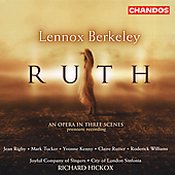
Lennox Berkeley: Ruth
18 Oct 2005

BERKELEY: Ruth

You may never have heard of Lennox Berkeley. But his music was admired by many of the most notable composers of the mid-20th century—Britten and Poulenc were close personal friends, and he has a dedicated band of admirers today (there is a Lennox Berkeley Society). Yet, for one reason or another, Berkeley has never become a household name.

Lennox Berkeley: Ruth

Jean Rigby (mezzo); City of London Sinfonia; Richard Hickox (cond.)

Chandos CHN 10301 [CD]


The composer wrote music in a broad range of genres, including four operas, only one of which—his 1954 opera Nelson—is a full length work. Ruth, his third, was commissioned by Britten’s English Opera Group after their successful premiere of his second opera, the comedic A Dinner Engagement. The libretto was provided by Britten collaborator Eric Crozier, and the role of Boaz was sung by Peter Pears.

Ruth premiered in October 1956, paired with seventeenth-century composer John Blow’s Venus and Adonis. Like all works performed by the English Opera Group, Ruth was scored for very small forces—two flutes, horn, piano, timpani, and eleven string players.

Berkeley was a lifelong Christian, converting to Catholicism in 1929, and his opera Ruth is clearly a statement of faith. The story, for the most part, sticks to the biblical narrative which tells how the Israelite woman Naomi and her two Moabite daughters-in-law return to Bethlehem after the deaths of Naomi’s Moabite husband, and her two sons. Crozier and Berkeley make a point of the fact that Moab was an enemy of Israel, and thus Ruth is treated as a feared outsider by the Israelites.

The 78-minute opera is divided into three scenes. In the first, Naomi, Ruth, and Orpah are nearing Bethlehem. Naomi is anxious about how she will be received, and urges her two daughters-in-law to return to the homes of their mothers. Orpah eventually obeys, but Ruth insists that she will stay with Naomi, singing an aria which enlarges on the famous biblical text:

Whither thou goest, I will go.
Where thou lodgest, I will lodge.
Where thou diest, I will die
and there I will be buried...
Thy people shall be my people,
and thy God my God!

Naomi and Ruth are destitute, and in the second scene Ruth tries to follow an Israelite custom which allows poor women to glean in the barley fields following the harvesters. But in Berkeley’s telling, the Israelites cruelly attempt to exclude Ruth as an enemy and a witch. The field’s owner, Boaz, intervenes, and scolds the harvesters for their inhospitality. Ruth is gracious, and urges Boaz not to judge his people harshly, as they merely “hate what they cannot understand”.

In the final scene, Naomi urges Ruth offer herself as a wife to Boaz, though the colorful biblical episode of Ruth lying down at the Boaz’s feet while he sleeps is absent. Boaz is surprised, but acquiesces. He presents his new wife to the people, and everyone rejoices, predicting that Ruth’s womb shall “bring forth kings” (Ruth was the foremother of both David and Jesus), and praising God.

Ruth is probably not an opera for those who define the form through their love of the warhorses that appear at their local opera house. This isn’t Tosca or Tristan. The music is not easy to describe. It is emotionally cool, reminiscent of Stravinsky and Britten, yet it is also rich in it’s sensuous orchestral timbres, reminding one perhaps of Ravel, a composer whom Berkeley had gone to for advice as a youth. For the most part it lacks any sense of naturalistic drama—seeming at times rather like a biblical pageant. Yet at others, it does gain a certain emotional momentum. The first scene seems especially dramatically detached—yet it’s mournful, astringent harmonies are affecting. The confrontation between Ruth and the reapers struck me as trying too hard for modern applicability (racial prejudice, etc.), yet the following exchange between Ruth and Boaz, though not exactly a love duet, is none-the-less poignant and touching. As the story develops, the chorus takes on a large role, and here the choral writing frequently reminded me of the much younger British choral composer John Rutter. Was Rutter an admirer of Berkeley, or did they both look to an earlier model? At times, recitative-like passages are accompanied only by the piano.

With Ruth, Chandos has released a characteristically fine product. The opera is attractively packaged, has excellent sound, and contains an informative booklet with full libretto translated into French and German. The soloists are fine, with mezzo-soprano Jean Rigby singing an affecting Ruth with her large, dark voice, and tenor Mark Tucker as Boaz—who I expect I would prefer in the role to Peter Pears—makes one curious to hear him in more familiar repertory. As Naomi, soprano Yvonne Kenny sings with a rather wide vibrato that gives her a more matronly sound, but considering the role, this is wholly appropriate. Richard Hickox leads the City of London Sinfonia in a performance of exquisite subtlety, which is exactly what this music requires.

All in all, for the adventurous opera lover who isn’t wholly repelled by the twentieth century musical language that developed after romanticism, Ruth offers many pleasures.

Eric D. Anderson
Send to a friend

Send a link to this article to a friend with an optional message.

Friend's Email Address: (required)

Your Email Address: (required)

Message (optional):