Subscribe to
Opera Today

Receive articles and news via RSS feeds or email subscription.


Recently in Reviews

MENDELSSOHN: Athalia

In addition, to his popular score to A Midsummer Night’s Dream Felix Mendelssohn wrote incidental music to several other plays. Commissioned by the Prussian King Friedrich Wilhelm IV, the incidental music to Athalia was intended for a private performance of the play by Jean Racine. While the story is a complicated Old Testament plot, Mendelssohn’s music captures the tone of the tragedy with delight, whimsy, and severity.

MORRIS: Reading Opera Between the Lines: Orchestral Interludes and Cultural Meaning from Wagner to Berg

Interludes in opera articulate moments when the lush voices of singers and vivid spectacle of scenery and action are removed and often the curtain is drawn, and thus they span a functional gap between textless instrumental music and explicit theatrical vehicle. Although composers and analysts suggest rich and multivalent meanings for the music, those implications often escape decoding by audiences. Even the interlude titles — Zwischenspiel, entr'acte, intermezzo — suggest their intermission-like nature. As functional placeholders for scene changes and the like, the interludes are for many a cue to relax attentive listening, read synopses, and whisper with companions. Undaunted by such complexities, Morris takes up the problematic nature of operatic interludes, engaging their ambiguities with eyes wide open in an effort to enrich our understanding of these challenging bits of music.

GOEHRING: Three modes of perception in Mozart — the philosophical, pastoral, and comic in Così fan tutte

According to the book jacket, this is the first major scholarly study of Così fan tutte, considered to be one of Mozart's least-understood operas and librettist Lorenzo Da Ponte's most interesting text. Così fan tutte has been studied extensively, despite the broad assertion stated in the book. What the author of this study brings to the reader, which others have not, is a detailed examination of the philosophical, pastoral, and comic background of the libretto, characters, and music of the opera. New perspectives on text and tone in the opera, the subtle use of the pastoral mode, and the tension and balance between philosophy and comedy are what the author brings to the study of this work. In addition, the author does an intensely close reading of the primary sources of the opera, in order to support his theories and statements.

TRIBO: Annals 1847-1897 del Gran Teatre del Liceu

The importance of the Teatre del Liceu, can not be overstated. The house ranks with all the leading theatres of the world, being right up there with Paris, London, New York, Vienna, Madrid, Rome, Milan, Lisbon, St. Petersburg, Moscow, Turin, Naples, Buenos Aires, and other cities of comparable importance. During its long history (158 years at the time of writing) it featured many of the great singers. These include Caruso, Battistini, Tamagno, Ruffo, Caballe, Tebaldi, Mario, Pavarotti, Vignas, Lazaro, O'Sullivan, Stracciari, Pagliughi, Gayarre, Masini, Stagno, Lauri-Volpi, Bellincioni, and countless others. Quite a few of these who sang there before 1897 are represented on the accompanying disc.

MAY: Decoding Wagner — An Invitation to His World of Music Drama

Thomas May's stated goal in Decoding Wagner is indeed summarized in his subtitle, An Invitation to His Music Dramas. Mr. May offers an introduction to those who may seek a reliable yet succinct guide in their first Wagnerian experience; a further potential readership is seen among those who have attended performances of Wagner but who wish to expand their appreciation of the music dramas. In his chronological overview of Wagner's oeuvre from the mid-1830s until the close of his career May presents an approachable guide to appreciating the composer's operatic genius. As an illustration of May's commentary on the works, a generous selection of Wagner's music is included on two Discs that accompany the volume in a protective sleeve.

The Cambridge Companion to the Lied

Books described as a "Companion" to this or that and published by university presses should be required to come with a Reader Beware label. As is the case with many books put out by university and many for-profit publishers, the main reason for publishing these is to advance the tenure and promotion prospects of the authors. This is not a bad thing, except that all too often the books aren't very good.

DUNSBY: Making Words Sing: Nineteenth- and Twentieth-Century Song

In Making Words Sing, Jonathan Dunsby investigates what he calls the "vocality" of song, that is, the "quality of having voice," as the author states in the introduction to his study. By using this perspective, Dunsby focuses on the intensification of the text that occurs when words are set to music, which stands in opposition to the kind of "songfulness" that Lawrence Kramer discussed in Musical Meaning: Toward a Critical History (Berkeley, CA: University of California Press, 2002).

RANDALL & DAVIS: Puccini & the Girl

"Puccini & the Girl" is a rare and engrossing work of scholarship that can be enjoyed on several levels. For the Puccini-lover, to say nothing of one who has a special interest in La Fanciulla del West, it will provide a wealth of information not previously available, particularly all in one place. Any one interested in the creative process will find it exposed and examined clearly. The scholar will recognize the fascinating chance discovery, the thrill of the chase and the deep rewards of work undertaken lovingly and with rigorous care by the dedicated and passionate co-authors.

HANSEN: The Sibyl Sanderson Story — Requiem for a Diva

Jack Winsor Hansen's 520-page biography of Sibyl Sanderson (1865 - 1903) is packed with romanticism and gossip that will delight and titillate true worshipers of operatic divas and inquisitive opera fans. It also fills a gap in the music-historical writings about opera at the end of the 19th century.

The Cambridge Companion to John Cage

Cage's music is like Einstein's theorem: most people know it exists, know it's important, but beyond these facts know nothing about it (count me in this category when it comes to Einstein).

WEAVER & PUCCINI: The Puccini Companion

If any opera lover feels daunted by the many biographies and analytical tomes dedicated to the life and art of Giacomo Puccini, Norton has done that reader a tremendous favor with the publication of The Puccini Companion. Tightly organized, this series of essays details the life, discusses the operas, and provides a wealth of supplementary information about the composer.

STRAUSS: Der Ziguenerbaron

When Rudolf Bing came to the Metropolitan Opera in 1950, he scored a tremendous hit with a new staging of the perennial operetta favorite Die Fledermaus. Both at the opera house on 39th Street and on national tour, the slickly Broadwayized Fledermaus packed in big audiences season after season. A decade later, Bing assembled a fine cast and proven production team for the company's first performances of Strauss's Der Zigeunerbaron in fifty years. 18 performances were scheduled. It sank like a stone and has never appeared at the MET again.

EVERETT: The Musical — A Research and Information Guide

Much current popular culture assumes that its audience is knowledgeable of the American musical. References to, and parodies of, specific musicals are frequently a part of episodes of The Simpsons and South Park, and ads for companies as diverse as The Gap and the World Wrestling Entertainment promotion recently have restaged numbers from West Side Story to plug their products or events. Rarely, if ever, are the sources acknowledged; it is simply taken for granted that a general audience will understand the quotations and parodies.

TOMMASINI: The New York Times Essential Library: Opera — A Critic’s Guide to the 100 Most Important Works and the Best Recordings

"I particularly want to reach newcomers" writes Anthony Tommasini, Times chief classical music critic, in his preface. I do not think they will be helped very much by this book. A rookie who picks it up and reads the subtitle may expect something more than two operas by Bellini, two by Donizetti, one Gounod (not Faust), one Massenet (not Manon) and no Lohengrin.

KRAMER: Opera and Modern Culture — Wagner and Strauss

"New musicology" is the cultural study, analysis and criticism of music, which proffers the belief that music has societal, religious, political, personal, and sexual agendas. Consequently, new musicology, much like the discussion of such topics at social gatherings, can be polarizing.

VIVALDI: Orlando Furioso

The box-sets contaning the complete recordings of the music of J.S. Bach and W.A. Mozart occupy substantial shelf space in the collections of those fortunate enough to possess them.

SMART: Mimomania: Music and Gesture in Nineteenth-Century Opera

Here's a serious niche book, a relatively slender volume dealing with a topic at once both arcane and surprisingly central to some of the major controversies in opera production today. I think it has major problems but it has become for me the pebble dropped into the pond that sends ripples to unexpected places, raising interesting questions in the process.

The Cambridge Companion to Grand Opera

Among the recent publications on opera, The Cambridge Companion to Grand Opera, edited by David Charlton, breaks new ground with its systematic and thorough exploration of grand opera, a specific part of the genre which played an important role in the musical culture of the nineteenth century.

LOEWENBERG: Annals of Opera, 1597-1940

This volume has long been regarded as the definitive work on the subject, and has been quoted in countless later works whenever a reference was required to the performance histories of individual operas. Taken as a whole, especially when one considers the state of library science when the book was first written, it is a magnificent piece of work, and belongs on the bookshelf of every researcher in the operatic field.

GOUNOD: Faust

During his heyday, Alain Vanzo did not get quite the recognition he deserved. Though the voice was sweeter and more beautiful than the somewhat white sound of Nicolai Gedda, it was the latter who got all the plums; primo because he was a discovery of Legge and a few years earlier on the scene and secundo while opera managers could cast him in other languages than French and Italian.

OPERA TODAY ARCHIVES »

Reviews

Henry Purcell: King Arthur
24 Oct 2005

King Arthur - the first musical?

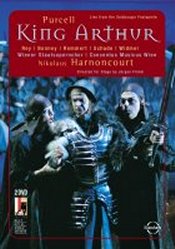
Reviewing this DVD recording of Purcell’s music-drama “King Arthur” from the 2004 Salzburg Festival was both a pleasure and a pain. The pleasure came from the intense, contagious sense of sheer fun that illuminates this production by Jurgen Flimm and Nikolaus Harnoncourt from start to finish.

Henry Purcell: King Arthur

Barbara Bonney, Michael Schade, Isabel Rey, Peter Maertens, Dietmar König. Directed for Stage by Jürgen Flimm. Concentus Musicus Wien, Nikolaus Harnoncourt (cond.). Recorded live at the Salzburg Festival, 2004.

EuroArts 2054508 [DVD]


Flimm’s magical and creative stage direction seldom flags, and Harnoncourt’s Concentus Musicus Wien drives the whole mad, not to say occasionally maddening, pantechnicon along at a great pace and with admirable musical sensibility.

The pain came with equal regularity however. An interesting point about these last great flowerings of young Henry Purcell’s genius, so soon to be snuffed out, is that they were almost an anachronism when they first reached the stage of the Queens Theatre, Dorset Garden, London in 1691. Italian opera was approaching as if on a flood tide. Today it is difficult for an audience raised on either that later opera seria or mainstream romantic opera to grasp either the idiom of English music theatre in the 1690s or accept its artistic context - such as might be gleaned from a quote in the Gentleman’s Journal of 1692 “…experience hath taught us that our English genius will not relish that perpetual Singing,” Those said Gentlemen preferred what we might call today “mixed media” with plots that were not only true to life but sported humour, slapstick and sensational effects. And this Salzburg production, in the final analysis, whilst trying to achieve relevance and an understandable context by updating this template from the 1690’s, is let down by artistic incoherence and muddle. The fun, the spirit and the comedy of what Harnoncourt has described as the “first musical in history” doesn’t quite make up for some pretty dire interpretative decisions.

So if not an “opera” at all, then or now, what is it? It’s a play, with words by Dryden, which has musical tableaux which intersperse the main blocks of story-telling dialogue. The drama, acted and spoken by professional actors, tells the story of enemy kings Arthur and Oswald, fighting for English power and the heart of a princess, Emmeline, who happens to be blind. Each is supported by their own “magical helpers” - Merlin (a slightly ineffectual English dandy) and Grimbald (a most unpleasant piece of work) - and accompanying spirits. There is no doubt who are the “goodies” and “baddies” and which side this jingoistic libretto takes. It also just so happens that the music that was written to accompany the piece at the theatre was some of the best truly indigenous English song writing ever to bloom on a London stage, even to this day. And as in Purcell’s time, both the actors and singers are on stage together and often “duplicate” each other with matching costumes - an idea that one soon assimilates without too much trouble, although the camera close ups of the DVD obviously make this deliberate deceit entirely transparent.

The story is a gift for any creative director with the full panoply of 21st century stage effects at his disposal, and Flimm makes admirable use of the unique setting: the Summer Riding School in Salzburg, with its baroque form and intriguing balustraded arcades, built in 1693. The excellent orchestra is housed in a sunken area around which the stage continues, allowing the actors and singers to occasionally encompass the musicians and, from time to time, even draw them and their conductor into proceedings. This allows nice little comic business: the rather august head of Nikolaus Harnoncourt being carefully wrapped in a woolly bobble cap against the cold of the Frost Scene; a terrified fairy seeks shelter amongst the bassoons… and so on. Video screens in the “sky”, flying lines for the fairy spirits, trap-doors for the almost Wagnerian evil-doers on the Saxon side - it’s all there, and you’d have to be a very miserable person not to respond with a smile, at least once per scene.

However, as was reported at the time of the stage premier, the successes must be weighed against some unfortunate decisions. Dryden’s story may not be exactly great drama - it’s been described as “tub-thumpingly patriotic” and you’d be hard pushed to deny that. But, and it’s a big but, the language he used to do the tub-thumping was elegant, witty and often beautiful. Here, presumably for the sake of Salzburg success, all the English drama is translated into German, with almost entirely German or Austrian actors. What was wit with a lighter touch becomes heavily obvious; what was English seaside-style slapstick becomes Bavarian bier-keller. Vowel-curdling diction in mock-mittel-european-horror-flick style does Dryden no favours, and it is with huge relief that one hears the first melodic lines of English when the singers (excellent in name, if uneven in performance on this showing) take the stage.

One is reminded of a kind of “beauty and the beast” scenario. On the DVD, of course, one has the convenience of subtitles - so at least the viewer at home can have the story explained in English, or whichever language is preferred. Not that this helps particularly with all the local in-jokes and modern Austro/German political references which attempt to make relevant some of the original humour - always high risk for an internationally-released production.

Yet, happily, it is the music of Purcell that saves the day every time - tune after tune delights the ear and kindles memories from a hundred earlier hearings in different, incomplete contexts: “First Act Tune”, “How blest are shepherds”, the “Chaconne”, “’Tis Love” and “Trumpet Tune”, the list goes on and on. To at last hear them in the way that London audiences did in 1691 is a treat indeed.

The voices are certainly starry: Barbara Bonney, Michael Shade, Isabel Rey, Oliver Widmer and Birgit Remmert and you have to applaud the way they throw themselves (sometimes literally) into the story even if some are hard pressed to produce their best sounds in some difficult situations and eccentric costumes. The sight of a well-built Michael Shade throwing himself around the stage, stand- mic clasped to mouth, legs akimbo, in a hilarious spoof on an ageing rocker howling out “Your hay, it’s mowed” in the form of a torch song to his adoring fans, won’t be easily forgotten.

Less successful was Bonney’s rendition of the lovely, seraphic “Fairest Isle, all Isles Excelling” towards the end of the performance - not approaching the silvery perfection of her CD recording and somewhat rushed and uncomfortable in execution. The famous “Frost Scene” was played for humour with a chorus of neatly-choreographed penguins (what else?) in support, even if Oliver Widmer’s rather clunky baritone made heavy arctic weather of the famously-extreme stuttering notes.

Yet, despite this and an overall problem with maintaining all the disparate threads of action, chorus, music, song, video and stage machinery, “King Arthur” is still a brave attempt to re-vivify the largely lost art form of English Restoration music-drama in something like its original concept - and I’d recommend it to anyone who loves the music of Purcell, as long as they have a capacity to forgive as well as to applaud.

© Sue Loder 2005
Send to a friend

Send a link to this article to a friend with an optional message.

Friend's Email Address: (required)

Your Email Address: (required)

Message (optional):