Recently in Reviews
English Touring Opera are delighted to announce a season of lyric monodramas to tour nationally from October to December. The season features music for solo singer and piano by Argento, Britten, Tippett and Shostakovich with a bold and inventive approach to making opera during social distancing.
This tenth of ten Live from London concerts was in fact a recorded live performance from California. It was no less enjoyable for that, and it was also uplifting to learn that this wasn’t in fact the ‘last’ LfL event that we will be able to enjoy, courtesy of VOCES8 and their fellow vocal ensembles (more below …).
Ever since Wigmore Hall announced their superb series of autumn concerts, all streamed live and available free of charge, I’d been looking forward to this song recital by Ian Bostridge and Imogen Cooper.
The Sixteen continues its exploration of Henry Purcell’s Welcome Songs for Charles II. As with Robert King’s pioneering Purcell series begun over thirty years ago for Hyperion, Harry Christophers is recording two Welcome Songs per disc.
Although Stile Antico’s programme article for their Live from London recital introduced their selection from the many treasures of the English Renaissance in the context of the theological debates and upheavals of the Tudor and Elizabethan years, their performance was more evocative of private chamber music than of public liturgy.
In February this year, Albanian soprano Ermonela Jaho made a highly lauded debut recital at Wigmore Hall - a concert which both celebrated Opera Rara’s 50th anniversary and honoured the career of the Italian soprano Rosina Storchio (1872-1945), the star of verismo who created the title roles in Leoncavallo’s La bohème and Zazà, Mascagni’s Lodoletta and Puccini’s Madama Butterfly.
Evidently, face masks don’t stifle appreciative “Bravo!”s. And, reducing audience numbers doesn’t lower the volume of such acclamations. For, the audience at Wigmore Hall gave soprano Elizabeth Llewellyn and pianist Simon Lepper a greatly deserved warm reception and hearty response following this lunchtime recital of late-Romantic song.
Collapsology. Or, perhaps we should use the French word ‘Collapsologie’ because this is a transdisciplinary idea pretty much advocated by a series of French theorists - and apparently, mostly French theorists. It in essence focuses on the imminent collapse of modern society and all its layers - a series of escalating crises on a global scale: environmental, economic, geopolitical, governmental; the list is extensive.
For this week’s Live from London vocal recital we moved from the home of VOCES8, St Anne and St Agnes in the City of London, to Kings Place, where The Sixteen - who have been associate artists at the venue for some time - presented a programme of music and words bound together by the theme of ‘reflection’.
'Such is your divine Disposation that both you excellently understand, and royally entertaine the Exercise of Musicke.’
Amongst an avalanche of new Mahler recordings appearing at the moment (Das Lied von der Erde seems to be the most favoured, with three) this 1991 Mahler Second from the 2nd Kassel MahlerFest is one of the more interesting releases.
‘And there was war in heaven: Michael and his angels fought against the dragon; and the dragon fought and his angels, And prevailed not; neither was their place found any more in heaven … that old serpent … Satan, which deceiveth the whole world: he was cast out into the earth, and his angels were cast out with him.’
If there is one myth, it seems believed by some people today, that probably needs shattering it is that post-war recordings or performances of Wagner operas were always of exceptional quality. This 1949 Hamburg Tristan und Isolde is one of those recordings - though quite who is to blame for its many problems takes quite some unearthing.
There was never any doubt that the fifth of the twelve Met Stars Live in Concert broadcasts was going to be a palpably intense and vivid event, as well as a musically stunning and theatrically enervating experience.
‘Love’ was the theme for this Live from London performance by Apollo5. Given the complexity and diversity of that human emotion, and Apollo5’s reputation for versatility and diverse repertoire, ranging from Renaissance choral music to jazz, from contemporary classical works to popular song, it was no surprise that their programme spanned 500 years and several musical styles.
The Academy of St Martin in the Fields have titled their autumn series of eight concerts - which are taking place at 5pm and 7.30pm on two Saturdays each month at their home venue in Trafalgar Square, and being filmed for streaming the following Thursday - ‘re:connect’.
The London Symphony Orchestra opened their Autumn 2020 season with a homage to Oliver Knussen, who died at the age of 66 in July 2018. The programme traced a national musical lineage through the twentieth century, from Britten to Knussen, on to Mark-Anthony Turnage, and entwining the LSO and Rattle too.
With the Live from London digital vocal festival entering the second half of the series, the festival’s host, VOCES8, returned to their home at St Annes and St Agnes in the City of London to present a sequence of ‘Choral Dances’ - vocal music inspired by dance, embracing diverse genres from the Renaissance madrigal to swing jazz.
Just a few unison string wriggles from the opening of Mozart’s overture to Le nozze di Figaro are enough to make any opera-lover perch on the edge of their seat, in excited anticipation of the drama in music to come, so there could be no other curtain-raiser for this Gala Concert at the Royal Opera House, the latest instalment from ‘their House’ to ‘our houses’.
"Before the ending of the day, creator of all things, we pray that, with your accustomed mercy, you may watch over us."
Reviews
06 Oct 2005
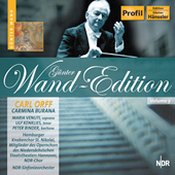
ORFF: Carmina Burana
Once hailed by the Nazis as a symbol of Aryan supremacy, Carmina Burana has come to be recognized as a powerful expression of the gluttony and depravity present in a medieval, pagan society. An effective performance of Orff’s musical adventure must allow audiences to envision the “imagines magicae,” or magical images conveyed through the convergence of music and choreography.
In the absence of a stage presence, the performers must strive to pointedly depict the illustrative tales portrayed in love songs, drinking songs, and fantasies that together form the rich tapestry that is Carmina Burana.
In this work, Carl Orff thoughtfully selected twenty-five Goliardic poems from the thirteenth-century Benektbeuren manuscript to set to music. The mood of each poem is so remarkably distinctive that in creating a musical setting, each required a drastically different approach. Through this wide-ranging contrast, Orff was able to demonstrate his amazing versatility as a composer. Likewise, Günter Wand and the musicians of the NDR Sinfonieorchester and Chorus commendably mirrored Orff’s talents.
The opening “Fortuna Imperatrix Mundi,” radiated the necessary strength and power to rival the most prominent of ensembles. “O Fortuna” lends itself to images of greatness, and this performance never diminishes the desired outcome. On the contrary, the strength of the chorus, the carefully balanced orchestra, and the well-articulated unison passages, all added to the percussive effect to create a feeling of imposing dominance.
In contrast to the bold statements in this first section, the “Primo Vere,” a section devoted to Spring, was lyrical and well-phrased, reinforcing the diversity of the piece and its interpreters. Baritone Peter Binder showcased his talents as well through his smooth voice and relaxed delivery. The springtime feeling continued in “Uf dem Anger” (On the Lawn) where the strings interjected playfully syncopated melodies that where delightfully light and care-free.
“In Taberna” (In the Tavern), a colorful section opening with Baritone Peter Binder and featuring Tenor Ulf Kenklies, was among the more dramatic (in the Thespian-sense), in that the inebriation referred to in the text certainly came across in the soloists’ voices. Ulf Kenklies noticeably exaggerates the intoxicated inflections in a quite entertaining way, depicting images of swan resigned to its miserable fate, as described in the text.
The love songs of the “Cour D’Amour” are characterized by lilting voices in the chorus and Soprano Maria Venuti, as well as seductive calls from the tenor and bass soloists. The songs range from playful, to mischievous, to utterly romantic. Maria Venuti is simply amazing in “Dulcissime,” the last song of the section, showing off with her unwavering tone and power in a register-taxing, cadenza-like passage.
The restatement of the “O Fortuna” is as impressive in the closing frame of the work as in the opening. The variety of styles and themes that come together to form such a complex entity tend to leave audiences fully satisfied. Carmina Burana fans won’t want to miss out on this extraordinary performance that exceeds the already high expectations generally attributed to this monumental work.
Nathalie Hristov
Music Librarian
University of Tennessee