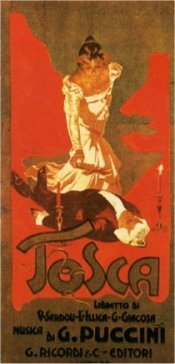
As remarkable as her comments seemed at the time, since Tosca has hardly left the stage in the hundred years since its premiere, it later dawned on me that the first audiences of Sardou's play La Tosca (which opened in 1887, starring its dedicatée Sarah Bernhardt) and Puccini's opera, were probably just as dumbfounded.
The shocking aspects of Tosca 's plot do more than simply surprise, however; the story plumbs profound currents of sex, power and violence After all, when Tosca stabs her would-be rapist, she penetrates him instead, turning the tables on her aggressor and reclaiming control (she thinks) of the situation. This type of turnabout is strong stuff, and Tosca - custom-made for Bernhardt’s provocative powers - provoked primal emotions in many members of the "premiere" audiences. The writer Pierre Louÿs, after seeing the first production of La Tosca with Bernhardt, gushed, "Ah, Sarah! Sarah! Sarah is grace, youth, divinity! I am beside myself. My god, what a woman!…When shall I see you again, my Sarah? I tremble, I grow mad!, I love you!" The American author Willa Cather, after seeing Bernhardt in the play in Omaha (!) wrote: "Art is Bernhardt's dissipation, a sort of Bacchic orgy." Even Puccini himself succumbed to the opera's sex appeal and kept for himself a pornographic version of a line of text in a sketch for Tosca's phrase, "Oh, come la sai bene / l'arte di farti amare!" (Oh, how well you know the art of making yourself loved!): one expletive-deleted rendering of his private lyric might read, "Oh, how well you know the art of getting in my pants!"
Although the Tosca of the opera is properly horrified at Scarpia's suggestion that she trade her virtue for Cavaradossi's life, in the original play, Floria jokes flirtatiously with the policeman when they meet at a court fête - an interchange that can be seen both as an ironic foreshadowing of what is to come, and also as a playful version of deeper, more serious sexual fantasies. In that scene, Scarpia notes that Tosca is wearing a bracelet of diamonds, rubies and sapphires, which together constitute a sort of French "tricolor" (an illegal symbol) and laughingly states that he could arrest her for wearing it:
Scarpia: It would be such a pleasure to have you for a prisoner.
Tosca, gaily: In a dungeon?
Scarpia, likewise: And under triple lock, to prevent your escape.
Tosca: And torture also, perhaps?
Scarpia: Until you love me.
As if taking a cue from this dangerously suggestive encounter, the writer Paola Capriolo, in her novel Vissi d'Amore created a fantasy trope on the opera. In her version, which takes the form of Scarpia's diary, the policeman goes to hear Tosca at the opera house, spies on the diva through a window while she is making love with Cavaradossi, and, in short, becomes completely obsessed by the singer. Then, in a stunning upset of power, Tosca appears to succumb to Scarpia’s desires and makes passionate love to him inside his torture chamber (while voluntarily shackled to the wall) thus bringing into reality his most exciting sexual fantasies. But, in a twist worthy of Sardou, she then tortures HIM by simply refusing to repeat the experience.
Scarpia's shocking murder, with its many sexual undercurrents, can be seen as just a small part of a larger pattern of plot reversals, however. Sudden plot twists have great dramatic power because they violate the audience's expectations; they create sudden change and increase intensity. It is Sardou's breathtaking panoply of reversals that raises the level of excitement. For example, the first audiences of Tosca did not expect an escaped convict to appear in a church setting at the outset of the play, nor did they anticipate Tosca's defiant suicide at the end. Reversals also surprise the characters themselves and result in plot complications. A case in point would be the early opening of the church for the celebratory Te Deum, which forces Angelotti to flee sooner than planned: this necessitates his requesting help from Cavaradossi, who then becomes implicated in a crime himself.
Of course the greatest reversal is accomplished by Napoleon, who in June 1800 won the Battle of Marengo after having appeared to have lost it. In the opera, it is this stunning news that inspires Cavaradossi to exclaim "Vittoria!" and degrade his criminal status from accomplice to true enemy of the state. But in the spoken play, Sardou uses the announcement of this reversal to abruptly halt the Palazzo Farnese gala at which the enraged Tosca is about to perform: after the Queen faints from the news in mid-sentence, Tosca (and the actress portraying her) is saved from actually having to sing. Sardou's audiences would have been waiting anxiously to discover if (and how well) Sarah Bernhardt would sing, and he played upon their curiosity.
Tosca: But I can't! As though I felt like it now…I am in a wonderful state to sing!…Can I sing?
Scarpia: Badly or well makes no difference…but the cantata, if you please, the cantata.
It is these reversals that form the main plot line: Tosca believes her betrayal of Angelotti's hiding place will free Cavaradossi; but instead, both she and her lover are more doomed than before. The final reversal - that of Cavaradossi's "simulated" execution - is given added suspense in the play by a "red herring" reversal: the soldiers want to remove Cavaradossi's body and Tosca, still believing her lover is alive, wants to keep hold of it. The first audiences were not yet sure that she had been misled:
Tosca, to the soldiers: Where are you going?…What do you want?
The Sergeant: To take the body away.
Tosca, alarmed, barring their way: You cannot take him! He is mine!…Scarpia gave him to me!…Didn't the captain say anything to you about it?…
The Sergeant: Nothing!
Tosca: Call for him…Find him…
Of course Tosca soon learns the truth, and defiantly leaps into the void — a final and fatal attempt to gain power over her life.
Puccini’s score also holds many surprises, following the twists and turns of the drama by suddenly shifting mode, meter, harmony, rhythm, and more. Swift musical contrasts are nothing new, but if we consider even the first two scenes of Tosca, we can see the extremes to which Puccini has taken the idea. When the escaped prisoner Angelotti appears, we hear very dissonant harmonies and chromatic melodies, set in variable phrase lengths with unstable dynamics - a perfect musical depiction of terror. Now the Sacristan enters. His non-threatening, jovial and comedic nature is immediately telegraphed to the audience by the musical accompaniment in C Major, with regular meter (6/8), and a diatonic (non-chromatic) melody. Puccini has even indicated spots in the score for the Sacristan to show a funny, nervous tic.
Later in Act I, Cavaradossi tries to calm Tosca by explaining that he had seen the Marquise Attavanti only by chance: accordingly, his words are set in an ingratiating G major. Tosca is not convinced however, and her suspicions are illustrated by the highly chromatic passage that follows. (In fact all twelve tones of the chromatic scale are heard here.) But perhaps the greatest musical contrast of the first act occurs at Scarpia’s entrance. Prior to that, the church of Sant'Andrea has become filled with noisy children, singers, priests and other clerics (in short, chaos descends), and the music follows suit. In this section, the tempo is fast and the harmony changes from A major to C major to E major to D major to F major to E major, back to A major, and then to B-flat major. The crowd is chaotic yet happy, and thus Puccini supplies harmony that is unstable yet always diatonic. However when Baron Scarpia enters, all the dramatic and musical action freezes: in a stately yet threatening andante sostenuto, we hear the three chords that have been associated with this villain. These chords, B-flat major, A-flat major and E major, destroy the diatonic syntax, since together they belong to no one key: they are based on the whole-tone scale and the upper notes (D, E-flat and E) rise chromatically. One does not need to know music theory to get the message here: the party is over.
Tosca’s twists and turns remain fresh today, a testament to the skill with which it was created. Even if one has seen the opera many times before, the lightning quick dramatic and musical reversals retain their electrifying power. If turnabout is fair play, then it also makes for great opera.
Deborah Burton