Recently in Reviews
English Touring Opera are delighted to announce a season of lyric monodramas to tour nationally from October to December. The season features music for solo singer and piano by Argento, Britten, Tippett and Shostakovich with a bold and inventive approach to making opera during social distancing.
This tenth of ten Live from London concerts was in fact a recorded live performance from California. It was no less enjoyable for that, and it was also uplifting to learn that this wasn’t in fact the ‘last’ LfL event that we will be able to enjoy, courtesy of VOCES8 and their fellow vocal ensembles (more below …).
Ever since Wigmore Hall announced their superb series of autumn concerts, all streamed live and available free of charge, I’d been looking forward to this song recital by Ian Bostridge and Imogen Cooper.
The Sixteen continues its exploration of Henry Purcell’s Welcome Songs for Charles II. As with Robert King’s pioneering Purcell series begun over thirty years ago for Hyperion, Harry Christophers is recording two Welcome Songs per disc.
Although Stile Antico’s programme article for their Live from London recital introduced their selection from the many treasures of the English Renaissance in the context of the theological debates and upheavals of the Tudor and Elizabethan years, their performance was more evocative of private chamber music than of public liturgy.
In February this year, Albanian soprano Ermonela Jaho made a highly lauded debut recital at Wigmore Hall - a concert which both celebrated Opera Rara’s 50th anniversary and honoured the career of the Italian soprano Rosina Storchio (1872-1945), the star of verismo who created the title roles in Leoncavallo’s La bohème and Zazà, Mascagni’s Lodoletta and Puccini’s Madama Butterfly.
Evidently, face masks don’t stifle appreciative “Bravo!”s. And, reducing audience numbers doesn’t lower the volume of such acclamations. For, the audience at Wigmore Hall gave soprano Elizabeth Llewellyn and pianist Simon Lepper a greatly deserved warm reception and hearty response following this lunchtime recital of late-Romantic song.
Collapsology. Or, perhaps we should use the French word ‘Collapsologie’ because this is a transdisciplinary idea pretty much advocated by a series of French theorists - and apparently, mostly French theorists. It in essence focuses on the imminent collapse of modern society and all its layers - a series of escalating crises on a global scale: environmental, economic, geopolitical, governmental; the list is extensive.
For this week’s Live from London vocal recital we moved from the home of VOCES8, St Anne and St Agnes in the City of London, to Kings Place, where The Sixteen - who have been associate artists at the venue for some time - presented a programme of music and words bound together by the theme of ‘reflection’.
'Such is your divine Disposation that both you excellently understand, and royally entertaine the Exercise of Musicke.’
Amongst an avalanche of new Mahler recordings appearing at the moment (Das Lied von der Erde seems to be the most favoured, with three) this 1991 Mahler Second from the 2nd Kassel MahlerFest is one of the more interesting releases.
‘And there was war in heaven: Michael and his angels fought against the dragon; and the dragon fought and his angels, And prevailed not; neither was their place found any more in heaven … that old serpent … Satan, which deceiveth the whole world: he was cast out into the earth, and his angels were cast out with him.’
If there is one myth, it seems believed by some people today, that probably needs shattering it is that post-war recordings or performances of Wagner operas were always of exceptional quality. This 1949 Hamburg Tristan und Isolde is one of those recordings - though quite who is to blame for its many problems takes quite some unearthing.
There was never any doubt that the fifth of the twelve Met Stars Live in Concert broadcasts was going to be a palpably intense and vivid event, as well as a musically stunning and theatrically enervating experience.
‘Love’ was the theme for this Live from London performance by Apollo5. Given the complexity and diversity of that human emotion, and Apollo5’s reputation for versatility and diverse repertoire, ranging from Renaissance choral music to jazz, from contemporary classical works to popular song, it was no surprise that their programme spanned 500 years and several musical styles.
The Academy of St Martin in the Fields have titled their autumn series of eight concerts - which are taking place at 5pm and 7.30pm on two Saturdays each month at their home venue in Trafalgar Square, and being filmed for streaming the following Thursday - ‘re:connect’.
The London Symphony Orchestra opened their Autumn 2020 season with a homage to Oliver Knussen, who died at the age of 66 in July 2018. The programme traced a national musical lineage through the twentieth century, from Britten to Knussen, on to Mark-Anthony Turnage, and entwining the LSO and Rattle too.
With the Live from London digital vocal festival entering the second half of the series, the festival’s host, VOCES8, returned to their home at St Annes and St Agnes in the City of London to present a sequence of ‘Choral Dances’ - vocal music inspired by dance, embracing diverse genres from the Renaissance madrigal to swing jazz.
Just a few unison string wriggles from the opening of Mozart’s overture to Le nozze di Figaro are enough to make any opera-lover perch on the edge of their seat, in excited anticipation of the drama in music to come, so there could be no other curtain-raiser for this Gala Concert at the Royal Opera House, the latest instalment from ‘their House’ to ‘our houses’.
"Before the ending of the day, creator of all things, we pray that, with your accustomed mercy, you may watch over us."
Reviews
21 Oct 2005
Welsh songs worth discovering
SAIN (the Welsh word for 'sound', and pronounced like the English word 'sign') is Wales' leading recording company, founded in 1969 in Cardiff by Dafydd Iwan, Huw Jones and Brian Morgan Edwards. The label has a strong social and political message, and for the first few years, SAIN specialised in songs by young singers, many of them concerning the national and linguistic resurgence of Wales, which had begun in the 60's.
So it is not surprising that the first CD's of the world famous Welsh bass-baritone Bryn Terfel were produced by this label. His first CD was released in 1988, when Bryn Terfel was the winner of the Kathleen Ferrier Memorial Scholarship. This was before his opera debut, and the compilation on this CD seems like an unconnected collection of casting arias. Besides Welsh songs of Idris Lewis, R. Vaughan Williams, Eric Jones, Vincent Davies, W. Mathews Williams, Osborne Roberts, W. Bradwen Jones, and two traditional songs arranged by the pianist Annette Bryn Parri, you will find Schubert’s "Fischermädchen", Mozart’s "Non più andrai", Gounod’s "Vous qui faites l'endormie", Händel’s "But who may abide the day of his coming?", Tosti’s "Ideale" and Franco Leoni’s "Tally-Ho!". This may be dramaturgically strange, but it shows the great variety of the young singer at the beginning of his career. Terfel’s wonderful voice is powerful and technically effortless, but sometimes sounds on this CD a little exhausted or not quite mature. This does, however, not reduce the listening enjoyment. The booklet is sparse with only short descriptions of the songs in English, and contains nothing about Welsh composers, some of whom are not well known.
In 1990 the second Bryn Terfel CD was released with the title "Cyfrol2-Volume2", again under the label SAIN. The booklet is even more meagre than that of the debut album: the publisher did not take the trouble to name the composers of some of the pieces. The collection seems similarly arbitrary as that of the first CD. Thus we find here the well known aria from "The Fiddler on the Roof" in Welsh, three beautiful Welsh songs by Meirion Williams, Schubert’s "Ständchen", an aria from the musical "South Pacific", an aria by Handel from "Judas Maccabäus" with piano accompaniment - marvelously sung by Bryn Terfel! -, songs by William Davies, W. Albert Williams, John Ireland, Mansel Treharne Thomas and Richard Samuel Hughes, a canzonet by Haydn, the Coat aria from "La Bohème", Don Giovanni's "Serenade" - all arias with piano accompaniment. Bryn Terfel's voice is beautiful, in his own language completely free and easy. But also listening to the opera arias one can anticipate the world career of this great singer. The Welsh songs are worth discovering. One wishes for a more detailed booklet about these unknown compositions.
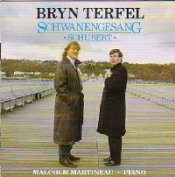
A year later, 1991, SAIN recorded with Bryn Terfel singing Schubert's „Schwanengesang“ with the well known pianist Malcolm Martineau. The quality of the recording is technically and musically excellent. Bryn Terfel has a beautiful flowing voice with apparently infinite breath and easy height. However his pronounciation of the German vowels and consonants is shaped by the Italian vowel sound and thus sometimes irritating to a German ear. Through this strange vowel sound each German word has a great importance, and sometimes the intermediate tones are missing; perhaps only a native speaker can produce these. This is remarkably apparent in "Abschied", where the ambiguity which one knows from Fischer-Dieskau is missing and Bryn Terfel is suffering exclusively. Every "Ade" he sings with great importance. Also the "Taubenpost" he sings similarily ponderous and suffering. However, Bryn Terfel sings "Kriegers Ahnung", "Aufenthalt", "Der Atlas" and "Die Stadt" in a wonderful way. Here his powerful bass-baritone voice and his great strength is especially effective. The booklet is in Welsh, English and German and in more detail than the ones included in the first two CD's.
1993 SAIN released the CD "Un Canu Caneuon" with songs by the Welsh composer Meirion Williams, sung by Bryn Terfel, with Annette Bryn Parri at the piano. Meirion Williams lived from 1901-1976 and was one of the composers mainly responsible for transforming Welsh classical song-writing. He always took great care to make sure that the words he used were appropriate for the expression of feelings. This CD contains the compositions of 40 years, including well known Welsh songs that Meirion Williams composed as a young man, and at the end the cycle "Adlewych", which he composed for BBC Wales when he was almost 70 years old. Meirion Williams' style is influenced by late romanticism. Developments like the twelve-tone technique have passed him by. This by no means diminishes the compositions: they are wonderful and passionate, and should be known outside Wales! Williams’ songs are about the love of country and landscape, and Welsh is a very singable language. The songs have wonderful melodies for the language and voice. The combination Bryn Terfel / Meirion Williams is ideal! Bryn Terfel's vigorous voice flows with infinite breath, and it is a joy to listen to him. This time the booklet is very detailed in Welsh and English, and one hopes that many listeners will get to know the songs of Meirion Williams.
Besides the CD's of Bryn Terfel, SAIN released the second solo album of the young Welsh tenor Rhys Meirion in 2004. Rhys Meirion was member of the Frankfurter Opera and this year sings "Rodolfo" in Sydney and "Roméo" in Melbourne. The label compares him with Bryn Terfel, with whom he has also sung duets. Rhys Meirion - a bright light tenor - has not made a good choice with the selection of all the songs for this CD. The lyric Welsh songs by Bilys Elwyn Edwards, R Lowry and Meirion Williams with piano accompaniment are beautiful and appropiate for his voice. Also very musical and beautiful are his version of "Caro Mio Ben" by Guiseppe Giordini. Unfortunately, for some songs and arias keyboard instead of orchestra accompaniment was chosen, and the keyboard playing falsifies the total sound of the compositions. In addition, Rhys Meirion has chosen 3 compositions by a friend of his, the composer Robat Arwyn, with keyboard and choir accompaniment, which are indescribable trivial. In the Italian arias "Torna a Surriento" by Curtis and "Core 'Ngrato" by Cadillo the keyboard sound seems inconvenient to the extent that it is difficult to listen to the singer`s voice. When one gets accustomed to Rhys Meirion`s bright voice he sings very musically, but one is relieved as a listener when he manages to reach the high notes. In "Ave Maria" by Schubert - again with keyboard accompaniment - one wonders painfully whether Meiron’s breath will be enough for the long phrases. The final piece, "Ombra Mai Fu" by Handel was - for whatever reasons - arranged by the pianist Annette Bryn Parri for keyboard, choir and tenor, which can seem banal. After listening to this CD I wish this young singer and the label more luck and a sensible ear in the compilation of the next program.
Wiebke Hoogklimmer