Subscribe to
Opera Today

Receive articles and news via RSS feeds or email subscription.


twitter_logo[1].gif


9780521746472.png

Recently in Reviews

James Melton: The Tenor of His Times

Those of us of a certain age have fond memories of James Melton, who entertained our parents starting in the 1930s and the rest of us in the 1940s and beyond on recordings, the radio, and films.

The Importance of Being Earnest, Covent Garden

The Importance of Being Earnest , Gerald Barry’s fifth opera, was commissioned by the Los Angeles Philharmonic Orchestra and the Barbican, and was first performed in concert, Thomas Adès conducting the London premiere.

Death in Venice by ENO

‘Beauty is the one form of spirituality that we experience through the senses.’ In Thomas Mann’s, Death in Venice, Plato’s axiom stirs the hopes of the aging, intellectually stale poet, Gustav von Aschenbach, that he may rekindle his creativity.

Adding Movie Magic to The Magic Flute

What better way for Masonic brothers, Wolfgang Amadeus Mozart and Emmanuel Shikaneder to disseminate Masonic virtues, than through the most popular musical entertainment of their age, a happy ending folktale that features a dragon, enchanting flutes and bells, mixed-up parentage, and a beautiful young princess in distress?

Madama Butterfly, Opera Holland Park

There is a sense in which it all began in London, Puccini having been seized in 1900 with the idea of an opera on this subject after watching David Belasco’s play here.

An Evening of Zarzuela and Latin American Music at Los Angeles Opera

The tenor that the audience most wanted to hear, Plácido Domingo, opened the vocal program with “Junto al puente de la peña” (Next to the rock bridge) from La Canción del Olvido (The song of Oblivion) by José Serrano. He sounded rested and his voice soared majestically over the orchestra.

Così fan tutte in San Francisco

Tucked away somewhere in the San Francisco Opera warehouse was an old John Cox production of Così fan tutte from Monte Carlo. Well, not that old by current standards at San Francisco Opera.

Rossini Maometto Secondo Garsington Opera at Wormsley

Rossini's Maometto Secondo is a major coup for Garsington Opera at Wormsley, confirming its status as the leading specialist Rossini house in Britain. Maometto Secondo is a masterpiece, yet rarely performed because it's formidably difficult to sing. It's a saga with some of the most intense music Rossini ever wrote, expressing a drama so powerful that one can understand why early audiences needed "happy endings" to water down its impact

Peter Grimes in Concert

I suppose it was inevitable that, in this Britten Centenary year, the 66th Aldeburgh Festival would open with Peter Grimes.

Die Entführung aus dem Serail, Garsington Opera at Wormsley

Die Entführung aus dem Serail at Garsington Opera at Wormsley isn’t Mozart as you’d expect but it’s true to the spirit of Mozart who loved witty, madcap japes.

Le nozze di Figaro, Glyndebourne

What a pity! On a glorious — well, by recent English standards — summer’s day, there can be few more beautiful English countryside settings than Glyndebourne, with the added bonus, as alas much of the audience appears to understand it, of an opera house attached.

Queens, Heroines and Ladykillers

Described by one critic as “cosmically gifted”, during her tragically short career, American mezzo-soprano Lorraine Hunt Lieberson amazed and delighted audiences with the spellbinding beauty of her singing and the astonishing honesty of her performances.

L’Incoronazione di Poppea from Virgin Classics

Since its first performance at the Teatro Santi Giovanni e Paolo during Venice’s 1643 Carnevale, Monteverdi’s L’Incoronazione di Poppea has been one of the most important milestones in the genesis of modern opera despite its 250 years of unmerited obscurity. 

Alzira by Chelsea Opera Group

“I wrote it almost without noticing.” So Verdi declared when reminded of his eighth — and perhaps least frequently performed, opera, Alzira. One might say that, since he composed the work, no-one else has much noticed either.

Les Contes d’Hoffmann in San Francisco

Just when you thought the protagonist was Hoffmann! Who, rather what stole the show?

La Tosca in Los Angeles

When is verismo verily veristic? Or what is a virginal girl dressed in communion white doing in the two murderous acts of the Los Angeles Opera’s current production of Tosca? And why does she sing the shepherd's song?

Saverio Mercadante: I due Figaro

Though 2013 is the bicentennial of the births of Giuseppe Verdi and Richard Wagner, the releases of Cecilia Bartoli’s recording of Bellini’s Norma on DECCA, a new studio recording of Donizetti’s Caterina Cornaro from Opera Rara, and this première recording of Saverio Mercadante’s forgotten I due Figaro, suggest that this is the start of a summer of bel canto.

Lohengrin, Welsh National Opera

Wagner’s Lohengrin is not an unfamiliar visitor to the UK thanks, in the main, to Elijah Moshinsky’s perennial production at Covent Garden.

Philip Glass: The Perfect American

Philip Glass's The Perfect American at the ENO in London is a visual treat, but the libretto is mind-numbingly anodyne.

Christian Thielemann’s Der Ring des Nibelungen

Recording Richard Wagner’s Der Ring des Nibelungen is for a record label equivalent to a climber reaching the summit of Mount Everest: it is the zenith from which a label surveys its position among its rivals and appreciates an achievement that can define its reputation for a generation. 

OPERA TODAY ARCHIVES »

Reviews

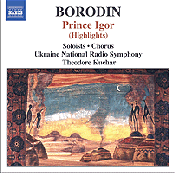
Alexander Borodin: Prince Igor (Highlights) / In the Steppes of Central Asia
01 Nov 2005

BORODIN: Prince Igor (Highlights)

Not long ago the record label Delos announced that they would embark on a series of studio recordings of highlights from operas. This intriguing idea seemed to address the recording crisis spawned by the shrinking market for full studio sets, with their high cost for both producer and purchaser.

Alexander Borodin: Prince Igor (Highlights) / In the Steppes of Central Asia

Angelina Shvachka, Dmytro Popov, Mykola Koval, Taras Shtonda, Kiev Chamber Choir, Mykola Hobdych (choirmaster), Ukrainian National Radio Symphony Orchestra, Theodore Kuchar (conductor).

Naxos 8.557456 [CD]


The first disc, of Tchaikovsky’s Queen of Spades, featured Dmitri Hvorostovsky in one of his signature roles, Prince Yeletsky, as well as Elena Obraztsova, and Sergei Larin. Despite this fairly successful disc, the series apparently suffered a quiet, ignored death.

Naxos may feel Delos had a good idea, as indicated by a recent release of studio-recorded highlights from Borodin’s Prince Igor. No star as glittery as Hvorostovsky headlines the cast, but the CD offers both the well-known selections (such as the overture and the Polovtsian Dances, here performed with chorus) and four arias.

But why only four arias? At 57 minutes, the CD has plenty of room for more music from the opera, and 7:32 of that total goes to a decent but not outstanding run through of Borodin’s In the Steppes of Central Asia. Such stingy allotment of the opera’s music suggests that Naxos does not feel the opera has that much that can be considered a highlight.

The frustration suggested here derives from the enjoyment produced by the four arias as recorded. Taras Shtonda, a bass, puts across a wonderful comic aria, “I don’t like boredom,” a paean to the sentiment so well expressed once by Mel Brooks, “It’s good to be king!”

Angelina Shvachka’s ripe, very Slavic mezzo will not be to everyone’s taste, but her aria, “Daylight is fading,” showcases Borodin’s atmospheric way with melody. The similarly titled “Slowly the day was fading,” sung by tenor Dmytro Popov, is a seductive ballad, though Popov’s unrelenting volume might be more effective live.

Finally, the title character, sung by Mykola Koval, sings the great “There is neither sleep, nor rest.” Koyal’s vibrato is unrestrained, where restraint could well have been urged, and his top threatens to collapse on him, but he certainly delivers on the drama of this piece.

Naxos, for once, provides a bilingual libretto (Russian/English), but since only the four arias and the choral Polovtsian Dances require translation, no less should be expected, even at Naxos’s prices.

The singers mostly come from the Ukraine National Opera. Kuchar leads the Ukraine National Radio Symphony with authority, and the recorded sound has fine balance and clarity.

Again, surely additional music from the opera should have been included for this disc to be a true “highlights” disc. As it is, Naxos has provided, for modest cost, an enjoyable disc of music from an opera that remains an obscurity, despite the fame of the overture and the Polovtsian Dances. Better singing can be heard on the complete sets of the opera, which can be found by the diligent and dedicated. Otherwise, this Naxos disc will hopefully serve to introduce some listeners to a few of the other delights of the work.

And Naxos will, one hopes, continue in the effort to keep the embers of operatic studio recording aglow, even if it has to be this sadly abridged form.


Chris Mullins
Los Angeles Unified School District, Secondary Literacy
Send to a friend

Send a link to this article to a friend with an optional message.

Friend's Email Address: (required)

Your Email Address: (required)

Message (optional):