As it happened, “Orlando” was a turning point in
Handel’s own career as an opera composer as it only lasted for ten
performances before his singers defected to a rival theatre, with devastating
consequences. As Sir Peter Jonas steps down as the Intendant at Munich Opera,
another era is passing, one which has helped to change the face of baroque
opera in Europe, and Alden, together with his equally significant design
colleagues Paul Steinberg (stage) and Buki Shiff (costumes), has been a major
innovative talent and pusher of boundaries. He also pushes the patience,
particularly that of the famously-conservative Munich patrons, and, with this
offering, he has thrown just about everything into the deliberately
provocative mix: video wall, sex, anti-war clichés, ridiculously over-the-top
props, a reference to suicide bombers, and a character obviously based on a
well-known B-list celebrity. So the very mixed reception on opening night was
hardly a surprise with the boos resounding loudly, only finally being
out-gunned by the crowd’s appreciation of the excellent cast of singers
and perhaps by some also appreciating the undeniable wit and zest of
Alden’s work.
“Orlando” follows on the heels of his equally controversial
productions of “Rinaldo”, “Ariodante” and
“Poppea” and this time he places Handel’s take on
Ariosto’s tale “Orlando Furioso” firmly in the present day,
give or take a decade or two. We are invited to join our hero and the godlike
sorcerer Zoroastro inside some corrugated military space research facility,
and both Orlando (David Daniels, countertenor, as an unwilling general
fixated on the pleasures of love rather than military glory) and Dorinda
(Olga Pasichnyk, soprano, here transmuted from pastoral shepherdess into
army-private-cum-personal assistant to Zoroastro) wear blue army camouflage
fatigues. The non-singing actors continue the theme, although they seemed to
have been chosen more for their athletic build than for their drill-skills.
Zoroastro, (Alastair Miles, bass, in neat grey suit, shiny shoes and
horn-rimmed glasses under abundant silver grey hair) presumably runs this
rather malignant operation from a stark grey desk — just a desk, as
Alden doesn’t believe in a superfluity of tokens. Miles achieved an
amusing, if thought-provoking, conflation of Dr.Strangelove and Donald
Rumsden. The lovely high-born Angelica who Orlando adores, (Rosemary Joshua)
is more smitten with her mysterious Medoro, and is played as a flashy,
trampish socialite with great relish by the English handelian soprano. Her
lover Medoro, who once loved Dorinda, is sung by American mezzo Beth Clayton
who adopts the disguise of a neo-Valentino in black Arab robes and beard,
amid much flashing of daggers and swirling of black silk.
If the setting was pure Alden euro trash — all flashing orange walls
and pink sequins — the singing and music was pure handelian delight
from start to finish. Ivor Bolton in the pit once more with this excellent
house orchestra made the most of their baroque experience and style and, if
occasionally allowing them too much dynamic rein for the quieter lower voices
of Clayton and Daniels, also encouraged some stunning playing — such as
from the two viole d’amore in the third act who accompanied Daniels as
he sang the exquisite lullaby Già l’ebro mio ciglio. Together
they accomplished the most memorably beautiful music of the evening. Daniels
is something of a Munich favourite and his following here has grown with
successive triumphs in “Poppea”, “Rinaldo” and
“Saul” and although he gets inside this role with his usual vocal
artistry and dramatic sense, it cannot be said that it is one that showcases
his voice as those certainly did. There is little writing high on the staff
where his velvet-toned instrument loves to live and is heard most effectively
in a house this big. When he does get the freedom to use his higher range
— particularly in some liquid and stylish ornamentation — the
Daniels magic is undeniable and was rewarded with both hushed attention in
the lullaby and noisy appreciation of the more florid arias such as Fammi
combattere and Cielo! Se tu il consenti. His sheer physical
commitment deserves mention too, as the intensely demanding “mad
scene” that ends Act Two culminates in Orlando throwing himself
repeatedly up against an inward-curving wall depicting the inside of his
skull. Incidentally, this scene was probably one of the most effective and
interesting in the opera: the singer entangled in yards of coloured cables,
representing, one assumes, the synapses of the maddened hero’s
brain.
The soprano roles in “Orlando” are the fire-cracker ones and
get most of the best traditional A-B-A da capo arias. Here Handel was playing
safer than with his quite daring, more unstructured arioso and accompagnato
work for Senesino to sing in the title role. Olga Pasichnyk was making her
debut here as Dorinda, and quickly established her credentials as a most
fluent and technically accomplished interpreter of the role — pin sharp
coloratura, easy leaps and sweet legato were all added to an appealing stage
presence of gamin charm. Her Amore è qual vento was attacked with
verve and astonishing virtuosity, yet also a warm tone that perfectly suited
the characterisation. She received some of the loudest applause of the night,
which was well deserved. In contrast, Rosemary Joshua was a crystalline and
razor-sharp Angelica, using her dramatic skills to underline vocally the
rather brazen nature of this spoilt baby of the boulevards. Certainly she
looked the part — slim, lithe and glittering — but she also
managed to suggest the character’s insecurity with admirable skill. If
occasionally she strayed a little too far down the path of vocal
assertiveness, at the cost of some tonal irregularity in, for instance,
Non potrà dirmi ingrate, all was forgiven when she returned just
minutes later to quieter, more reflective work in Verdi piante.
In casting the role of romantic swain Medoro as a mezzo, Munich is in fact
following Handel’s original casting plan, even though today the part is
as often taken by a countertenor. Beth Clayton, a graduate of Houston’s
Opera Studio, seems to specialise in the trouser role repertoire of Handel
and Mozart and her facility with the genre was evident as she strode
convincingly, yet elegantly, around as the “Bedouin warrior” of
Buki Shiff’s imagination. However, her voice, warm and full-toned as it
was, left something to be desired as she somehow seemed to miss the essential
pathos and endearing honesty of the character. This was most evident in
Medoro’s musing upon his writing of his own and Angelica’s
initials on the rocket ship (Alden’s transposition from the original
tree), expressed by Handel so evocatively in the ravishing, limpid aria
Verdi allori. Of all the singers, she was perhaps the least
accomplished in the baroque style stakes, although admittedly was up against
stern opposition.
In contrast, Alastair Miles is a bass of huge experience in this type of
role and it shows — he drew a nice portrait of a probably-mad Chief
Scientist playing with the hearts and minds of those around him. Vocally he
was secure and, for a bass, very adept at the demanding coloratura required
by Handel who, unlike later composers, made few concessions to tessitura. It
was unfortunate that one of his most demanding bravura arias, Sorge
infausta una procella, co-incided with a particularly crass bit of
Aldenesque jokeyness: he was expected to climb up and cling to the side of a
large rocket ship as it “took off”, complete with billowing white
smoke and strobing red light flames, by the slightly ridiculous means of a
hefty “soldier” pushing it determinedly off-stage whilst trying
not to be seen. It was too much for some: the boos started before the music
had quite finished and whist the unfortunate Miles was still being shunted
out of sight.
If the boo-ers thought that the worst bit of kitsch was over (they had
managed to restrain themselves with mere stripping-off, simulated sex,
putting gerberas down the muzzles of machine-guns et al) then they were to be
disappointed: Alden had one more stroke of over-the-top genius dreamed up and
it was certainly memorable. When Orlando is totally crazy, unable to cope
with either his own split personality or being betrayed by his beloved, he
resorts to violence in a dreadful acquiescence to the military prowess
advocated by Zoroastro. This is where Alden, Steinberg and Shiff really throw
down the gauntlet and dare us go along for the ride — but it’s a
big call when, with lights flashing, walls trembling and guns booming,
Orlando arrives on scene astride a monstrously funny robotic tank, which
moves somewhat hilariously on individual legs like some huge sci-fi spider
from a comic book. The audience laughed out loud. Equally comic-book was the
hero’s attire: throughout the opera Daniels had been gradually upping
the hardwear slung about his body, as the hero’s mental state
deteriorated, but now he resembled nothing less than Arnold Schwarzeneggar in
“Terminator”, pumped up and helmeted, eyes glittering madly
through smears of camouflage paint as he rode his war machine into battle
with the “evil spirits” — the boys in blue again — in
his mind. Bang, crash, smoke and flame, and they all fell down.
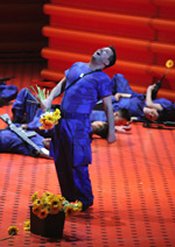
Yet, paradoxically, from this chaos of ugly and frankly juvenile pastiche
came beauty, in the form of Orlando’s final lullaby to himself; and the
more so as it was sung from front of stage, the phalanxes of dead behind,
with creamy tone and superb control — yet also with an eerie calm that
sent shivers. From the ridiculous to the sublime in five minutes. Maybe that
is this director’s saving grace.
It will be a shame if David Alden doesn’t direct Handel here again
— for all his perverse and challenging ways, he has helped open up
baroque opera to a new way of thinking, a new way of putting it into modern
context, and he works with his singers rather than imposing upon them.
Whether he takes all his audience with him is debatable — but as long
as he takes most of them, and his singers continue to be willing to risk all
for him, then he won’t end up like Mr. Handel in 1733 with an empty
stage.
© S.C. Loder