Since then, the opera’s popularity has eroded severely, and now it
lingers on the outermost fringes of the canon, emerging from time to time
like an elderly lion to remind us that it, too, once held audiences in thrall
with its roar. One of the surest signs of L’amore’s
near-obsolescence is the simple fact that the Opera Orchestra of New York
decided to conclude its 35th anniversary season at Carnegie Hall with a
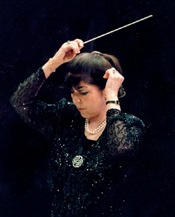
performance of the work. Eve Queler’s organization has made its name
over the years by reviving neglected operatic scores, and its concert
presentation of L’amore on 4 May was no exception.
The reason for the opera’s fall from grace cannot have much to do
with its actual merits. By any standard, this is a powerful and well-crafted
work, both musically and dramatically. Sem Benelli’s libretto is a
naked melodrama of raw emotion elevated and concentrated by its archaic
setting in 10th-century Italy. The barbarian king Archibaldo is suspicious of
his son Manfredo’s new bride, Fiora. The suspicion is justified: Fiora
has been secretly trysting with fellow Italian Avito, the man she was
supposed to marry before the barbarians conquered their homeland.
Archibaldo’s blindness prevents him from discovering Fiora in
flagrante delicto, but when she finally admits her transgression to him
and refuses to reveal her lover’s identity, the king strangles her. In
the opera’s final act, Avito kisses Fiora’s corpse, but he dies
from the poison the barbarians have placed on her lips. Manfredo, unable to
master his grief, cannot restrain himself from kissing Fiora as well, and the
opera concludes with Archibaldo holding his dying son in his arms.
Montemezzi’s music fills out this tale of betrayal and passion with
all the high-stakes energy it can bear, yet the score never devolves into
hysterics. Although it clearly lives within the borders of verismo, the opera
owes more than a little to Wagner and Debussy. There is a distinctly
Wagnerian swagger to the end of Act One, for example, as Manfredo takes Fiora
to bed and Archibaldo laments his son’s ignorance. And when Fiora
defiantly confesses her guilt to Archibaldo at the heart of Act Two
(“Allora...Allora...Quello ch’io baciavo”), it is hard not
to think of the similarly electric moment in the second act of
Parsifal when Kundry drops her seductress routine and finally
confronts Parsifal with the truth about her identity. Meanwhile, the
evocative orchestral atmospherics of the opera call Pelléas to mind,
and certainly Benelli’s storyline and dramatis personae refer
back to Maeterlinck’s drama. Nevertheless, the opera is
quintessentially Italian in its approach. All the characters are fully aware
of their motivations, and as they maneuver toward their aims, their emotions
surge directly to the surface, finding expression in line after line of
wide-ranging, ardent melody. Today, with our predilection for late Wagner and
Pelléas, we expect a story like this to receive an elusive,
psychologically layered musical treatment. Perhaps this tacit assumption can
help to explain why Montemezzi’s opera has not managed to retain its
allure over the past half-century. In any case, it certainly deserves
attention on its own terms.
Even if the opera’s overall quality was in doubt, no greater excuse
could be proffered for its revival than to give Samuel Ramey the opportunity
to sing the role of Archibaldo. Ramey’s performance on Thursday night
was strong and self-assured, and yet there was room in his interpretation of
Archibaldo for hints of the self-pity and despair that sap the soul of this
blind and aging king. Ramey’s voice, on the other hand, seems not to
have aged much, at least not on this occasion. His bass sound, rich and
unforced, filled the hall throughout the evening, and the climax of his
first-act aria (“Italia! Italia!...è tutto il mio ricordo!”) was
thrilling. As Fiora, the soprano Fabiana Bravo seemed content at first to
indulge in histrionics rather than tap into the considerable resources of her
instrument. Her weak Callas impersonation, peppered with the usual gasps,
sobs and wails, was applied just as assiduously to her love duet with Avito
in Act One as it was to her dissimulating dialogue with Manfredo at the
beginning of Act Two. As the second act progressed, however, Bravo let her
voice do the work, and it soared. The iron core of her middle range
communicated Fiora’s resolute pride, while the glitter of her high
notes made us understand what attracted these men to her in the first place.
Fernando de la Mora (Avito) was the only principal who sang his role from
memory, and the deeper level of dramatic commitment on his part was evident
and much appreciated. Unfortunately, his quintessential lyric tenor voice,
naturally honeyed and supple, was pushed beyond its limits in many places,
and the result was diffuse and flat. Much the same could be said of baritone
Pavel Baransky in the role of Manfredo.
It’s hard to blame these singers for overexerting themselves,
however, since Maestro Queler never accommodated them by limiting the sound
of her orchestra. Concert presentations of opera always come up against the
problem of balance, but for this performance Queler seems to have ignored the
problem altogether. Still, the orchestra made its way through the score
without too much calamity, and some of the players memorably rose to the
occasion in featured moments (the flute solo in Act One, the viola solos in
Act Three, the offstage trumpets throughout). Let’s hope that this
performance inspires a few opera companies to assemble a fully-staged
production in the near future.
Benjamin Binder