Subscribe to
Opera Today

Receive articles and news via RSS feeds or email subscription.


Recently in Commentary

Octavio Roca on Carmen

Carmen Forever By Octavio Roca October 19, 2004 Bizet's legendary heroine still inspires artists and opera lovers. The woman is fascinating, no question about it. Little by little, we are still getting to know Carmen. The fascination is strong, and...

FT on Countertenor Lawrence Zazzo

US countertenor who is a wow in Europe By Francis Carlin Published: October 28 2004 03:00 | Last updated: October 28 2004 03:00 It is always a good sign when you find a singer attending a performance of something else...

A Tribute to Robert Merrill (1919-2004)

MEMORIES OF ROBERT MERRILL: AMERICAN OPERATIC ICON by James Engdahl, Engdahl Artists International Robert Merrill, born Moishe Miller in the Williamsburg section of Brooklyn, passed away last Saturday, October 22, 2004, as he watched the first game of the World...

FT on the Future of Wexford Opera Festival

Wexford's dilemma for future operas By Andrew Clark Published: October 27 2004 03:00 | Last updated: October 27 2004 03:00 When Wexford's opera festival was young and innocent, audiences used to talk of "one for the head, one for the...

Looking for Wolfgang in All the Wrong Places

Scientists dig up family skeletons Luke Harding in Berlin Wednesday October 27, 2004 The Guardian It has been a mystery for more than a century - is a skull in an Austrian basement really that of arguably the greatest composer...

The Guardian Profiles René Jacobs

Not so hippy now Since the 1960s, René Jacobs has been a pioneer of the early music movement. Stephen Everson hears how his vision has evolved Friday October 22, 2004 The Guardian Anyone who still thinks "authentic" performances of baroque...

An Interview with Michael Kaye on Puccini Rediscovered

*New Repertoire Discoveries for Singers: An Interview with Michael Kaye* by Maria Nockin Did you ever wonder why that last Tales of Hoffmann you sang had all those photocopied sheets added in? Or why the version of "Butterfly" you learned...

The Independent: John Tavener Rejects Orthodox Faith; To Compose Theatric Work Based on Krishna

Top composer Tavener turns to Islam for inspiration The Orthodox faith inspired him for more than 25 years, but after a rift with his spiritual adviser, the composer has rejected its 'tyranny' in a major work based on the Koran....

Ópera Actual Interviews Anne Sofie von Otter

El sexo en la ópera no es sólo vulgar: ya nos aburre Fuera de la escena, la mezzo sueca es áspera y poco acogedora. Sus escasas sonrisas son un premio y sus respuestas son rápidas y precisas. Una evidente robustez...

Daily Telegraph Interviews Pierre Boulez

Mistakes? I've made a few... (Filed: 04/10/2004) Pierre Boulez, the greatest and most uncompromising composer-conductor of our time, is mellowing as he approaches 80. He talks to Ivan Hewett However hard one normally prepares for interviews, there's always the feeling...

Deborah Voigt withdraws from Vancouver Opera’s production of Der Rosenkavalier

*Deborah Voigt withdraws from Vancouver Opera's production of Der Rosenkavalier* Vancouver, BC ~ American soprano Deborah Voigt, who was to make her role début as the Marschallin in the company's première production of Richard Strauss's Der Rosenkavalier, has withdrawn from...

Licia Albanese at the Opening of the San Francisco Performing Arts Library and Museum's Exhibition "Madame Butterfly: From Puccini to Miss Saigon"

Many a tear was shed when soprano Licia Albanese sang. Now she is celebrating her signature work, 'Madama Butterfly.' Allan Ulrich, Special to The Chronicle Monday, October 4, 2004 Was she or wasn't she? Licia Albanese is adamant. "Diva? Hah!...

Le Figaro Interviews Felicity Lott

Deux reprises, des tournées, un DVD, le prix de la critique : La Belle Hélène par le tandem Minkowski/Pelly fut l’un des plus grands et des plus durables succès du Châtelet. De quoi donner envie de reconduire l’équipe gagnante dans un autre Offenbach : ce sera La Grande Duchesse de Gérolstein. Mais à une condition : que la vedette en soit à nouveau Dame Felicity Lott, la plus française des chanteuses britanniques, dont la classe et le naturel s’imposent de l’opérette viennoise à l’opéra-bouffe français, en passant par la nostalgie du Chevalier à la rose ou le désespoir de La Voix humaine. Nous avons rencontré cette femme délicieuse début septembre, juste avant que le spectacle n’inaugure la nouvelle salle de Grenoble, «rodage» précédant les représentations parisiennes.

Le Monde on Film Makers and Opera

L'opéra au cinéma, entre chic et surprise LE MONDE | 30.09.04 | 14em5 La mise en scène d'opéra est, pour des cinéastes comme Benoît Jacquot, Atom Egoyan, Robert Altman... l'occasion d'expériences exceptionnelles. "Il y a dans l'opéra un truc qui...

A Profile of Anna Netrebko

In the October 2004 issue of BBC Music magazine, Amanda Holloway writes: The phrase most often used of Anna Netrebko is a 'package': stunning looks, acting ability and a gorgeous, effortless lyric soprano voice. The following is a profile...

Pavarotti’s forgotten predecessor: Bruno Prevedi

By Jan Neckers The line of Decca-tenors seems to run straight from Del Monaco to Bergonzi to Pavarotti. Granted there are some intrusions by Giuseppe Campora, Giuseppe Di Stefano and Franco Corelli but their names are not widely associated with...

Joseph Schmidt (1904-2004)

This is not a biography of the Jewish tenor. Just some personal thoughts on a few interesting aspects. Those interested in a biographical article and an outstanding discography better purchase the June 2000 issue of The Record Collector where your servant and Hansfried Sieben devoted more than sixty small print pages to the tenor. Those able to read German can still buy Alfred Fasbind’s biography published at the Schweizer Verlagshaus in Zürich 1992. It is still available in some German bookshops and maybe with the author himself (Rosenbergstrasse 16, 8630 Rüti, Switzerland).

THE RISE OF NEAPOLITAN COMIC OPERA

Goldberg No. 27 By Brian Robins During the eighteenth century Naples was one of the largest and most vibrant cities in Europe. Hot, dirty and overcrowded, it was a city of teeming life and colour that flowed from court and...

Kiri Te Kanawa in Philadelphia

Soprano still sings, and talks about it By David Patrick Stearns Inquirer Music Critic The majestic voice of Metropolitan Opera radio announcer Milton Cross became painfully flummoxed at the name Kiri Te Kanawa. It was the soprano's 1974 debut at...

Chicago Tribune on Bolcom's Wedding

William Bolcom: The `Wedding' planner By John von Rhein Tribune music critic September 12, 2004 Elden is William Bolcom's middle name, but it might just as well be Eclectic. He's perhaps the most versatile "serious" composer now at work in...

OPERA TODAY ARCHIVES »

Commentary

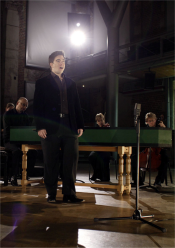
Michael Maniaci during recording for the programme.
23 Jun 2006

"Castrato" — In Search of a Lost Voice

Nestling artistically in a bowl, carefully arranged and lit to suit the camera early in the programme, the testicles seemed to glow softly with their hidden history, their inherent potential and, now, their very lack of future.

One might say they reflected rather neatly the subject of this film recently made for television by BBC Producer Francesca Kemp: those fabled creatures of the 17th and 18th centuries, the Castrati. These singers were such artists, such performers, such celebrities in their heyday of the mid baroque, that our musical folk memory is still full of them — they have never really died. It seems that each new generation of music lovers is re-discovering their story, is enraptured by the myth, and fascinated by the reality of their lives as we know it today. But the greatest fascination of all is the voice itself — what did it sound like? Would we recognise it as the marvel it was then considered? We are still chasing that holy grail, that rainbow’s end, with ever more sophisticated methods, and this film sets out to try to illuminate, if not answer, some of the questions we still have about it.

If you are wondering just why people might be tempted to watch, Kemp herself has no such doubts. “We're so much more interested in their repertoire now, especially the operatic; it’s a natural extension of the recent explosion of interest in the countertenor voice. And we're so much more aware of issues around period style — we know how exciting and revealing it is to hear Mozart concerti played on a fortepiano, and I think there's an equally valid interest in getting closer to understanding what this particular vocal quality might or might not have been.” She adds: “And more broadly, it's a fascinating model for understanding our eternal obsession with the humanly bizarre or unusual, and our current preoccupations with a whole host of socio-cultural issues such as fame at any price/body alteration/gender models/child abuse and so on.”

The film’s central scientific thrust is one of the attempted regeneration of the voice electronically, and unlike the well-known attempt to do this for the feature film “Farinelli” whereby the engineers rather crudely morphed a soprano and countertenor voice, here the professors and scientists seek to try to match electronically on a computer certain elements of what is probably our only recorded history of a castrato voice, that of Alessandro Moreschi, with elements of a tenor and treble voice. How they do this, and what they base their ideas on, makes for interesting viewing and listening. Whether the final result satisfies, or merely frustrates, will be up to the viewer to decide — certainly there is no definitive answer here even if intriguing pathways are opened up for exploration. As presenter Nicholas Clapton (author of works on the castrati) says: “In the recordings of Moreschi, which I do not believe are as bad as many people do, we have “documentary” evidence of the castrato sound. There is a strong tenor element in his voice, although because of his child-size vocal tract it is a tenor sound “up an octave”, with what sounds rather like a super-charged treble above that.”

During the experiments, we hear examples of several voices: boy treble, soprano, countertenor (Clapton himself,) and perhaps most exciting of all, that of the young American operatic male soprano Michael Maniaci. Excerpts of his rendition of the Alleluja from Mozart's motet “Exultate, jubilate”, K. 165, written in 1773 for the famous castrato Venanzio Rauzzini, certainly raise the musical temperature of the film many notches and were impressive. (As a footnote, Mozart also created the role of Lucio Cinna for Rauzzini in his opera “Lucio Silla” — a role that Maniaci has recently sung at Santa Fe Opera).

In contrast to the music made by this male soprano, the electronic experiments seem only to have produced some, frankly, unattractive sounds so far and I asked for Francesca Kemp’s view. “Yes I agree Michael is completely wonderful. But I do wonder whether we're right to think that he's “closer” to the castrato sound than the other electronic or human examples ………we don't know what the end result should be, and as is pointed out in the film, we absolutely don't know that we'd like the sound of an 18th century castrato voice any more than we tend to “like” that of Moreschi”. Clapton agrees: “My hunch is that modern listeners would find the voice, manner and whole performance of a castrato like Farinelli extremely strange, indeed alien, much like we would find the conversation of Handel, Johnson, or George II extremely peculiar today”.

If so, despite our enduring fascination with these long-dead superstars, perhaps this is a reason for letting sleeping voices lie?

S.C. Loder © 2006

(The broadcast is scheduled for screening on BBC 4 television in the UK, on July 5th at 2100hrs.)
Send to a friend

Send a link to this article to a friend with an optional message.

Friend's Email Address: (required)

Your Email Address: (required)

Message (optional):