31 Jul 2006
Strong Tempest at Santa Fe
The news from Santa Fe Opera last week-end is good, unexpectedly so. The British composer Thomas Ades’ new (2004) opera, a riff on Shakespeare’s The Tempest, has been rumored hard to perform and harder to hear.
English Touring Opera are delighted to announce a season of lyric monodramas to tour nationally from October to December. The season features music for solo singer and piano by Argento, Britten, Tippett and Shostakovich with a bold and inventive approach to making opera during social distancing.
This tenth of ten Live from London concerts was in fact a recorded live performance from California. It was no less enjoyable for that, and it was also uplifting to learn that this wasn’t in fact the ‘last’ LfL event that we will be able to enjoy, courtesy of VOCES8 and their fellow vocal ensembles (more below …).
Ever since Wigmore Hall announced their superb series of autumn concerts, all streamed live and available free of charge, I’d been looking forward to this song recital by Ian Bostridge and Imogen Cooper.
Although Stile Antico’s programme article for their Live from London recital introduced their selection from the many treasures of the English Renaissance in the context of the theological debates and upheavals of the Tudor and Elizabethan years, their performance was more evocative of private chamber music than of public liturgy.
Evidently, face masks don’t stifle appreciative “Bravo!”s. And, reducing audience numbers doesn’t lower the volume of such acclamations. For, the audience at Wigmore Hall gave soprano Elizabeth Llewellyn and pianist Simon Lepper a greatly deserved warm reception and hearty response following this lunchtime recital of late-Romantic song.
For this week’s Live from London vocal recital we moved from the home of VOCES8, St Anne and St Agnes in the City of London, to Kings Place, where The Sixteen - who have been associate artists at the venue for some time - presented a programme of music and words bound together by the theme of ‘reflection’.
'Such is your divine Disposation that both you excellently understand, and royally entertaine the Exercise of Musicke.’
‘And there was war in heaven: Michael and his angels fought against the dragon; and the dragon fought and his angels, And prevailed not; neither was their place found any more in heaven … that old serpent … Satan, which deceiveth the whole world: he was cast out into the earth, and his angels were cast out with him.’
There was never any doubt that the fifth of the twelve Met Stars Live in Concert broadcasts was going to be a palpably intense and vivid event, as well as a musically stunning and theatrically enervating experience.
‘Love’ was the theme for this Live from London performance by Apollo5. Given the complexity and diversity of that human emotion, and Apollo5’s reputation for versatility and diverse repertoire, ranging from Renaissance choral music to jazz, from contemporary classical works to popular song, it was no surprise that their programme spanned 500 years and several musical styles.
The Academy of St Martin in the Fields have titled their autumn series of eight concerts - which are taking place at 5pm and 7.30pm on two Saturdays each month at their home venue in Trafalgar Square, and being filmed for streaming the following Thursday - ‘re:connect’.
The London Symphony Orchestra opened their Autumn 2020 season with a homage to Oliver Knussen, who died at the age of 66 in July 2018. The programme traced a national musical lineage through the twentieth century, from Britten to Knussen, on to Mark-Anthony Turnage, and entwining the LSO and Rattle too.
With the Live from London digital vocal festival entering the second half of the series, the festival’s host, VOCES8, returned to their home at St Annes and St Agnes in the City of London to present a sequence of ‘Choral Dances’ - vocal music inspired by dance, embracing diverse genres from the Renaissance madrigal to swing jazz.
Just a few unison string wriggles from the opening of Mozart’s overture to Le nozze di Figaro are enough to make any opera-lover perch on the edge of their seat, in excited anticipation of the drama in music to come, so there could be no other curtain-raiser for this Gala Concert at the Royal Opera House, the latest instalment from ‘their House’ to ‘our houses’.
"Before the ending of the day, creator of all things, we pray that, with your accustomed mercy, you may watch over us."
The doors at The Metropolitan Opera will not open to live audiences until 2021 at the earliest, and the likelihood of normal operatic life resuming in cities around the world looks but a distant dream at present. But, while we may not be invited from our homes into the opera house for some time yet, with its free daily screenings of past productions and its pay-per-view Met Stars Live in Concert series, the Met continues to bring opera into our homes.
Music-making at this year’s Grange Festival Opera may have fallen silent in June and July, but the country house and extensive grounds of The Grange provided an ideal setting for a weekend of twelve specially conceived ‘promenade’ performances encompassing music and dance.
There’s a “slide of harmony” and “all the bones leave your body at that moment and you collapse to the floor, it’s so extraordinary.”
“Music for a while, shall all your cares beguile.”
The hum of bees rising from myriad scented blooms; gentle strains of birdsong; the cheerful chatter of picnickers beside a still lake; decorous thwacks of leather on willow; song and music floating through the warm evening air.
The news from Santa Fe Opera last week-end is good, unexpectedly so. The British composer Thomas Ades’ new (2004) opera, a riff on Shakespeare’s The Tempest, has been rumored hard to perform and harder to hear.
Sitting in at the final dress rehearsal Thursday night, this auditor tended to agree, and departed after Act I to rest his ears. The first act had seemed dense musically, over-loaded with exposition and narrative line and unrelieved by much lyric beauty. The much-hyped Ades has been criticized widely for ‘singing with the voices of others,’ and his prickly and disdainful outbursts against other composers, especially Johannes Brahms, have left a sour impression with many classical music audiences. “He’s not out to please,” one BBC official told me.
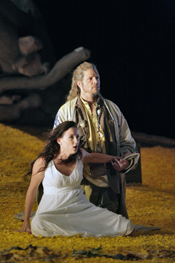
All negatives vanished Saturday (July 29) at the opening. The Tempest showed itself, in a masterful Santa Fe Opera production, a valid and even moving theatre piece, with a score that slowly develops into one of considerable beauty and emotional power. Ades, and his librettist Meredith Oakes, have condensed and somewhat rearranged the Shakespeare play, removed virtually all of its poetry, and made room for their own music to tell the story of the magician Prospero, more in love with his books than with life (perhaps), his innocent daughter Miranda and their adventures on a magical isle with the servant sprite Ariel and the earthy monster Caliban — figures much beloved in English literature over the centuries. You may still love them, as the comedy and humanity of the sweet old play remain and are reinforced by Ades’ beautiful and elegant music.
In terms of ‘singing with the voices of others,’ I will stick with that description of Ades, but not in any negative way. As the opera proceeds it increases in lyric quality, especially beginning with the Miranda/Ferdinand love scene closing Act II, and throughout Act III to its eloquent resolutions at the end. His inspiration is clearly Benjamin Britten — and the more ‘Britten’ we hear, the better the piece sounds.
Ades has his own way with harmonics and the musical rhetoric, but it is certainly sired by Wagner out of Britten, for without those two ancestors this score would not exist. The particular characteristics we hear are the uses of voice as another instrument of the orchestra, so to speak, and the moving back and forth between orchestra and stage of the special elements of musical drama. Wagner often claimed the real drama of his operas was in the orchestra; there is much of that here. But the colors and patterns of speech and line, familiar from Britten (especially Peter Grimes), inhabit this work and give it human scale and emotional availability. As one of the singers said of the closing pages of Act III, “in the end, it’s just open intervals and air.” The results are magical. The final act runs about ten minutes too long; I would have been happy to have Prospero close the piece with his benediction of the young lovers and acceptance of his need to forgive in life, but the creators wanted a reprieve for Caliban. “I have refocussed Caliban,” Ades said in a panel discussion before The Tempest’s opening, “and while Shakespeare was not looking, changed him a bit.”
There is so much more to say, and no room here. But the Santa Fe production team has to be given credit — and a major debt of gratitude it is! The unit set is an ingenious raked golden beach giving off into an edge of blue water at the footlights. Characters appear and disappear in surprising places — up from the sand or out of the water. A single barren tree overhangs the beach as a perch for Ariel and Prospero, while props and trappings come and go as if by magic. Costumes range from modern formal wear and stylish dresses for the court and chorus of survivors of the shipwreck that starts the action, to a magician’s robe for Prospero, and blue paint and not much else for the high soprano singing Ariel. The mise-en-scène delights, but it does not overshadow, for the music saturates everything and properly dominates the mood. Jonathan Kent’s direction and Paul Brown’s visual design are worthy supporting players in the scheme, as is Duane Schuler’s intense lighting.
The cast is uniformly strong, but out of a company of peers Rod Gilfry’s winning playing and resilient baritone singing as Prospero, as well as the high-pitched antics of Cyndia Sieden‘s Ariel predominate — as they should; their characters run the play and the opera. Young lovers Miranda and Ferdinand are attractive in the charge of Patricia Risley and Toby Spence, while familiar figures such as Chris Merritt and Gwynne Howell handle their lesser assignments well enough. Caliban is a nasty little brute energetically played and sung with a strong if reedy tenor by William Ferguson.
Much laud and glory are due Santa Fe Music Director Alan Gilbert for his musical control of the enterprise. He commanded the complex Ades score brilliantly; the Santa Fe Opera Orchestra, which has thriven under Gilbert’s management, played with great effect. One regrets hearing this is Gilbert’s last season in his position with Santa Fe Opera, not yet officially announced, but much discussed in the community. He will be hard to replace. Gilbert, chief conductor of the Stockholm, Sweden Philharmonic, is said to be ambitious, and it’s to be regretted his aims may not include more Santa Fe seasons, for his contribution could be highly valuable to the long-term health of the opera company. Starting with his very first operatic assignment (Falstaff), in his Santa Fe debut (2001), Gilbert has developed into an eloquent operatic talent in only a few seasons.
General Director Richard Gaddes and his UK team of producers are to be complimented for presenting the North American premiere of an important new opera. It is in the best historic tradition of the pioneering festival company.
J. A. Van Sant
Santa Fe, New Mexico
(c) 2006
Note: After posting this commenatry, your reporter received a telephone call from Richard Gaddes, General Director of the Santa Fe Opera, who reads Opera Today. He wanted to make the point that he is perfectly delighted to have Alan Gilbert as Music Director of the opera company, and further that Gilbert has never told Gaddes he will not continue to serve. When I mentioned that Gilbert’s contract is said to have run out this season, Gaddes responded, “Yes, we do have some talking to do.” He said further, “Alan and I have an excellent relationship.” I thought these facts were worth adding to my review. J.A.V.S.