16 Oct 2006
Opera at Curtis
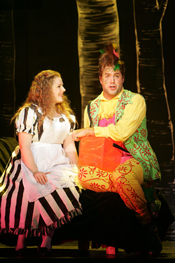
Curtis, America’s top fully funded conservatory, is on the move as one of the nation’s leading opera preparatory programs.
English Touring Opera are delighted to announce a season of lyric monodramas to tour nationally from October to December. The season features music for solo singer and piano by Argento, Britten, Tippett and Shostakovich with a bold and inventive approach to making opera during social distancing.
Conductor Oliver Zeffman has commissioned the very first opera for a socially distanced world, which is now available to watch exclusively on Apple Music. Eight Songs From Isolation has been written by eight leading composers, specifically for streaming - rather than live performance - and is the first opera written for a time when the performers were unable to meet in person.
Leading freelance musicians unite in Parliament Square to call for targeted support for colleagues in the arts and entertainment sector.
Duo Lewis Murphy (composer) and Laura Attridge (writer) have launched a charitable song project entitled Notes From Isolation. The resulting songs, featuring some of the UK's top singing talent, are being released online between August and October 2020 and can be enjoyed free of charge.
The Royal Opera House is thrilled to announce an exciting, wide-ranging new line-up for its autumn programme. For the first time, extraordinary performances will be accessible online for a global audience through livestreams and for socially distanced live audiences at our home in Covent Garden. In a global first, we present a new opera in hyper-reality, alongside repertory favourites from both artistic companies.
Some of the most famous and outstanding stars from the opera world are to take part in a very special evening from Wexford Festival Opera, including Aigul Akhmetshina, Joseph Calleja, Daniela Barcellona, Juan Diego Flórez, Igor Golovatenko, Ermonela Jaho, Sergey Romanovsky, and many more.
Following its successful launch in 2019, OperaStreaming streams nine operas on YouTube from the historic opera houses of Emilia-Romagna during the 2020-21 season, with fully-staged productions of Verdi's La traviata in October from Modena and Verdi'sOtello from Bologna in...
‘A brief history of song’ is the subtitle of the 2020 Oxford Lieder Festival (10th-17th October), which will present an ambitious, diverse and imaginative programme of 40 performances and events.
Bampton Classical Opera returns to the Baroque splendour of London’s St John’s Smith Square on November 6 with a concert performance of Gluck’s one-act opera The Crown, the first in the UK since 1987. The performance will also be filmed and available to watch on demand on the Bampton website from 9 November.
While many of us spent lockdown at home taking it a little easier, composer Andrew Synnott wrote an opera.
Owen Wingrave is part of the new Interim Season of 19 brand new events, all free to view online between September and December 2020.
The Arts Council has awarded innovative UK charity Music and Theatre For All (MTFA) a major new grant to develop three ambitious new projects in the wake of Covid 19.
English National Opera (ENO) will reopen the London Coliseum to socially distanced audiences on 6 and 7 November for special performances of Mozart’s Requiem. These will provide audiences with an opportunity to reflect upon and to commemorate the difficulties the nation has faced during the pandemic.
The Royal Opera House is proud to continue its curated #OurHouseToYourHouse programme into the autumn, bringing audiences the best of the ROH through a new series of Friday Premieres and cultural highlights.
After six months of closure, the Royal Opera House is thrilled to be opening its doors to the public as part of Open House London weekend, giving visitors a taste of one of the world’s most famous theatres for free.
The Academy of St Martin in the Fields is thrilled to announce re:connect - an eight concert series with live socially distanced audiences at its namesake church, St. Martin-in-the-Fields. The autumn concerts will take place at 5pm & 7:30pm on two Saturdays per month with guest artists including baritone Roderick Williams, soprano Carolyn Sampson and composer-conductor-pianist Ryan Wigglesworth performing a wide range of repertoire.
Music and poetry unite and collide across centuries, from the Medieval to the Enlightenment to the present day. This year, the Oxford Lieder Festival will present a thrilling and innovative programme comprising more than forty events streamed over eight days.
The English Concert with artistic director Harry Bicket is delighted to announce a series of concerts from 1-15 October 2020. The concerts take place in historic London venues with star soloists and will be performed and streamed live to a paying audience at 7pm GMT on each performance date. The programmes include first-class vocal and instrumental works from the two pillars of the English Baroque, covering different aspects of the repertoire.
Glyndebourne has announced plans for a ‘staycation’ series of socially-distanced indoor performances, starting on 10 October 2020.
The Royal Opera House is delighted to announce two packed evenings of opera and ballet, live from our stage in Covent Garden and available to view wherever you are in the world online.
Curtis, America’s top fully funded conservatory, is on the move as one of the nation’s leading opera preparatory programs.
Directed by Mikael Eliasen, internationally renowned vocal collaborator and coach, the Curtis Opera Theatre trains around twenty-five singers, ages 18-28, each year in the Bachelor of Music, Master of Music, and Professional Studies programs. Students from around the world audition, singing four to five selections from opera, oratorio and art song, depending on the desired program. Many audition, but few are accepted to pursue this elite training.
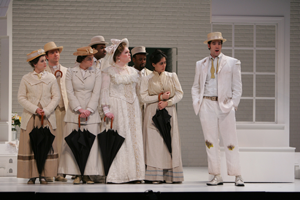
What makes this program cutting edge is its emphasis on musical and dramatic values, offering weekly classes in movement, repertoire, make-up and foreign language diction, along with performance seminars lead by Eliasen. Students also receive three hours of vocal coaching each week, as well as additional language classes.
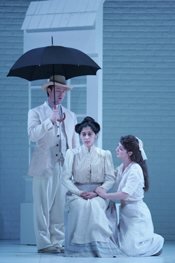
With such extensive training and performing experiences, it is no surprise that more than sixty alumni have sung with the Metropolitan Opera, and Curtis graduates can be found singing on stages worldwide.
Cick here for information on this year's performances at the Curtis Opera Theatre.
Sarah Hoffman
All photos by David Swanson
[Editor's Note: This is the first in a series of articles on music education relating to opera and vocal music.]