08 Oct 2006
Settling the Score — An Interview with Philip Gossett
Introduction: Philip Gossett is one of those rarities in academia: a scholar of the first order and a consummate teacher.
English Touring Opera are delighted to announce a season of lyric monodramas to tour nationally from October to December. The season features music for solo singer and piano by Argento, Britten, Tippett and Shostakovich with a bold and inventive approach to making opera during social distancing.
Conductor Oliver Zeffman has commissioned the very first opera for a socially distanced world, which is now available to watch exclusively on Apple Music. Eight Songs From Isolation has been written by eight leading composers, specifically for streaming - rather than live performance - and is the first opera written for a time when the performers were unable to meet in person.
Leading freelance musicians unite in Parliament Square to call for targeted support for colleagues in the arts and entertainment sector.
Duo Lewis Murphy (composer) and Laura Attridge (writer) have launched a charitable song project entitled Notes From Isolation. The resulting songs, featuring some of the UK's top singing talent, are being released online between August and October 2020 and can be enjoyed free of charge.
The Royal Opera House is thrilled to announce an exciting, wide-ranging new line-up for its autumn programme. For the first time, extraordinary performances will be accessible online for a global audience through livestreams and for socially distanced live audiences at our home in Covent Garden. In a global first, we present a new opera in hyper-reality, alongside repertory favourites from both artistic companies.
Some of the most famous and outstanding stars from the opera world are to take part in a very special evening from Wexford Festival Opera, including Aigul Akhmetshina, Joseph Calleja, Daniela Barcellona, Juan Diego Flórez, Igor Golovatenko, Ermonela Jaho, Sergey Romanovsky, and many more.
Following its successful launch in 2019, OperaStreaming streams nine operas on YouTube from the historic opera houses of Emilia-Romagna during the 2020-21 season, with fully-staged productions of Verdi's La traviata in October from Modena and Verdi'sOtello from Bologna in...
‘A brief history of song’ is the subtitle of the 2020 Oxford Lieder Festival (10th-17th October), which will present an ambitious, diverse and imaginative programme of 40 performances and events.
Bampton Classical Opera returns to the Baroque splendour of London’s St John’s Smith Square on November 6 with a concert performance of Gluck’s one-act opera The Crown, the first in the UK since 1987. The performance will also be filmed and available to watch on demand on the Bampton website from 9 November.
While many of us spent lockdown at home taking it a little easier, composer Andrew Synnott wrote an opera.
Owen Wingrave is part of the new Interim Season of 19 brand new events, all free to view online between September and December 2020.
The Arts Council has awarded innovative UK charity Music and Theatre For All (MTFA) a major new grant to develop three ambitious new projects in the wake of Covid 19.
English National Opera (ENO) will reopen the London Coliseum to socially distanced audiences on 6 and 7 November for special performances of Mozart’s Requiem. These will provide audiences with an opportunity to reflect upon and to commemorate the difficulties the nation has faced during the pandemic.
The Royal Opera House is proud to continue its curated #OurHouseToYourHouse programme into the autumn, bringing audiences the best of the ROH through a new series of Friday Premieres and cultural highlights.
After six months of closure, the Royal Opera House is thrilled to be opening its doors to the public as part of Open House London weekend, giving visitors a taste of one of the world’s most famous theatres for free.
The Academy of St Martin in the Fields is thrilled to announce re:connect - an eight concert series with live socially distanced audiences at its namesake church, St. Martin-in-the-Fields. The autumn concerts will take place at 5pm & 7:30pm on two Saturdays per month with guest artists including baritone Roderick Williams, soprano Carolyn Sampson and composer-conductor-pianist Ryan Wigglesworth performing a wide range of repertoire.
Music and poetry unite and collide across centuries, from the Medieval to the Enlightenment to the present day. This year, the Oxford Lieder Festival will present a thrilling and innovative programme comprising more than forty events streamed over eight days.
The English Concert with artistic director Harry Bicket is delighted to announce a series of concerts from 1-15 October 2020. The concerts take place in historic London venues with star soloists and will be performed and streamed live to a paying audience at 7pm GMT on each performance date. The programmes include first-class vocal and instrumental works from the two pillars of the English Baroque, covering different aspects of the repertoire.
Glyndebourne has announced plans for a ‘staycation’ series of socially-distanced indoor performances, starting on 10 October 2020.
The Royal Opera House is delighted to announce two packed evenings of opera and ballet, live from our stage in Covent Garden and available to view wherever you are in the world online.
Introduction: Philip Gossett is one of those rarities in academia: a scholar of the first order and a consummate teacher.
Music is his passion, which he is eager to share with others. Generally recognized as a leading expert on Nineteenth Century Italian opera, Opera Today interviewed Professor Gossett to discuss his life and work.
Discussion:
OT: How long have you been a member of the faculty of the University of Chicago?
PG: I have been a member of faculty since 1968. Two years ago, however, I also joined the faculty of the University of Rome. I now teach alternately at Chicago and Rome.
OT: Do you teach only at the graduate level or do you also teach undergraduates?
PG: At Chicago, I teach undergraduates and graduates, including the introductory music course. At Rome, my undergraduate students are at a somewhat more advanced level than those at Chicago. This is because by the time they arrive there they know they want to pursue the study of music. Moreover, when it comes to opera, these students tend to be more informed of the background, thereby enabling discussions in more depth.
 OT: What is a musicologist? Are you also a musician?
PG: A musicologist is a music historian. My instrument is the piano. I often accompany singers for rehearsals or for performances of works where I have acted as consultant or in some other capacity.
OT: What led you to specialize in 19th Century Italian opera?
PG: I received my Ph.D. from Princeton in 1970. Contrary to the trends of the time, I chose the operas of Rossini as my dissertation topic. Together with Charles Rosen, I later published a series of facsimiles of printed scores or autograph manuscripts devoted to Early Romantic Opera that consisted of approximately 40 works. This was followed by another series of facsimiles devoted to Italian Opera 1810-1840. This latter project proved to be too ambitious and it was terminated after the publication of 25 volumes. Sadly, these are all out of print because their publisher, Garland, is no longer in business; and, in any event, libraries do not have the budgets that permit the acquisition of such costly series.
Meanwhile, I became the general editor of the critical editions of the Opera omnia of Gioachino Rossini and of the Works of Giuseppe Verdi.1 The need for these critical editions is pressing. Contrary to popular belief, neither of these composers saw their works in print until, in the case of Verdi, perhaps with Otello and Falstaff. And, Verdi’s letters to Ricordi complained of numerous mistakes in the materials, printed and manuscript, the firm prepared. Indeed, Ricordi tended to use sources that were available in Milan, autograph manuscripts when he had them, otherwise poor copies . He didn’t bother looking for alternate sources, particularly for works by Rossini, Bellini, Donizetti, or Verdi whose most important sources were in other collections. The printed scores that have been available for the last 100 years, then, do not represent the best evidence of the composer’s intentions.
I am also on the advisory boards of the Bellini and Donizetti editions, which are being prepared by many scholars who first worked under my direction.
OT: The Rossini project shows that Il barbiere di Siviglia is forthcoming. Yet Alberto Zedda produced a critical edition of this work several years ago. Why is this work en queue?
PG: Alberto Zedda is a talented musician but he is not a musicologist. When he prepared his edition, he believed that the secco recitatives in the autograph manuscript were in the hand of Rossini. They were not. He was also unaware of additional music, as well as Rossini manuscripts containing cadenzas and variations. He found many contradictions between the traditional Ricordi edition and the autograph manuscript. He revised the Ricordi edition, making important changes, but in the process, many errors were committed. Nonetheless, Zedda took on a monumental task that resulted in the first critical edition of a 19th Century opera.
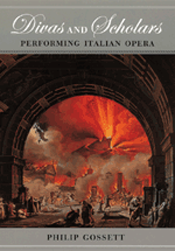
OT: Let’s move on to your new book, Divas and Scholars — Performing Italian Opera.2 How would you describe your book at the “30,000 foot” level?
PG: This book takes on the subject of the performance of Italian opera and places critical editions in relation to performing traditions and their subsequent transformations. In studying this relationship, I try to provide information about all aspects of performance, instrumentation, the art of vocal ornamentation, cuts, versions, staging. It is not a study of Italian opera in its entirety, but is limited largely to the works of Donizetti, Bellini, Rossini and Verdi, which have been the focus of my studies over the years.
The book is divided into two principal parts. The first part, which is entitled “Knowing the Score,” is an account of the preparation of critical editions. For example, I recently returned from St. Petersburg where I examined Verdi manuscripts in the library of the Mariinsky Theatre. I found there complete traces of much of his earlier work on La forza del destino, much of which was prepared from his 1861 skeleton score. A skeleton score contains the complete form of the vocal lines, bass and important instrumental ideas. This would be subsequently “filled in” by completing the orchestration. Now, what is interesting about the Mariinsky collection is that it includes all the vocal parts prepared from that 1861 skeleton score, because the planned premiere was delayed for a year as a consequence of the prima donna’s illness. A great deal of material in the collection is in Verdi’s own hand.
Between the first and second parts is a chapter entitled “Intermezzo.” This is a case study of the preparation of the critical edition of Rossini’s Semiramide and the problems posed in performing it.
The second part is entitled “Performing the Opera.” This covers such matters as the selection of versions of a score, ornamentation, transposition, and performance issues. One chapter, which is entitled “Serafin’s Scisors,”3 takes on the issue of cuts as traditionally made and artistic integrity. In this regard, it needs to be emphasized that a performance is not an edition and that by no means is a critical edition intended to foreclose making cuts and following performance traditions.
The book concludes with a “Coda” that relates to the reconstruction of two operas — Verdi’s Gustavo III (the predecessor of Un ballo in maschera) and Rossini’s Il viaggio a Reims in which the, theatrical genius, Dario Fo, substantially rewrote large parts of the libretto.
OT: At the back of your book is a glossary that not only defines technical terms but includes with the definitions some of the key points that you make throughout the book. For example, the definition of “come scritto” is “as written.” Yet, you go on to write:
Some performers believe that they should follow strictly the indications of a written or printed score. In doing so, they fail to understand that implicit within a composer’s notation are a series of conventions for interpreting that notation.
PG: An accurate reconstruction of the score is not the end of the matter. There were certain conventions that the composer assumed when putting pen to paper. For example, there were performance conventions regarding vocal ornamentation and performance styles that have long been known. Rossini’s notation clearly implies the use of appoggiaturas. Verdi, on the other hand, wrote out embellishments, though even here singers would add their own cadenzas.
OT: You make an important point that music can accommodate different texts. What is the relation of text and music in 19th Century Italian operas?
PG: The relationship of text and music in opera is a fascinating subject. But, I am approaching this in a more limited manner. I cite Hanslick’s famous example of an aria from Gluck’s Orhpée et Euridice. He noted that if the words “J’ai perdu mon Euridice, / Rien n’égale à mon malheur” (I have lost my Euridice, nothing equals my sadness) were changed to “J’ai trouvé mon Euridice, / Rien n’égale à mon bonheur” (I have found my Euridice, nothing equals my joy), a new union of music and text is created that is just as satisfying as the original. What this means is that, through the substitution of text, the same music can accommodate different “atmospheres” or idealize different content. Rossini, for one, did not hesitate to rework music with different texts.
OT: What about translations? For example, Don Carlo is the Italian translation of Don Carlos, which had a libretto in French for performance at the Paris Opéra?
PG: The problem of translations is particularly apparent in the several versions of Les Vêpres siciliennes where Verdi was directly involved. The translation between Italian and French is particularly problematic, because poetic systems were quite different and it was common to translate the words into another series of poetic forms and then stuff the words under the music in the most absurd fashion.
OT: Do you maintain that the instrumental accompaniment to the operas of Donizetti and Rossini, for example, should be played with original instruments?
PG: Not necessarily. Most performances today certainly employ modern instruments. But, it is important to note that the 19th Century trombone, for example, was quite different from the modern instrument. Therefore, when the score calls for trombones to play forte, that means mezzo forte or even mezzo piano, for modern instruments simply because historic instruments were incapable of producing the same volume of sound.
OT: Then you are not dogmatic when it comes to so-called historically informed performance practices?
PG: There is no such thing as an historically authentic performance. Alleged authenticity must give way to the complex interactions of theory and practice, history and contemporaneity, tradition and innovation.
OT: Where do things go from here?
PG: Using the results of my research at St. Petersburg, we will be producing a critical edition of Forza, followed by Giovanna d’Arco, Attila, Un ballo in maschera, Aroldo, Falstaff, and so on.
As for the Rossini project, I have parted ways with the Fondazione Rossini, which has had serious problems financially and politically. With the use of some of the Mellon Award,4 I am fairly certain that continuation of the project will be taken up by Bärenreiter. The Petite Messe Solennelle is in the works, and La cambiale di matrimonio and Il barbiere di Siviglia will follow soon after. There is much yet to be done.
OT: And you are enjoying every minute of it. Thank you Professor Gossett.
1. For an explanation of critical editions, see Patricia B. Brauner, What is a critical edition? How does it happen? at http://humanities.uchicago.edu/orgs/ciao/Introductory/Rcritical%20edition.html.
2. Divas and Scholars — Performing Italian Opera (Chicago: Univ. of Chicago Press, 2006).
3. This refers to Tullio Serafin, the resident conductor at La Scala in the 1950s and co-author with Alceo Toni of Stile, tradizione e convenzioni del melodrama italiana del Settecento e dell’Ottocento (Milan: Ricordi, 1958).
4.In 2004, Professor Gossett received the Mellon Distinguished Achievement Award, the first musicologist to receive this award. The award was in the amount of $1.5 million. See Philip Gossett Receives Mellon Distinguished Achievement Award (17 December 2004) at this link.