Recently in Performances
English Touring Opera are delighted to announce a season of lyric monodramas to tour nationally from October to December. The season features music for solo singer and piano by Argento, Britten, Tippett and Shostakovich with a bold and inventive approach to making opera during social distancing.
This tenth of ten Live from London concerts was in fact a recorded live performance from California. It was no less enjoyable for that, and it was also uplifting to learn that this wasn’t in fact the ‘last’ LfL event that we will be able to enjoy, courtesy of VOCES8 and their fellow vocal ensembles (more below …).
Ever since Wigmore Hall announced their superb series of autumn concerts, all streamed live and available free of charge, I’d been looking forward to this song recital by Ian Bostridge and Imogen Cooper.
Although Stile Antico’s programme article for their Live from London recital introduced their selection from the many treasures of the English Renaissance in the context of the theological debates and upheavals of the Tudor and Elizabethan years, their performance was more evocative of private chamber music than of public liturgy.
Evidently, face masks don’t stifle appreciative “Bravo!”s. And, reducing audience numbers doesn’t lower the volume of such acclamations. For, the audience at Wigmore Hall gave soprano Elizabeth Llewellyn and pianist Simon Lepper a greatly deserved warm reception and hearty response following this lunchtime recital of late-Romantic song.
For this week’s Live from London vocal recital we moved from the home of VOCES8, St Anne and St Agnes in the City of London, to Kings Place, where The Sixteen - who have been associate artists at the venue for some time - presented a programme of music and words bound together by the theme of ‘reflection’.
'Such is your divine Disposation that both you excellently understand, and royally entertaine the Exercise of Musicke.’
‘And there was war in heaven: Michael and his angels fought against the dragon; and the dragon fought and his angels, And prevailed not; neither was their place found any more in heaven … that old serpent … Satan, which deceiveth the whole world: he was cast out into the earth, and his angels were cast out with him.’
There was never any doubt that the fifth of the twelve Met Stars Live in Concert broadcasts was going to be a palpably intense and vivid event, as well as a musically stunning and theatrically enervating experience.
‘Love’ was the theme for this Live from London performance by Apollo5. Given the complexity and diversity of that human emotion, and Apollo5’s reputation for versatility and diverse repertoire, ranging from Renaissance choral music to jazz, from contemporary classical works to popular song, it was no surprise that their programme spanned 500 years and several musical styles.
The Academy of St Martin in the Fields have titled their autumn series of eight concerts - which are taking place at 5pm and 7.30pm on two Saturdays each month at their home venue in Trafalgar Square, and being filmed for streaming the following Thursday - ‘re:connect’.
The London Symphony Orchestra opened their Autumn 2020 season with a homage to Oliver Knussen, who died at the age of 66 in July 2018. The programme traced a national musical lineage through the twentieth century, from Britten to Knussen, on to Mark-Anthony Turnage, and entwining the LSO and Rattle too.
With the Live from London digital vocal festival entering the second half of the series, the festival’s host, VOCES8, returned to their home at St Annes and St Agnes in the City of London to present a sequence of ‘Choral Dances’ - vocal music inspired by dance, embracing diverse genres from the Renaissance madrigal to swing jazz.
Just a few unison string wriggles from the opening of Mozart’s overture to Le nozze di Figaro are enough to make any opera-lover perch on the edge of their seat, in excited anticipation of the drama in music to come, so there could be no other curtain-raiser for this Gala Concert at the Royal Opera House, the latest instalment from ‘their House’ to ‘our houses’.
"Before the ending of the day, creator of all things, we pray that, with your accustomed mercy, you may watch over us."
The doors at The Metropolitan Opera will not open to live audiences until 2021 at the earliest, and the likelihood of normal operatic life resuming in cities around the world looks but a distant dream at present. But, while we may not be invited from our homes into the opera house for some time yet, with its free daily screenings of past productions and its pay-per-view Met Stars Live in Concert series, the Met continues to bring opera into our homes.
Music-making at this year’s Grange Festival Opera may have fallen silent in June and July, but the country house and extensive grounds of The Grange provided an ideal setting for a weekend of twelve specially conceived ‘promenade’ performances encompassing music and dance.
There’s a “slide of harmony” and “all the bones leave your body at that moment and you collapse to the floor, it’s so extraordinary.”
“Music for a while, shall all your cares beguile.”
The hum of bees rising from myriad scented blooms; gentle strains of birdsong; the cheerful chatter of picnickers beside a still lake; decorous thwacks of leather on willow; song and music floating through the warm evening air.
Performances
23 Jan 2007
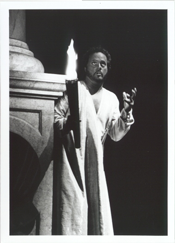
OONY Gives Rare Performance of Rossini's Otello
There are three reasons often cited for the paucity of performances of Rossini’s Otello: the horrible hack job of the Shakespearean drama by librettist Francesco Maria Berio, the difficulties in casting an opera requiring at least three top-rate tenor voices, and comparisons with Verdi’s popular opera of the same title.
Though these arguments hold much weight, they also have little
to do with Rossini’s expressive and thoroughly enjoyable score, as was evident in the Opera
Orchestra of New York’s concert performance of the work on Wednesday night at Carnegie Hall.
Shakespeare’s work was not as well-known in northern Italy at the time of the opera’s
composition, perhaps accounting for the free treatment that the story received. Berio’s retelling
of the classic tale makes such a mess of things that there is little left of the original drama but the
names of the characters. Lord Byron wrote of the opera in 1818: “They have been crucifying
Othello into an opera,” and in my mind he spoke the truth. Indeed, the story never leaves the
shores of Venice, the signal handkerchief becomes a furtive love letter, Desdemona is stabbed
rather than strangled, and Jago’s role in the drama is lessened while the peripheral Rodrigo
becomes integral.
Regardless, the work was hugely successful in the nineteenth century, its popularity lasting until
Verdi’s Otello overtook it in the operatic canon. I would posit that the inevitable association of
the two works is the principal reason that Rossini’s now lesser-known interpretation has fallen
into obscurity as much as it has. Comparisons inevitably paint the earlier in a bad light by virtue
of its much-maligned libretto.
Seen as the product of Rossini, the work is well worth its weight in gold. There are some truly
beautiful moments, though it admittedly lags a bit in the middle. The opening, for instance,
features not one, not two, not even three. . . but FOUR solo tenors singing their hearts out in one
of the most exciting moments of tenor multiplicity in the repertoire. The Act Two confrontation
between Otello and Rodrigo is also a moment of high drama, and Desdemona’s Willow Song is
as hauntingly beautiful as is the more widely-known Verdi version.
The night also belonged to the performers that realized the impossible and sublimely beautiful
bel canto score, for the work cannot stand on its own without talented virtuosos. In fact, this
opera has always been at the mercy of willing and able singers; an abundance of virtuosic tenors
in Naples precipitated the composition of myriad vocal fireworks for the tenor voice. The cast
was led by veteran Rossini interpreter Bruce Ford, a last-minute stand-in for Ramon Vargas.
Ford sang a lot of notes on Wednesday night, all with confidence and ease. Equally impressive
was Kenneth Tarver as Roderigo, whose lyricism and light touch complemented the role. His
high-lying aria, Ah, come mai non senti, was one of the best moments of the night. Solid too was
Robert McPherson as the villainous Jago. His voice was that much louder, harsher than his
colleagues’— well-suited for the antagonist. In the men’s camp it would be remiss not also to
mention Gaston Rivero as the Doge (and later as the Gondolier), the fourth component in the
opening.
The preponderance of tenors on the stage precludes any solo female voices for the first half hour
of the work. Furthermore, in a seemingly concerted effort to keep the tessitura of the ensemble
in the human voice’s middle range, the role of Desdemona is written for a mezzo. When we
finally meet Desdemona, she remains a peripheral character — there is no entrance aria for her,
nor is there ever a love duet. Ruxandra Donose nevertheless sang the role beautifully, and the
impassioned Willow Song was the crown jewel of the concert.
If there was a drawback to the performance, it would be that the orchestra was not prepared, and
perhaps more to the point, unenthused about the performance. It is eternally difficult to create
cohesiveness in an opera orchestra, especially one that performs together only a few times per
year. Still, the group was sloppier than most: brass instruments fracked, there was at least one
blatant wrong note, and entrances were not together. On the other hand, the members of the
orchestra performed solos beautifully. The virtuosic instrumental passages typical of Rossini
were right on, and harpist Grance Paradise, Desdemona’s partner in the Willow Song, was as
stunning in the aria as the mezzo.
So hats off to Eve Queler and the Opera Orchestra of New York, for performing such an
undervalued work. Queler has long been a champion of lesser-known opera, and her choice of
programming here was excellent. Carry on Ms. Queler!
Sarah Gerk