Recently in Performances
English Touring Opera are delighted to announce a season of lyric monodramas to tour nationally from October to December. The season features music for solo singer and piano by Argento, Britten, Tippett and Shostakovich with a bold and inventive approach to making opera during social distancing.
This tenth of ten Live from London concerts was in fact a recorded live performance from California. It was no less enjoyable for that, and it was also uplifting to learn that this wasn’t in fact the ‘last’ LfL event that we will be able to enjoy, courtesy of VOCES8 and their fellow vocal ensembles (more below …).
Ever since Wigmore Hall announced their superb series of autumn concerts, all streamed live and available free of charge, I’d been looking forward to this song recital by Ian Bostridge and Imogen Cooper.
Although Stile Antico’s programme article for their Live from London recital introduced their selection from the many treasures of the English Renaissance in the context of the theological debates and upheavals of the Tudor and Elizabethan years, their performance was more evocative of private chamber music than of public liturgy.
Evidently, face masks don’t stifle appreciative “Bravo!”s. And, reducing audience numbers doesn’t lower the volume of such acclamations. For, the audience at Wigmore Hall gave soprano Elizabeth Llewellyn and pianist Simon Lepper a greatly deserved warm reception and hearty response following this lunchtime recital of late-Romantic song.
For this week’s Live from London vocal recital we moved from the home of VOCES8, St Anne and St Agnes in the City of London, to Kings Place, where The Sixteen - who have been associate artists at the venue for some time - presented a programme of music and words bound together by the theme of ‘reflection’.
'Such is your divine Disposation that both you excellently understand, and royally entertaine the Exercise of Musicke.’
‘And there was war in heaven: Michael and his angels fought against the dragon; and the dragon fought and his angels, And prevailed not; neither was their place found any more in heaven … that old serpent … Satan, which deceiveth the whole world: he was cast out into the earth, and his angels were cast out with him.’
There was never any doubt that the fifth of the twelve Met Stars Live in Concert broadcasts was going to be a palpably intense and vivid event, as well as a musically stunning and theatrically enervating experience.
‘Love’ was the theme for this Live from London performance by Apollo5. Given the complexity and diversity of that human emotion, and Apollo5’s reputation for versatility and diverse repertoire, ranging from Renaissance choral music to jazz, from contemporary classical works to popular song, it was no surprise that their programme spanned 500 years and several musical styles.
The Academy of St Martin in the Fields have titled their autumn series of eight concerts - which are taking place at 5pm and 7.30pm on two Saturdays each month at their home venue in Trafalgar Square, and being filmed for streaming the following Thursday - ‘re:connect’.
The London Symphony Orchestra opened their Autumn 2020 season with a homage to Oliver Knussen, who died at the age of 66 in July 2018. The programme traced a national musical lineage through the twentieth century, from Britten to Knussen, on to Mark-Anthony Turnage, and entwining the LSO and Rattle too.
With the Live from London digital vocal festival entering the second half of the series, the festival’s host, VOCES8, returned to their home at St Annes and St Agnes in the City of London to present a sequence of ‘Choral Dances’ - vocal music inspired by dance, embracing diverse genres from the Renaissance madrigal to swing jazz.
Just a few unison string wriggles from the opening of Mozart’s overture to Le nozze di Figaro are enough to make any opera-lover perch on the edge of their seat, in excited anticipation of the drama in music to come, so there could be no other curtain-raiser for this Gala Concert at the Royal Opera House, the latest instalment from ‘their House’ to ‘our houses’.
"Before the ending of the day, creator of all things, we pray that, with your accustomed mercy, you may watch over us."
The doors at The Metropolitan Opera will not open to live audiences until 2021 at the earliest, and the likelihood of normal operatic life resuming in cities around the world looks but a distant dream at present. But, while we may not be invited from our homes into the opera house for some time yet, with its free daily screenings of past productions and its pay-per-view Met Stars Live in Concert series, the Met continues to bring opera into our homes.
Music-making at this year’s Grange Festival Opera may have fallen silent in June and July, but the country house and extensive grounds of The Grange provided an ideal setting for a weekend of twelve specially conceived ‘promenade’ performances encompassing music and dance.
There’s a “slide of harmony” and “all the bones leave your body at that moment and you collapse to the floor, it’s so extraordinary.”
“Music for a while, shall all your cares beguile.”
The hum of bees rising from myriad scented blooms; gentle strains of birdsong; the cheerful chatter of picnickers beside a still lake; decorous thwacks of leather on willow; song and music floating through the warm evening air.
Performances
28 Jan 2007
ROSSINI: Il Viaggio a Reims
Rossini’s last Italian opera, staged in 1825 as a part of Charles X’s coronation festivities, is a bizarre creation — a sassy little farce capped with a coronation cantata in the best traditions of staged court entertainment, from 16th-century Italian intermedi through their Baroque and Classic operatic progeny.
This production, a combined effort of the Kirov Opera and Théâtre du
Châtelet, was premiered in 2005, and has made its way to the Kennedy Center in Washington DC
as a part of the Kirov’s residency here, now in its fifth year.
Minimal staging (sets by Pierre-Alain Bertola) strips the “Golden Lily Hotel” to its scaffolding,
revealing the opera for what it truly is — a collection of sparkling vignettes with hardly a
semblance of a plot; a glorious divertimento; a concert in costumes — but what fabulous
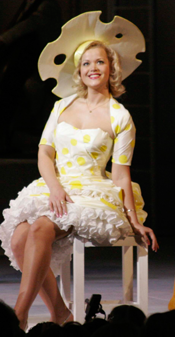
costumes! Among costume designer Mireille Dessigy’s creations, not to be missed are the
Contessa de Folleville’s outrageous hats and Corinna’s ancient regime version of fuzzy slippers.
The Russian general’s garb complete with a sailor’s tunic and a white horse (yes, an actual —
and impressively well-behaved — animal) is hilarious. As for Corinna’s entrance costume,
capped with a fantastic feather turban and illuminated from within by flashing electric lights, it is
beyond description, and would surely land some Hollywood star enterprising enough to steal it a
place on the “worst dressed, yet most memorable” red carpet list. The “English golf dandy” outfit
of Chevalier Belfiore, on the other hand, was funny but not particularly convincing.
The Kirov’s performance started well before the opera began, with the orchestra players (with
their instruments) and singers (with their luggage) making their way to the “hotel” from the
auditorium, greeting the audience in two languages (none of them Italian), and then negotiating
stage space with the “cleaning crew,” mops and vacuums in hand. The conductor — maestro
Gergiev himself — did not carry a suitcase, was relieved of his coat by one of the choristers, but
would keep his hat on throughout the evening. Both the conductor and the orchestra (dressed in
white and reduced almost to a chamber group for the occasion) were positioned on stage, with a
harpsichordist placed on the proscenium and dressed up in full ancient regime regalia, complete
with high heels and a powdered wig. Similarly dressed was a harpist wheeled onto the stage on a
special platform whenever her services were required to accompany Corinna the poetess (the
lovely Irma Gigolashvili); and a fabulous flutist (unfortunately not identified in the program) who
performed her second act solo flawlessly, all the while engaged in a clever pantomimed “duet”
with Lord Sydney (Eduard Tsanga).
Throughout, the production (directed by Alain Maratrat) was filled with stage business — always
energetic, often clever, and occasionally detrimental to sound production: for instance, practically
nothing performed on the back section of the scaffolding (behind the orchestra) made it into the
hall. On the other hand, plenty of singing (and some very funny acting) occurred in the orchestra
— among the orchestra seats, that is. This clearly delighted the audience but presented a
significant challenge to ensemble performance — a challenge that the young troupe, to their
credit, met and triumphed over, even in the lightning-fast stretti. Overall, the vocal performance
of the young cast, including some tremendously difficult passagework, was almost uniformly
superior: Anastasia Kalagina as Madame Cortese impressed with the precision of her coloratura;
Larisa Yudina as the Contessa proved herself a comic talent, yet was ever ready with those
breathtaking E-flats. Dmitry Voropaev as Belfiore, Daniil Shtoda as Count di Libenskoff,
Vladislav Uspensky as Baron di Trombonoc, and particularly Nikolay Kamensky as basso buffo
Don Profondo were all excellent. Anna Kiknadze as Melibea was less impressive, but she did
occasionally enjoy her moments of glory (unfortunately, the final polonaise was not one of those
moments). Only Alexey Safiulin as Don Alvaro was truly disappointing: he did well in the
ensembles, but the solos — including the gorgeous “fake flamenco” song Rossini had smuggled
into the grand finale — were almost entirely lost. The chorus — members of the Mariinsky
Academy of Young Singers — acted lustily and sang well; the orchestra sound was clean, crisp,
and tastefully “classic” — in fact, barely recognizable as coming from an orchestra better known
for the sweeping romantic sound of its Tchaikovsky and Wagner productions.
Grand drama devotees might find Il Viaggio a Reims annoyingly fluffy. Opera purists could
object to the coloratura occasionally getting lost in the stage business or covered with the
audience’s laughter. Yet, to those who think of opera as primarily a theatrical spectacle, the
Kirov production proves deliciously watchable. It is just what King Charles X of France had
ordered from his favorite composer — a splendid and frivolous piece of entertainment for a very
special occasion.
Olga Haldey