13 Feb 2007
Dust-bowl opera overwhelming at Minnesota premiere
The great American opera? Ricky Ian Gordon’s “Grapes of Wrath” might be it.
English Touring Opera are delighted to announce a season of lyric monodramas to tour nationally from October to December. The season features music for solo singer and piano by Argento, Britten, Tippett and Shostakovich with a bold and inventive approach to making opera during social distancing.
This tenth of ten Live from London concerts was in fact a recorded live performance from California. It was no less enjoyable for that, and it was also uplifting to learn that this wasn’t in fact the ‘last’ LfL event that we will be able to enjoy, courtesy of VOCES8 and their fellow vocal ensembles (more below …).
Ever since Wigmore Hall announced their superb series of autumn concerts, all streamed live and available free of charge, I’d been looking forward to this song recital by Ian Bostridge and Imogen Cooper.
Although Stile Antico’s programme article for their Live from London recital introduced their selection from the many treasures of the English Renaissance in the context of the theological debates and upheavals of the Tudor and Elizabethan years, their performance was more evocative of private chamber music than of public liturgy.
Evidently, face masks don’t stifle appreciative “Bravo!”s. And, reducing audience numbers doesn’t lower the volume of such acclamations. For, the audience at Wigmore Hall gave soprano Elizabeth Llewellyn and pianist Simon Lepper a greatly deserved warm reception and hearty response following this lunchtime recital of late-Romantic song.
For this week’s Live from London vocal recital we moved from the home of VOCES8, St Anne and St Agnes in the City of London, to Kings Place, where The Sixteen - who have been associate artists at the venue for some time - presented a programme of music and words bound together by the theme of ‘reflection’.
'Such is your divine Disposation that both you excellently understand, and royally entertaine the Exercise of Musicke.’
‘And there was war in heaven: Michael and his angels fought against the dragon; and the dragon fought and his angels, And prevailed not; neither was their place found any more in heaven … that old serpent … Satan, which deceiveth the whole world: he was cast out into the earth, and his angels were cast out with him.’
There was never any doubt that the fifth of the twelve Met Stars Live in Concert broadcasts was going to be a palpably intense and vivid event, as well as a musically stunning and theatrically enervating experience.
‘Love’ was the theme for this Live from London performance by Apollo5. Given the complexity and diversity of that human emotion, and Apollo5’s reputation for versatility and diverse repertoire, ranging from Renaissance choral music to jazz, from contemporary classical works to popular song, it was no surprise that their programme spanned 500 years and several musical styles.
The Academy of St Martin in the Fields have titled their autumn series of eight concerts - which are taking place at 5pm and 7.30pm on two Saturdays each month at their home venue in Trafalgar Square, and being filmed for streaming the following Thursday - ‘re:connect’.
The London Symphony Orchestra opened their Autumn 2020 season with a homage to Oliver Knussen, who died at the age of 66 in July 2018. The programme traced a national musical lineage through the twentieth century, from Britten to Knussen, on to Mark-Anthony Turnage, and entwining the LSO and Rattle too.
With the Live from London digital vocal festival entering the second half of the series, the festival’s host, VOCES8, returned to their home at St Annes and St Agnes in the City of London to present a sequence of ‘Choral Dances’ - vocal music inspired by dance, embracing diverse genres from the Renaissance madrigal to swing jazz.
Just a few unison string wriggles from the opening of Mozart’s overture to Le nozze di Figaro are enough to make any opera-lover perch on the edge of their seat, in excited anticipation of the drama in music to come, so there could be no other curtain-raiser for this Gala Concert at the Royal Opera House, the latest instalment from ‘their House’ to ‘our houses’.
"Before the ending of the day, creator of all things, we pray that, with your accustomed mercy, you may watch over us."
The doors at The Metropolitan Opera will not open to live audiences until 2021 at the earliest, and the likelihood of normal operatic life resuming in cities around the world looks but a distant dream at present. But, while we may not be invited from our homes into the opera house for some time yet, with its free daily screenings of past productions and its pay-per-view Met Stars Live in Concert series, the Met continues to bring opera into our homes.
Music-making at this year’s Grange Festival Opera may have fallen silent in June and July, but the country house and extensive grounds of The Grange provided an ideal setting for a weekend of twelve specially conceived ‘promenade’ performances encompassing music and dance.
There’s a “slide of harmony” and “all the bones leave your body at that moment and you collapse to the floor, it’s so extraordinary.”
“Music for a while, shall all your cares beguile.”
The hum of bees rising from myriad scented blooms; gentle strains of birdsong; the cheerful chatter of picnickers beside a still lake; decorous thwacks of leather on willow; song and music floating through the warm evening air.
The great American opera? Ricky Ian Gordon’s “Grapes of Wrath” might be it.
Although opera buffs were sufficiently curious to sell out all five performances of the work premiered by Minnesota Opera on February 10, they nonetheless found it difficult to imagine John Steinbeck’s account of the exodus from the Oklahoma Dust Bowl as an opera.
The 1939 novel seemed too long, too complex and too freighted with despair for such transformation. And doubts were enhanced by reports that identified Gordon with Broadway and Sondheim.
Wasn’t this a task for a heavy-weight composer?
But during rehearsals of “GOW” at St. Paul’s Ordway Center for the Performing Arts, word got around that Brian Leerhuber, Tom Joad in the huge cast, had called the new opera “Verdi on steroids.”
And at the premiere that assessment was wondrously born out by Gordon’s amazing and unusual score, for “GOW” — the composer’s first large-scale work — is of monumental dimensions. With two intermissions it runs over 4 hours, and it calls for 13 principal singers, plus 50 featured roles, several sung by one vocalist.
In three acts divided into 33 scenes, “GOW” is of epic sweep and of a mesmerizing grandeur that makes the audience participants in the Joads’ flight from Oklahoma to California in the depth of the Great Depression.
“GOW” is the product of a collective of gifted artists assembled by MO artistic director Dale Johnson. Librettist Michael Korie has stripped down Steinbeck’s 600 pages to a lean and singable text in verse that only occasionally rhymes and retains the speech patterns of the Okies.
Stage director and dramaturg Eric Simonson, a member of Chicago’s Steppenwolf Theatre for 20 years, has directed, adapted and acted in numerous plays, including Frank Galati’s stage version of “Grapes of Wrath,” in which he played eight minor roles in the production seen both in London and Chicago.
“I was in on the opera from the start,” says Simonson, who recalls “batting around ideas” with Johnson back in 1996. And, working closely with Gordon and Korie, he was a “hands-on” participant in “GOW” as a work in progress.
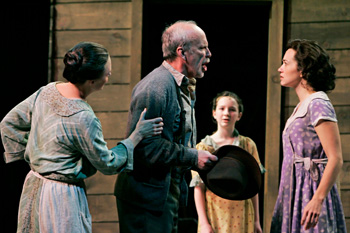 “Others had sought permission to make an opera of the novel from the Steinbeck estate,” he says,
“but we were the first to whom it was granted.”
“Others had sought permission to make an opera of the novel from the Steinbeck estate,” he says,
“but we were the first to whom it was granted.”
“It was then a matter of whittling the book down to a manageable libretto. We decided to focus on Tom Joad and his mother.”
“Once that decision was made, everything fell into place. Everything else was unessential.”
For the sets - a steel catwalk frames the stage - designer Allen Moyer sought inspiration in Walker Evans’ photographic documentation of the Depression. Projections on the back wall of the stage - sometimes black and white, sometimes motion picture excerpts - add to the dramatic impact of the staging.
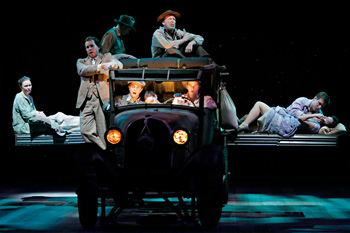 Costumes are the work of Kärin Kopischke; choreographer Doug Varone has added animation to
the action.
Costumes are the work of Kärin Kopischke; choreographer Doug Varone has added animation to
the action.
Early on the creative crew considered making “GOW” an American “Ring” running over several evenings; the idea, however, was abandoned
And although there will be demands that the opera be “shrunk,” it is now the length that the story demands.
The score - without recitative - is song based and many scenes flow easily into the next. Gordon points to models in “Porgy and Bess,” “Street Scene,” “Showboat” and Sondheim, but he has gone beyond them in a score that is original and completely his.
One recognizes, to be sure, art songs, musical comedy, jazz, traditional blues and other references to the music of the time of the novel, but the composer has assimilated these influences and washed over them with a style essentially contemporary.
“I want the opera to be a powerful evocation of Steinbeck’s story,” Gordon says in an essay written for the premiere, “a story about great flat distances, wide open spaces, vast silences filled with doubt, fear and hope, with pain and loss and ultimately with compassion and human kindness.
“The wide-open spaces of Copland are in it — filtered through me.”
About the score Leerhuber says that Gordon “gives us lines to sing that soar and tunes that are immediate in their expressive outpouring; it is emotionally gripping music that moves you.”
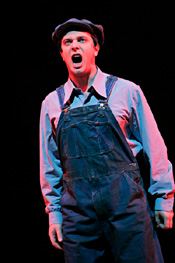
The mammoth cast is without a weak link. Leerhuber - happily free of references to Henry Fonda’s 1940 movie portrayal, is a strong and sensitive Tom Joad, the son who hopes to help his mother — mezzo Deanne Meek — hold the family together.
Tenor Roger Honeywell is lapsed preacher Jim Casy, and baritone Andrew Wilkowske is moving as retarded son Noah, whose suicide by drowning is expanded from the novel to conclude Act Two.
A gem of the score is baritone Robert Orth’s funereal “Little Dead Moses,” with which he angry — but tenderly — sets Rosasharn’s still-born baby afloat on the river.
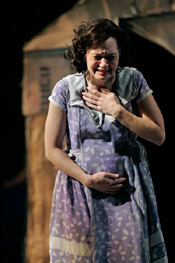
Yet it is Kelly Kaduce who tops her many colleagues as downtrodden adolescent Rosasharn (Rose of Sharon). As in the novel — something beyond Hollywood in 1940 — she offers her breast to a starving man and then sings the concluding “One Star,” which “like a candle in a dust storm” will one day “fill the sky with silver sparkles.”
Thus — despite the darkness and overt tragedy of their story — Gordon and Korie lower the curtain with hope.
“GOW,” in sum, is not about the Okies; it is the Okies, these “tumbleweeds on the road to nowhere,” as Korie says, confronted head on. Their story is not told; it is lived out with compelling immediacy before the eyes of the audience, who make the journey with them.
And this it is that places “GOW” in the company of Janáček and Shostakovich’s “Lady Macbeth.”
Almost a century after Mahler’s quintessential score, Gordon and Korie have created a new — and American — song of the earth.
Tom Joad sums it all up at the conclusion of Act Two:
This red land — is us.
All its hardship — is us.
And the flood years.
And the drought years.
And the dust years — all us.
Till we find a place to live,
A home for us to stay,
Our home is here we are,
‘cause us — is USA.
“It’s the story of a disenfranchised people,” says Brian Leerhuber. “And Americans today are struggling with very similar issues of physical and emotional displacement, trying to figure out what the American dream is all about.”
“Grapes of Wrath,” a co-commission of Minnesota Opera and Utah Symphony & Opera, will be on staged in Salt Lake City in May. It will be seen later at Pittsburgh Opera and Houston Grand Opera. Tulsa Opera was considering the work to mark the centennial of Oklahoma statehood in 2007; however, the company’s board of directors, wishing to distance itself from the theme of Okies and the Dust Bowl, vetoed the idea.
Footnote: Since apocalyptic thinking is vogue in certain circles today, it is recalled that Steinbeck’s title comes from the Book of Revelations, Chapter 14, where — in anticipation of the Apocalypse — the grapes in question are pressed.
Ricky Ian Gordon’s latest compact disc is “Orpehus & Euridice,” a song cycle on the world’s oldest love story, premiered on the American Songbook and New Visions series in 2005. Commissioned by Lincoln Center for the Performing Arts, the Ghostlight Records release features soprano Elizabeth Futral, clarinetist Todd Palmer and pianist Melvin Chen.
Wes Blomster