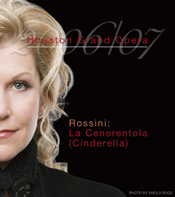
Indeed, this is Rossini of a higher order, no doubt the highlight of the season here and a triumph
for Anthony Freud in his first full year as HGO general director.
The unusually engaging production is the work of Comediants, a Barcelona-based collective of
actors, musicians and artists who draw inspiration from symbols, myths and rituals. And Joan Font, who founded the troupe in 1971, defines the
HGO staging as “a comic book of colored cartoons that captures the happiness in Rossini’s
music.
As director he has been assisted by colleagues Joan J. Guillén, set and
costume design, Xevi Dorca, choreography, and Albert Faura, lighting.
And it is Faura who is responsible for much of the magic of the production, for it is on his
lighting that everything depends. Props are minimal, while a single back wall changes color
continually to complement — and underscore — the action before it.
To call this staging “colorful” is an understatement.
Nasty stepsisters Clorinda (Tamara Wilson) and Tisbe (Catherine Cook) appear first in their
underwear, augmented by large bolsters around hips which, when they dress for the ball, hold up
the wide skirts of their period court dresses. Their wigs are — like their multi-colored costumes -
outrageous mimics of the most frivolous late 18th century royal hairstyles — vertical mounds of
pink and blond, topped with minuscule feathered hats. The members of the large male chorus -
their wigs are appropriately “royal” blue — wear flared pimento- colored jackets with swags of
orange and light colors that make a frolic of their cleverly choreographed movements.
A stroke of special genius is the silent “chorus” of six man-size mice on stage throughout the
performance. Amusingly choreographed by Dorca, they are often heart breaking in their
sympathy for Angelina. They further serve as stage hands.
This creative team faces up fully to the strange set of contradictions that “Cenerentola” is. For it
is indeed a comic opera, the classic perhaps of the genre, Four of its seven characters are
caricatures, good for laughs in everything they do. But does this make the work first and
foremost comic?
Valet Dandini (Earle Petriarcha) has his lighter side, but — wise in the ways of the world — he is
the devoted servant of his prince and dedicated to a no-nonsense search for the right woman.
And at the very heart of the work is Alidoro (Nikolai Didenko), the aged tutor who has instilled
values good as gold in his student Don Ramiro (Lawrence Brownlee). Like the wandering Wotan
in “Siegfried,” he enters in disguise to gain a valid assessment of Don Magnifico’s family. He is
horrified at what he sees, and yet — like Sarastro in “The Magic Flute” — he must let matters run
their course; he can guide — but not force — the prince toward his goals.
Alidoro — especially when dressed, as he is here, as a man in tune with the planets — is the magus,
the Prospero, if one will, who above and beyond the delightful fluff of “Cinderella” affirms that
Rossini — like Mozart — was a child of the Enlightenment, aware of injustice and determined to
overcome it. He — when sung so superbly as he is by Russian bass Nikolai Didenko — gives the
opera an uncanny weight, and his parting summary of what is gold and what is dross in life
touches the heart and makes this staging — in addition to the unabashed fun that it is — deeply
moving.
In the title role Houston has brought back one of its very own, Joyce DiDonato, a studio alumna
who has made Angelina her signature role.
The soprano is loveliness and grace incarnate, beautiful both in voice and appearance. She
handles Rossini’s acrobatics without effort and plays the abused young woman with dignity.
“It’s a role that’s been very good to me,” DiDonato said of Angelina in a telephone interview
shortly before opening night of the production. “I first sang it while in the Merola studio program
at the San Francisco Opera.
“It’s dear to my heart and fits my voice like the proverbial glove.”
An alumni also of the HGO studio, where she created Meg in Mark Adamo’s “Little Women” in
1998, she has sung Angelina it both at Milan’s La Scala and the Garnier in Paris.
“It not just about patter, and it’s more than fireworks,” the Kansas-born soprano says. “Angelina
is a real woman with a real heartbeat and a strong dose of humanity.”
Turning to the affinity that she feels for the role, she focuses on her opening duet with the
disguised prince.
“It’s not exactly a love duet,” she says, “but it’s very touching. “In it she expresses everything she
has been through.
“It’s a magical moment.”
Last summer at the Santa Fe Opera DiDonato donned trousers to sing Prince Charming in
“Cendrillon,” Massenet’s version of the Cinderella story, an enriching experience that leaves her
with the feelings of a vocalist who has sung both Tristan and Isolde.
“That opera was a bit of a surprise for me,” she says. “But it was a real treat to discover it. I
enjoyed Massenet’s approach to the story, and the score contains some of the most beautiful
music I’ve ever sung.”
DiDonato is delighted with what the Comediants have wrought in Houston.
“It’s unique,” she says of the staging. “It’s completely fresh, colorful and clean, yet the story is
told in a traditional way.
“This creative team is theater based, but they know their music. Their instincts are astonishing.”
And DiDonato is impressed by the ease with which Comediants bring the light and dark sides of
the story together.
“They make is all happen so naturally,” she says.
This same naturalness comes through in the conducting of senior Italian master Edoardo Müller,
who understand that Rossini was writing champagne music long before
Lawrence Welk turned on the bubble machine.
`He makes the score crisp and clear, transparent and effervescent.
The Houston cast is without a weak link. The singers too — following the example of the stellar
production team — have made this a collective collaboration.
And they’re obviously having the time of their lives. On January 27 — opening night — their joy
carried over to the audience, whose “bravos” were as spontaneous as enthusiastic.
In June Joyce DiDonato is back in trousers for her role debut as Octavian in Richard Strauss’
“Rosenkavalier” at the San Francisco Opera.
Wes Blomster