Recently in Performances
English Touring Opera are delighted to announce a season of lyric monodramas to tour nationally from October to December. The season features music for solo singer and piano by Argento, Britten, Tippett and Shostakovich with a bold and inventive approach to making opera during social distancing.
This tenth of ten Live from London concerts was in fact a recorded live performance from California. It was no less enjoyable for that, and it was also uplifting to learn that this wasn’t in fact the ‘last’ LfL event that we will be able to enjoy, courtesy of VOCES8 and their fellow vocal ensembles (more below …).
Ever since Wigmore Hall announced their superb series of autumn concerts, all streamed live and available free of charge, I’d been looking forward to this song recital by Ian Bostridge and Imogen Cooper.
Although Stile Antico’s programme article for their Live from London recital introduced their selection from the many treasures of the English Renaissance in the context of the theological debates and upheavals of the Tudor and Elizabethan years, their performance was more evocative of private chamber music than of public liturgy.
Evidently, face masks don’t stifle appreciative “Bravo!”s. And, reducing audience numbers doesn’t lower the volume of such acclamations. For, the audience at Wigmore Hall gave soprano Elizabeth Llewellyn and pianist Simon Lepper a greatly deserved warm reception and hearty response following this lunchtime recital of late-Romantic song.
For this week’s Live from London vocal recital we moved from the home of VOCES8, St Anne and St Agnes in the City of London, to Kings Place, where The Sixteen - who have been associate artists at the venue for some time - presented a programme of music and words bound together by the theme of ‘reflection’.
'Such is your divine Disposation that both you excellently understand, and royally entertaine the Exercise of Musicke.’
‘And there was war in heaven: Michael and his angels fought against the dragon; and the dragon fought and his angels, And prevailed not; neither was their place found any more in heaven … that old serpent … Satan, which deceiveth the whole world: he was cast out into the earth, and his angels were cast out with him.’
There was never any doubt that the fifth of the twelve Met Stars Live in Concert broadcasts was going to be a palpably intense and vivid event, as well as a musically stunning and theatrically enervating experience.
‘Love’ was the theme for this Live from London performance by Apollo5. Given the complexity and diversity of that human emotion, and Apollo5’s reputation for versatility and diverse repertoire, ranging from Renaissance choral music to jazz, from contemporary classical works to popular song, it was no surprise that their programme spanned 500 years and several musical styles.
The Academy of St Martin in the Fields have titled their autumn series of eight concerts - which are taking place at 5pm and 7.30pm on two Saturdays each month at their home venue in Trafalgar Square, and being filmed for streaming the following Thursday - ‘re:connect’.
The London Symphony Orchestra opened their Autumn 2020 season with a homage to Oliver Knussen, who died at the age of 66 in July 2018. The programme traced a national musical lineage through the twentieth century, from Britten to Knussen, on to Mark-Anthony Turnage, and entwining the LSO and Rattle too.
With the Live from London digital vocal festival entering the second half of the series, the festival’s host, VOCES8, returned to their home at St Annes and St Agnes in the City of London to present a sequence of ‘Choral Dances’ - vocal music inspired by dance, embracing diverse genres from the Renaissance madrigal to swing jazz.
Just a few unison string wriggles from the opening of Mozart’s overture to Le nozze di Figaro are enough to make any opera-lover perch on the edge of their seat, in excited anticipation of the drama in music to come, so there could be no other curtain-raiser for this Gala Concert at the Royal Opera House, the latest instalment from ‘their House’ to ‘our houses’.
"Before the ending of the day, creator of all things, we pray that, with your accustomed mercy, you may watch over us."
The doors at The Metropolitan Opera will not open to live audiences until 2021 at the earliest, and the likelihood of normal operatic life resuming in cities around the world looks but a distant dream at present. But, while we may not be invited from our homes into the opera house for some time yet, with its free daily screenings of past productions and its pay-per-view Met Stars Live in Concert series, the Met continues to bring opera into our homes.
Music-making at this year’s Grange Festival Opera may have fallen silent in June and July, but the country house and extensive grounds of The Grange provided an ideal setting for a weekend of twelve specially conceived ‘promenade’ performances encompassing music and dance.
There’s a “slide of harmony” and “all the bones leave your body at that moment and you collapse to the floor, it’s so extraordinary.”
“Music for a while, shall all your cares beguile.”
The hum of bees rising from myriad scented blooms; gentle strains of birdsong; the cheerful chatter of picnickers beside a still lake; decorous thwacks of leather on willow; song and music floating through the warm evening air.
Performances
28 Feb 2007
La Bohème – English National Opera
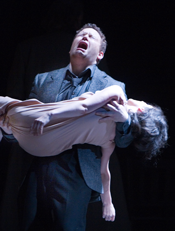
The death this month of director Stephen Pimlott could have cast a shadow over this revival of his 1993 production, but a hugely affectionate pre-show tribute by colleague Nicholas Hytner ensured that the performance only served to do great honour to the memory of a man who was clearly loved and cherished by many.
The first night of this revival, directed by Ian Rutherford, did the late director proud. Following a
triumph in the role on Glyndebourne’s 2005 tour, Peter Auty’s Rodolfo was physically and
vocally full of youthful ardour, while as Mimì, Mary Plazas combined the looks of a china doll
with the vocal warmth and personality of a flesh-and-blood young woman. 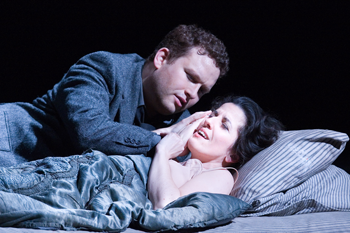 Mark Stone’s
Marcello was masculine and glamorous, with every word projected clearly; there was real
passion in the ‘big moment’ when he takes up the melody in Musetta’s aria. Giselle Allen’s
portrayal of Musetta was quite remarkable, a young woman full of promise brought to her knees
by miserable poverty, and the exceptional bass Matthew Rose made much of his role as Colline,
creating a moment of stillness and awe with his Act 4 aria.
Mark Stone’s
Marcello was masculine and glamorous, with every word projected clearly; there was real
passion in the ‘big moment’ when he takes up the melody in Musetta’s aria. Giselle Allen’s
portrayal of Musetta was quite remarkable, a young woman full of promise brought to her knees
by miserable poverty, and the exceptional bass Matthew Rose made much of his role as Colline,
creating a moment of stillness and awe with his Act 4 aria.
Musically the performance was not entirely successful. Conductor Xian Zhang had a mixed
evening with tempi which were at times so measured that they almost ground to a halt, but
seemed to have a particular affinity with Plazas in her arias, and as the tragedy reached its
conclusion, grew in expressive breadth. A balance problem between pit and stage in the first act
caused whole passages of solo singing to become inaudible, but this was seemingly addressed in
due course as the issue was no longer apparent after the interval.
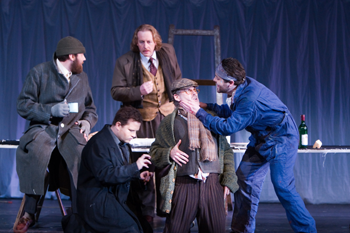
However on stage there was diligent attention to detail; a piece of luxury casting found Robert
Poulton singing the dual roles of Benoit and Alcindoro, which he contrasted with two very
different styles of seediness. The crowded stage of Act 2 felt like a genuine public gathering,
with a particularly convincing children’s chorus; the simultaneous duets of Act 3 were
well-defined and audible alongside one another. A few minor anomalies in the production’s
updating to the mid-20th century can be forgiven in the overall scheme of a staging which
continues to feel immediate and ‘real’.
 One would hope – and expect – that Pimlott would have been well pleased with this touching and
credible realisation of his enduringly popular production.
One would hope – and expect – that Pimlott would have been well pleased with this touching and
credible realisation of his enduringly popular production.
Ruth Elleson, February 26th 2007