Recently in Recordings
The Gran Teatre del Liceu in Barcelona, after suffering a calamitous fire in the early 1990s, reopened in 1999, lovingly restored. TDK has released a series of DVDs from the Liceu since that date, providing ample evidence of the world...
Premiered posthumously, the symphonic song-cycle Das Lied von der Erde by Gustav Mahler (1860-1911) remains one of his defining works because of its synthesis of song and symphony, two genres he pursued throughout his career.
In 1851 during his first season as music director in Düsseldorf, Robert Schumann presented a performance of Bach’s St. John Passion, and unsurprisingly adapted the score both to nineteenth-century taste and nineteenth-century practicalities.
The centrality of dance at the French court helped bring grace, order, and political allegory into the characteristic prominence they enjoyed during the reigns of Louis XIV and Louis XV; theatre presentations of all stripes were infused with choreographic diversions.
In tandem with the recently released set of Sir Simon Rattle’s recordings of Mahler’s symphonies on EMI Classics, the set of the complete symphonies by Jean Sibelius merits attention.
As much as Richard Wagner espoused opera reform in his theoretical writings by bringing to his works for the stage a closer unity between music and text, his actual means of doing so at times involved the use of orchestral forces that sometimes overwhelmed the sung word.
The budget label Gala purveys live performances both historic and relatively recent; of the three discussed here, the La Scala Fedora dates back to 1931, while the Attila comes from a 1987 La Fenice performance.
National styles of music in the seventeenth century were often distinctive, and in the case of French and Italian music, famously so.
With its recent release of Mahler’s symphonies conducted by Sir Simon Rattle, EMI Classics makes available in a single place an outstanding contribution to the composer’s discography.
This DVD records and commemorates a 1981 production of Parsifal in its Bayreuth lair, and the singers of 1981 are as fine as recollection might paint them.
Once the custom of the world's opera houses was to translate great operas into the language of each respective country.
Repackaging older recordings having become the primary focus of a classical recording company's business, Deutsche Grammophon budgeted some funds for art direction for its budget series called "Opera House" (although that appellation only appears in a link found on the back inside cover of the sets' booklets).
Of Rosenkavaliers on DVD, the classics tend to be lovingly detailed productions, going back to the film of Herbert von Karajan leading an exemplary cast, with Elizabeth Schwarzkopf's iconic Marschallin.
Despite an unsurprising degree of conservatism in liturgical music, devotional life in Rome often found ways of taking advantage of modern musical style.
“Her fioritura is priceless, breathtaking, and effortless.”
The English composer Nicholas Maw has been a major voice since the 1960's, with a wide range of works that include the 2002 opera, "Sophie’s Choice," a violin concerto for Joshua Bell (1993), and the monumentally-scaled orchestral work, "Odyssey" (1972-87).
As is often the case, last works that remain incomplete at the time of a composer’s death, are quick to invoke controversy and conspiracy theories.
This is a valuable new recording of a work that is only rarely heard, but was widely influential and wildly popular during the eighteenth century. Philosophe Jean-Jacques Rousseau wrote both the libretto and the music, with mixed success.
This disc is well worth the price for the first track alone: the opening measures of Jean-Féry Rebel’s “Cahos,” (Chaos), written in 1737 or 1738, may cause you to wonder if you accidentally left a Stockhausen or Ligeti disc in the changer.
This recording made half a century ago will not be anyone’s first choice unless one is a die-hard fan of one of the principal singers; neither of them belonging to the absolute top in their profession.
Recordings
27 Feb 2007
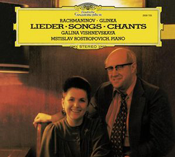
Rachmaninov and Glinka: Lieder • Songs • Chants
Originally released by Deutsche Grammophon in 1976, this recording of selected songs by Sergei
Rachmaninov (1873-1943) and Mikhail Glinka (1804-57) make available some fine examples of
Russian art song to Western audiences.
At that time the voice of Galina Vishnevskaya was known in
the West, notably in the famous recording of Benjamin Britten’s War Requiem. Yet this release shows
Vishnevskaya in her native mileu, with works that are quintessentially Russian, albeit separated by
seventy years, from the earliest songs by Glink to the latest ones by Rachmaninov.
At the mention of Russian art song, aural images of several pieces by Tchaikovsky or Mussorgsky
emerge, but the repertoire is much richer than that, with a tradition that antedates both composers and
extends beyond them. The famous “Vocalise” of Rachmaninov (op. 34, no. 14) is known in various
settings, and Vishnevskaya’s performance on this recording is a solid one that shows her burnished
timbre and elegant lyricism. This work brings to mind the modal inflections that are stylistically present in
the art songs of a number of Russian composers, albeit to varying degrees of emphasis. With the five
selections by Rachmaninov chosen for this recording, such modality supports the long melodic lines that
reinforce the texts. While Pushkin may be the most familiar of the poets for these selections, the other
verses show Rachmaninov’s sensitivity to texts that he found meaningful. “Ne poi, krassavica” op. 4,
no. 4 (translated here as “Oh, never sing to me again”) is a fine example of the kind of art song that
Rachmaninov pursued and which Vishnevskaya delivers well.
Yet the music of the earlier generation of Russian composers is not without interest, and the art songs of
Glinka call attention to the fine vocal music he composed. While Western audiences may know him for
the overture to Russlan and Ludmilla, the vocal writing in that opera and other works shows his
sensitivity to the declamation of Russian texts and an expressive line that transcends the literal texts. The
“Barkarola” (with an anonymous text) translates the Western form to a Russian and vocal idiom. In
another, “K nej,” (“To her”) Glinka sets the poetry of Polish writer Adam Mickiewicz, whose works
influenced others, including Gustav Mahler. While some of Glinka’s songs are relatively short, some of
the more sustained pieces, like “Somnenie” (translated here as “Doubt”) convey the sense of a dramatic
moment that a signer like Vishnevskaya can project well in live performances and also in recordings like
this. The eight selections of Glinka’s songs are well chosen, and the performances are convincing. With
a singer like Vishnevskaya accompanied by such a fine pianist as Mstislav Rostropovich, this recital of
Russian song (total duration, about forty-five minutes), not only captures the national style, but also the
intrinsically musical qualities of the music these performers chose to preserve in this recording.
Not previously released on CD, this recording was reissued to commemorate Vishnevskaya’s eightieth
birthday. The CD is a fine transfer of the recording, with fine sonics and the kind of ambiance that is
customary with Deutsche Grammophon. Those unfamiliar with Vishnevskaya’s voice should enjoy this
recital which shows the soprano at her prime, and individual who are familiar with the singer in operas
and other large-scale works will enjoy her more intimate performances in this song recital.
James L. Zychowicz