08 Mar 2007
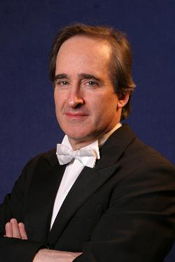
Conlon makes his mark at LA Opera
To his work as music director of the Los Angeles Opera James Conlon brings two commitments that some in music would find incompatible.
English Touring Opera are delighted to announce a season of lyric monodramas to tour nationally from October to December. The season features music for solo singer and piano by Argento, Britten, Tippett and Shostakovich with a bold and inventive approach to making opera during social distancing.
Conductor Oliver Zeffman has commissioned the very first opera for a socially distanced world, which is now available to watch exclusively on Apple Music. Eight Songs From Isolation has been written by eight leading composers, specifically for streaming - rather than live performance - and is the first opera written for a time when the performers were unable to meet in person.
Leading freelance musicians unite in Parliament Square to call for targeted support for colleagues in the arts and entertainment sector.
Duo Lewis Murphy (composer) and Laura Attridge (writer) have launched a charitable song project entitled Notes From Isolation. The resulting songs, featuring some of the UK's top singing talent, are being released online between August and October 2020 and can be enjoyed free of charge.
The Royal Opera House is thrilled to announce an exciting, wide-ranging new line-up for its autumn programme. For the first time, extraordinary performances will be accessible online for a global audience through livestreams and for socially distanced live audiences at our home in Covent Garden. In a global first, we present a new opera in hyper-reality, alongside repertory favourites from both artistic companies.
Some of the most famous and outstanding stars from the opera world are to take part in a very special evening from Wexford Festival Opera, including Aigul Akhmetshina, Joseph Calleja, Daniela Barcellona, Juan Diego Flórez, Igor Golovatenko, Ermonela Jaho, Sergey Romanovsky, and many more.
Following its successful launch in 2019, OperaStreaming streams nine operas on YouTube from the historic opera houses of Emilia-Romagna during the 2020-21 season, with fully-staged productions of Verdi's La traviata in October from Modena and Verdi'sOtello from Bologna in...
‘A brief history of song’ is the subtitle of the 2020 Oxford Lieder Festival (10th-17th October), which will present an ambitious, diverse and imaginative programme of 40 performances and events.
Bampton Classical Opera returns to the Baroque splendour of London’s St John’s Smith Square on November 6 with a concert performance of Gluck’s one-act opera The Crown, the first in the UK since 1987. The performance will also be filmed and available to watch on demand on the Bampton website from 9 November.
While many of us spent lockdown at home taking it a little easier, composer Andrew Synnott wrote an opera.
Owen Wingrave is part of the new Interim Season of 19 brand new events, all free to view online between September and December 2020.
The Arts Council has awarded innovative UK charity Music and Theatre For All (MTFA) a major new grant to develop three ambitious new projects in the wake of Covid 19.
English National Opera (ENO) will reopen the London Coliseum to socially distanced audiences on 6 and 7 November for special performances of Mozart’s Requiem. These will provide audiences with an opportunity to reflect upon and to commemorate the difficulties the nation has faced during the pandemic.
The Royal Opera House is proud to continue its curated #OurHouseToYourHouse programme into the autumn, bringing audiences the best of the ROH through a new series of Friday Premieres and cultural highlights.
After six months of closure, the Royal Opera House is thrilled to be opening its doors to the public as part of Open House London weekend, giving visitors a taste of one of the world’s most famous theatres for free.
The Academy of St Martin in the Fields is thrilled to announce re:connect - an eight concert series with live socially distanced audiences at its namesake church, St. Martin-in-the-Fields. The autumn concerts will take place at 5pm & 7:30pm on two Saturdays per month with guest artists including baritone Roderick Williams, soprano Carolyn Sampson and composer-conductor-pianist Ryan Wigglesworth performing a wide range of repertoire.
Music and poetry unite and collide across centuries, from the Medieval to the Enlightenment to the present day. This year, the Oxford Lieder Festival will present a thrilling and innovative programme comprising more than forty events streamed over eight days.
The English Concert with artistic director Harry Bicket is delighted to announce a series of concerts from 1-15 October 2020. The concerts take place in historic London venues with star soloists and will be performed and streamed live to a paying audience at 7pm GMT on each performance date. The programmes include first-class vocal and instrumental works from the two pillars of the English Baroque, covering different aspects of the repertoire.
Glyndebourne has announced plans for a ‘staycation’ series of socially-distanced indoor performances, starting on 10 October 2020.
The Royal Opera House is delighted to announce two packed evenings of opera and ballet, live from our stage in Covent Garden and available to view wherever you are in the world online.
To his work as music director of the Los Angeles Opera James Conlon brings two commitments that some in music would find incompatible.
He is, on the one hand, an enthusiastic Wagnerian, busy already in his first LAO season with plans for the company’s first-ever staging of “Der Ring des Nibelungen.” On the other, he is the world’s leading advocate of those composers persecuted, exiled and killed by the machinations of the man who made Wagner the court composer of National Socialism.
Thus it’s not surprising that a recent weekend found Conlon on the podium in Dorothy Chandler Pavilion for performances of both Wagner’s “Tannhäuser” and “Mahagonny” by Kurt Weill.
“I’ve been a total Wagner freak since I was 12 or 13,” Conlon said in a telephone interview before the weekend. “It was then a Wagnerian heyday at the Met with Birgit Nilsson, Christa Ludwig, Walter Berry, Jess Thomas and Karl Böhm.
“I went with my brother; we saw ‘Lohengrin’ several times.”
When a question arises about his love for Wagner, Conlon calls it a “non-issue.”
“In 1989, when I offered the position as general music director of the City of Cologne, I was asked what they could offer to get me to accept.
“I said I’d come only if I could do all of Wagner in the opera there.”
During his years in Cologne Conlon conducted the “canon” — Wagner’s 10 mature works — and he repeated most of them at Paris’ Garnier Opera as well.
With a new “Tristan” slated for next season and the completion of the “Ring” scheduled for 2010 he brings that same commitment to Los Angeles.
“I can’t imagine not conducting Wagner,” he says. “I can’t imagine living without Wagner.
“He’s a giant, the greatest creative genius in Western civilization, and he will never be out of fashion.”
Despite the demands on his energy, the performances of “Tannhäuser” and “Mahagonny” in less than 24 hours found Conlon in good form.
In Wagner’s early celebration of the Middle Ages he sustained long, lyric lines and extracted burnished beauty from the brass of his orchestra. He kept things under careful control, resisting any temptation to wallow in the steamy sexuality of the Venusberg. He brought the guests to the second-act battle of the minstrels on stage crisply and did not allow the pilgrims to lag.
And in Weill’s 1930 collaboration with dramatist Bert Brecht Conlon conducted decisively, stressing the craftsmanship of this one-time student of Busoni.
As a production, however, “Tannhäuser” was a sadly updated affair, in which the minstrels thumped a Steinway on stage, while a harp played in the pit.
Conlon opted for a now-standard hybrid of Dresden and Paris versions of Wagner’s score, while director Ian Judge and designer Gottfried Pilz outdid themselves in a skin-show Bacchanale on the level of Sex Education 101.
Silly as the efforts of Judge and Pilz were, they did little to detract from Conlon’s work with Wagner’s sublime romantic view of the world.
There is, however, little left of the robust tenor that made Peter Seiffert a memorable Tannhäuser two decades ago, and there was slight suggestion of searing sensuality in Lioba Braun’s Venus. Indeed, the most sensuous voice in the cast came from Petra Maria Schnitzer as the virginal Elisabeth.
Among her colleagues she had an equal only in Franz Joseph Selig, who was a commanding Landgraf. Martin Gantner warmed the heart with the serenade to the “Evening Star,” the opera’s greatest hit.
It was Conlon’s conducting that made the staging worthwhile.
Director John Doyle, who has made his mark staging Broadway musicals, missed it totally — alas — in “Mahagonny.” He decided upon “big” Weill, intent on proving that this too is grand opera.
It didn’t work. Absent was the bite of the story and the grit of the music. And rock-level amplification only underscored the wrongness of the approach.
(Does no one listen to Lotte Lenya’s historic recordings of her husband’s songs today?)
Superbly talented Audra McDonald, of course, can do no wrong, yet it was an effort to ignore Doyle’s overwrought direction in order to enjoy her artistry as the prostitute Jenny. And Patti LuPone, gussied up as a Mae West look-alike, was simply the wrong choice for that paragon of capitalism Leocadia Begbick.
(Memory again! Does anyone recall the gutsy, depraved Begbick that an ageing Astrid Varnay sang for a Met telecast of “Mahagonny” a quarter century ago?)
As fall guy Jimmy Anthony Dean Griffey, the first Mitch in Andre Previn’s “Streetcar Named Desire,” proved himself a formidable tenor. Donnie Ray Albert was a snarling Trinity Moses.
But it was only Mark Bailey’s minimalist stage sets that paid homage to the true spirit of “Mahagonny.”
LAO “Ring des Nibelungen”
The Los Angeles Opera will launch its first-ever production of Wagner’s “Ring des Nibelungen” during the 2008-2009 season. Germany’s Achim Freyer will both design and direct the staging; LAO music director James Conlon will conduct.
Conlon will conduct, in his first performance of the cycle in the US.
The four operas that make up the “Ring” will each be performed seven times during the 2008-2009 and 2009-2010 seasons, and in the summer of 2010 the company will present three full “Ring” cycles.
“Wagner’s Ring cycle has become today almost a ‘statement of identity’ for an opera company,” says LAO general director Placido Domingo. “Not only does it mean that the company has the financial means for such a mammoth undertaking, but it is also a sign of the artistic vision of its management team.
“This is truer than in almost any other operatic venture, because Wagner himself laid down very specific staging details — certainly more so than any other composer who comes to mind.”
Total estimated cost of the project is approximately $32 million.
“I want the LA Opera to become a hub of Wagnerian activity in coming years,” Conlon says. “Los Angeles, as one of the cultural capitals of the world, needs to have a giant Wagnerian magnet just as do New York, London, Paris and Vienna.”
Between 2001 and 2010 the LAO will have presented all of Wagner’s major operas, beginning with “Lohengrin” in 2001 and continuing with “Der fliegende Holländer” in 2003, “Parsifal” in 2005, the current staging of “Tannhäuser” and up-coming productions of “Die Meistersinger von Nürnberg” and “Tristan und Isolde.”
The “Ring’ cast will be headed by Linda Watson (Brünnhilde), John Treleaven (Siegfried), ViAalij Kowaljow (Wotan), Anja Kampe (Sieglinde), Michelle DeYoung (Fricka) and Eric Halfvarson (Fafner).
Domingo plans to sing Siegmund in “Walküre.” Although he has sung the role for many seasons, he will be 67 when the LAO “Ring” begins and 69 when it is completed. There is thus the possibility that he will retire from the stage before then.
“Recovered Voices” at the LAO
On the heels of its production of “Mahagonny” James Conlon conducted two concerts that make the inauguration of the company’s “Recovered Voices” project, an endeavor unique to any opera in the world today.
The multi-year project focuses attention on composers affected by the Holocaust, the effort of Germany’s National Socialists to “cleanse” the country of what was labeled “degenerate art.”
Slated for performance are works by many composers who were forced to leave Germany and by others who died in the Nazi death camps.
The opening programs on March 7 and 9 featured scores by — among others — Erich Korngold, Erwin Schulhoff, Ernst Krenek and Viktor Ullmann, along with a complete performance of Alexander Zemlinsky’s “Eine florentinische Tragödie.”
“Recovered Voices” is made possible largely by a donation of $4 million by Los Angeles philanthropist Marilyn Ziering.
Wes Blomster