13 Mar 2007
LA Opera “Recovered Voices”
Just about halfway though his first season as music director of Los Angeles Opera, James Conlon has already made himself an endearing and appreciated figure.
English Touring Opera are delighted to announce a season of lyric monodramas to tour nationally from October to December. The season features music for solo singer and piano by Argento, Britten, Tippett and Shostakovich with a bold and inventive approach to making opera during social distancing.
This tenth of ten Live from London concerts was in fact a recorded live performance from California. It was no less enjoyable for that, and it was also uplifting to learn that this wasn’t in fact the ‘last’ LfL event that we will be able to enjoy, courtesy of VOCES8 and their fellow vocal ensembles (more below …).
Ever since Wigmore Hall announced their superb series of autumn concerts, all streamed live and available free of charge, I’d been looking forward to this song recital by Ian Bostridge and Imogen Cooper.
Although Stile Antico’s programme article for their Live from London recital introduced their selection from the many treasures of the English Renaissance in the context of the theological debates and upheavals of the Tudor and Elizabethan years, their performance was more evocative of private chamber music than of public liturgy.
Evidently, face masks don’t stifle appreciative “Bravo!”s. And, reducing audience numbers doesn’t lower the volume of such acclamations. For, the audience at Wigmore Hall gave soprano Elizabeth Llewellyn and pianist Simon Lepper a greatly deserved warm reception and hearty response following this lunchtime recital of late-Romantic song.
For this week’s Live from London vocal recital we moved from the home of VOCES8, St Anne and St Agnes in the City of London, to Kings Place, where The Sixteen - who have been associate artists at the venue for some time - presented a programme of music and words bound together by the theme of ‘reflection’.
'Such is your divine Disposation that both you excellently understand, and royally entertaine the Exercise of Musicke.’
‘And there was war in heaven: Michael and his angels fought against the dragon; and the dragon fought and his angels, And prevailed not; neither was their place found any more in heaven … that old serpent … Satan, which deceiveth the whole world: he was cast out into the earth, and his angels were cast out with him.’
There was never any doubt that the fifth of the twelve Met Stars Live in Concert broadcasts was going to be a palpably intense and vivid event, as well as a musically stunning and theatrically enervating experience.
‘Love’ was the theme for this Live from London performance by Apollo5. Given the complexity and diversity of that human emotion, and Apollo5’s reputation for versatility and diverse repertoire, ranging from Renaissance choral music to jazz, from contemporary classical works to popular song, it was no surprise that their programme spanned 500 years and several musical styles.
The Academy of St Martin in the Fields have titled their autumn series of eight concerts - which are taking place at 5pm and 7.30pm on two Saturdays each month at their home venue in Trafalgar Square, and being filmed for streaming the following Thursday - ‘re:connect’.
The London Symphony Orchestra opened their Autumn 2020 season with a homage to Oliver Knussen, who died at the age of 66 in July 2018. The programme traced a national musical lineage through the twentieth century, from Britten to Knussen, on to Mark-Anthony Turnage, and entwining the LSO and Rattle too.
With the Live from London digital vocal festival entering the second half of the series, the festival’s host, VOCES8, returned to their home at St Annes and St Agnes in the City of London to present a sequence of ‘Choral Dances’ - vocal music inspired by dance, embracing diverse genres from the Renaissance madrigal to swing jazz.
Just a few unison string wriggles from the opening of Mozart’s overture to Le nozze di Figaro are enough to make any opera-lover perch on the edge of their seat, in excited anticipation of the drama in music to come, so there could be no other curtain-raiser for this Gala Concert at the Royal Opera House, the latest instalment from ‘their House’ to ‘our houses’.
"Before the ending of the day, creator of all things, we pray that, with your accustomed mercy, you may watch over us."
The doors at The Metropolitan Opera will not open to live audiences until 2021 at the earliest, and the likelihood of normal operatic life resuming in cities around the world looks but a distant dream at present. But, while we may not be invited from our homes into the opera house for some time yet, with its free daily screenings of past productions and its pay-per-view Met Stars Live in Concert series, the Met continues to bring opera into our homes.
Music-making at this year’s Grange Festival Opera may have fallen silent in June and July, but the country house and extensive grounds of The Grange provided an ideal setting for a weekend of twelve specially conceived ‘promenade’ performances encompassing music and dance.
There’s a “slide of harmony” and “all the bones leave your body at that moment and you collapse to the floor, it’s so extraordinary.”
“Music for a while, shall all your cares beguile.”
The hum of bees rising from myriad scented blooms; gentle strains of birdsong; the cheerful chatter of picnickers beside a still lake; decorous thwacks of leather on willow; song and music floating through the warm evening air.
Just about halfway though his first season as music director of Los Angeles Opera, James Conlon has already made himself an endearing and appreciated figure.
He likes to speak to early-comers to the Dorothy Chandler as part of the “lecture” events, and his work with the orchestra so far, and their response to him, indicates a solid relationship being established.
He has also brought with him a passion for the music of a particular set of the composers who were exiled, banned, or killed by the Nazi regime. He expressed his happiness at having Brecht and Weill’s Mahagonny as part of this season, and he also helped find the support (primarily from Marilyn Ziering and the Ziering Family Foundation) for two concert evenings called “Recovered Voices.” At the second performance, March 10th, he appeared before both halves of the program to speak with enthusiasm and erudition about the composers and their works. The evening, it seems, is a preview of repertoire that Conlon intends to bring to the regular LAO season schedule. In fact, next season he makes a start, with a double-bill evening of Zemlinsky’s Der Zwerg and Ullman’s Der Zerbrochene Krug.
The first half consisted of a sort of suite that Conlon devised from the music of six composers. The conductor asked the audience to hold its applause until the end of the final segment, and they dutifully did so. First came the dark swirl of textures in Franz Schreker’s prelude to Die Gezeichneten. Somewhat ironically, this opera recently appeared on DVD in a performance conducted by Kent Nagano, Conlon’s predecessor at LAO.
Stacy Tappan, a soprano who has specialized in high-lying roles so far (she sang the Dew Fairy in LAO’s recent Hansel und Gretel), appeared first on the bare stage, with a screen for projections behind her. Maiko Nezu designed the tasteful images that evoked the moods if not always the settings of the various selections. Ms. Tappan sang a charming aria from Walter Braunfels’ Die Vogel, left and then reappeared with a pianist (uncredited in the program) for a number from Ernest Krenek’s Jonny spielt auf. A huge hit in its day, even in this short excerpt one could hear why the opera has become a curiosity today - the jazz elements not very well incorporated into a timidly modernistic fabric.
Donnie Ray Albert (the father in that same Hansel und Gretel) sang “The Emperor’s farewell” from Viktor Ullamn’s The Emperor of Atlantis. Out of context, the aria still managed to create a mood of wistful resignation, an amazing achievement for a man writing in a concentration camp, and too soon to die there.
Tenor Roderick Dixon took on an aria from Erwin Schulhoff’s Flammen, a discursive affair that gave a more prominent role to orchestral texture rather than to the vocal line.
All of this music boasted to one degree or another a power and sweep to the orchestration, but rather less in the way of memorable thematic material. That cannot be said of the final segment, from Erich Korngold’s Die tote Stadt. Unlike the other operas represented, Korngold’s has managed to keep a precarious hold on a place on the fringes of the standard repertory. It helps that the opera features two smashing arias. First Tatiana Pavlovskaya sang “Marietta’s lied,” with Mr. Dixon joining her. Although her top grew a little wild, Ms. Pavlovskaya had the warm sensuality needed for Korngold’s exquisite tune. Then the fine baritone Martin Gantner, currently singing Wolfram in the new Tannhäuser at LAO, sang a poignant “Pierrot’s Tanzlied.”
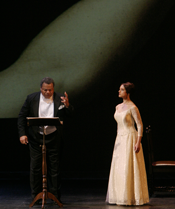
After intermission came a one-act opera from Alexander Zemlinsky, with only minimal direction for the singers and a few chairs as props, while the projections became a bit more literal in an attempt to convey the essence of Oscar Wilde’s A Florentine Tragedy. Speaking before the audience, Conlon detailed Zemlinsky’s unhappy love affair with Gustav Mahler’s future wife Alma, and suggested that Zemlinsky at least took that pain as a form of creative inspiration. Basically a psychological battle of wills between a gruff merchant and a young nobleman over the merchant’s wife, the piece ends with the sort of “twist” which smacks a bit too much of a Freudian-era Twilight Zone episode. Never short on drama and formal invention, the score would probably be better known if it had more memorable melodies. And that was true of most of the evening’s fare. Albert, Pavlovskaya, and Anthony Dean Griffey as the nobleman had to work against the minimal staging and the story’s claustrophobic nature, and all managed to deserve the audience’s respect for their efforts.
Much of this repertory was written in the first third of the last century, and in an opera world eager for fresh material, it seems unlikely that an undiscovered masterpiece lies among the works of these composers. The works must stand on their own, regardless of the tragic fate of their composers. Conlon’s passion, however, makes him a brilliant advocate, and Los Angeles Opera audiences will at least know that a steady diet of Traviata and Bohème will be interspersed with the dark, sometimes acerbic work of these composers over the coming seasons.
Chris Mullins