20 Mar 2007
Teseo — Handel by the Sea
Nice Opera, on the French Cote d’Azur, seemed a most suitable place for this early work by Handel.
English Touring Opera are delighted to announce a season of lyric monodramas to tour nationally from October to December. The season features music for solo singer and piano by Argento, Britten, Tippett and Shostakovich with a bold and inventive approach to making opera during social distancing.
This tenth of ten Live from London concerts was in fact a recorded live performance from California. It was no less enjoyable for that, and it was also uplifting to learn that this wasn’t in fact the ‘last’ LfL event that we will be able to enjoy, courtesy of VOCES8 and their fellow vocal ensembles (more below …).
Ever since Wigmore Hall announced their superb series of autumn concerts, all streamed live and available free of charge, I’d been looking forward to this song recital by Ian Bostridge and Imogen Cooper.
Although Stile Antico’s programme article for their Live from London recital introduced their selection from the many treasures of the English Renaissance in the context of the theological debates and upheavals of the Tudor and Elizabethan years, their performance was more evocative of private chamber music than of public liturgy.
Evidently, face masks don’t stifle appreciative “Bravo!”s. And, reducing audience numbers doesn’t lower the volume of such acclamations. For, the audience at Wigmore Hall gave soprano Elizabeth Llewellyn and pianist Simon Lepper a greatly deserved warm reception and hearty response following this lunchtime recital of late-Romantic song.
For this week’s Live from London vocal recital we moved from the home of VOCES8, St Anne and St Agnes in the City of London, to Kings Place, where The Sixteen - who have been associate artists at the venue for some time - presented a programme of music and words bound together by the theme of ‘reflection’.
'Such is your divine Disposation that both you excellently understand, and royally entertaine the Exercise of Musicke.’
‘And there was war in heaven: Michael and his angels fought against the dragon; and the dragon fought and his angels, And prevailed not; neither was their place found any more in heaven … that old serpent … Satan, which deceiveth the whole world: he was cast out into the earth, and his angels were cast out with him.’
There was never any doubt that the fifth of the twelve Met Stars Live in Concert broadcasts was going to be a palpably intense and vivid event, as well as a musically stunning and theatrically enervating experience.
‘Love’ was the theme for this Live from London performance by Apollo5. Given the complexity and diversity of that human emotion, and Apollo5’s reputation for versatility and diverse repertoire, ranging from Renaissance choral music to jazz, from contemporary classical works to popular song, it was no surprise that their programme spanned 500 years and several musical styles.
The Academy of St Martin in the Fields have titled their autumn series of eight concerts - which are taking place at 5pm and 7.30pm on two Saturdays each month at their home venue in Trafalgar Square, and being filmed for streaming the following Thursday - ‘re:connect’.
The London Symphony Orchestra opened their Autumn 2020 season with a homage to Oliver Knussen, who died at the age of 66 in July 2018. The programme traced a national musical lineage through the twentieth century, from Britten to Knussen, on to Mark-Anthony Turnage, and entwining the LSO and Rattle too.
With the Live from London digital vocal festival entering the second half of the series, the festival’s host, VOCES8, returned to their home at St Annes and St Agnes in the City of London to present a sequence of ‘Choral Dances’ - vocal music inspired by dance, embracing diverse genres from the Renaissance madrigal to swing jazz.
Just a few unison string wriggles from the opening of Mozart’s overture to Le nozze di Figaro are enough to make any opera-lover perch on the edge of their seat, in excited anticipation of the drama in music to come, so there could be no other curtain-raiser for this Gala Concert at the Royal Opera House, the latest instalment from ‘their House’ to ‘our houses’.
"Before the ending of the day, creator of all things, we pray that, with your accustomed mercy, you may watch over us."
The doors at The Metropolitan Opera will not open to live audiences until 2021 at the earliest, and the likelihood of normal operatic life resuming in cities around the world looks but a distant dream at present. But, while we may not be invited from our homes into the opera house for some time yet, with its free daily screenings of past productions and its pay-per-view Met Stars Live in Concert series, the Met continues to bring opera into our homes.
Music-making at this year’s Grange Festival Opera may have fallen silent in June and July, but the country house and extensive grounds of The Grange provided an ideal setting for a weekend of twelve specially conceived ‘promenade’ performances encompassing music and dance.
There’s a “slide of harmony” and “all the bones leave your body at that moment and you collapse to the floor, it’s so extraordinary.”
“Music for a while, shall all your cares beguile.”
The hum of bees rising from myriad scented blooms; gentle strains of birdsong; the cheerful chatter of picnickers beside a still lake; decorous thwacks of leather on willow; song and music floating through the warm evening air.
Nice Opera, on the French Cote d’Azur, seemed a most suitable place for this early work by Handel.
The opera house itself is a stone’s throw from the Mediterranean and, with the pale blue shallows merging into the proverbial “wine dark sea” of legend beyond, it didn’t take much of a leap of the imagination to envisage these waters carrying the ships of Theseus, Aegeus and Medea to their immortality. Helping this conceit along was the fact that this particular production designed by Gilbert Blin and conducted from the violin by Gilbert Bezzina pulled absolutely no punches in terms of the oft-maligned term “authentic”. If the great man himself had time-travelled from 1714 to 2007 and walked into the theatre as the curtain rose, he surely would have nodded approvingly at everything he saw beyond the footlights and, mostly, heard from the pit.
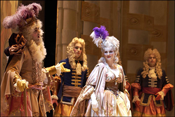
Make no mistake; this was very serious opera seria. From the painted clouds to the bewigged and silken-gowned protagonists, from the hand-shaken thunder machine to the monsters rolled on from the sides, this was as near to an authentic experience of baroque opera as might be achieved today. Its quaint charm - not to mention the gorgeous stuffs of the costumes - beguiled the eye at every turn. So much so in fact, that it was all too easy to almost ignore occasional vocal lapses that elsewhere in a starker, more real-politik, setting might have been more prominent.
These lapses were highlighted by the fact that in terms of even Handel’s soundscapes, Teseo is unusual. There is no bass or tenor role, and the characters are sung by sopranos (both male and female), mezzo-sopranos and, today, counter-tenors. When the mixed chorus including lower voices occasionally makes a vocal entrance it thus has a surprisingly sonorous effect. The mainly French speaking cast of principles are not widely known beyond western Europe: soprano Brigitte Hool as the heroine Agilea, who loves Teseo, the returning warrior to the court of King Egeo, was by far the most accomplished and appealing of voices on display with a nice line in delicate ornamentation, good diction and a charming stage personality. In contrast, the wicked-witch character of Medea, that epitome of woman-wronged and vengeful, sung by mezzo soprano Aurelia Legay, was anything but delicate – except in volume which was sadly lacking in the early Acts. By the fourth and fifth she seemed to have found her full voice, but a little late. Egeo, not a large role, was sung by the very experienced French counter-tenor Pascal Bertin who showed a real baroque feel for this music, if not exactly setting the stage alight with his vocalism. The “sub-plot” pair of lovers, so often used by Handel to fill out the stories and the score, were sung by soprano Valerie Gabail (Clitia) and young French counter-tenor Damien Guillon (Arcane). The latter was certainly the most exciting discovery of the performance with a firm vocal production, consistent through the range, and with true alto warmth with no hootiness or recourse to root voice. A young man to watch in this field. Of the principles, that leaves the title role, and here there was disappointment. Having heard male soprano Jacek Laszczowski sing this role in England last year, it was perturbing to hear his obvious vocal problems throughout this production. They seemed to centre on his inability to produce his male soprano effectively in the lower reaches of the recitatives and ariosi. The sounds produced then were not pleasant – in contrast to some of his arias where when he sang at the top of the staff and beyond and his voice produced both beautiful pianissimos and clarion fortes. Let us hope that this is a temporary situation.
Apart from the singers and costumes, much of the authentic feel of this production came from the musical support of the “Ensemble baroque de Nice” – one of the major baroque groups in southern France – ably if somewhat pedantically led from the violin by their Director, Gilbert Bezzina. One could not argue with his reading of the score, but his tempi sometimes dragged down an already-top-heavy (if only by the huge wigs) staging even more than was perhaps inevitable.
Sue Loder © 2007