02 May 2007
Delightful Organ at St Margaret’s Palm Desert
Who says an organ recital cannot be jolly good fun?
English Touring Opera are delighted to announce a season of lyric monodramas to tour nationally from October to December. The season features music for solo singer and piano by Argento, Britten, Tippett and Shostakovich with a bold and inventive approach to making opera during social distancing.
This tenth of ten Live from London concerts was in fact a recorded live performance from California. It was no less enjoyable for that, and it was also uplifting to learn that this wasn’t in fact the ‘last’ LfL event that we will be able to enjoy, courtesy of VOCES8 and their fellow vocal ensembles (more below …).
Ever since Wigmore Hall announced their superb series of autumn concerts, all streamed live and available free of charge, I’d been looking forward to this song recital by Ian Bostridge and Imogen Cooper.
Although Stile Antico’s programme article for their Live from London recital introduced their selection from the many treasures of the English Renaissance in the context of the theological debates and upheavals of the Tudor and Elizabethan years, their performance was more evocative of private chamber music than of public liturgy.
Evidently, face masks don’t stifle appreciative “Bravo!”s. And, reducing audience numbers doesn’t lower the volume of such acclamations. For, the audience at Wigmore Hall gave soprano Elizabeth Llewellyn and pianist Simon Lepper a greatly deserved warm reception and hearty response following this lunchtime recital of late-Romantic song.
For this week’s Live from London vocal recital we moved from the home of VOCES8, St Anne and St Agnes in the City of London, to Kings Place, where The Sixteen - who have been associate artists at the venue for some time - presented a programme of music and words bound together by the theme of ‘reflection’.
'Such is your divine Disposation that both you excellently understand, and royally entertaine the Exercise of Musicke.’
‘And there was war in heaven: Michael and his angels fought against the dragon; and the dragon fought and his angels, And prevailed not; neither was their place found any more in heaven … that old serpent … Satan, which deceiveth the whole world: he was cast out into the earth, and his angels were cast out with him.’
There was never any doubt that the fifth of the twelve Met Stars Live in Concert broadcasts was going to be a palpably intense and vivid event, as well as a musically stunning and theatrically enervating experience.
‘Love’ was the theme for this Live from London performance by Apollo5. Given the complexity and diversity of that human emotion, and Apollo5’s reputation for versatility and diverse repertoire, ranging from Renaissance choral music to jazz, from contemporary classical works to popular song, it was no surprise that their programme spanned 500 years and several musical styles.
The Academy of St Martin in the Fields have titled their autumn series of eight concerts - which are taking place at 5pm and 7.30pm on two Saturdays each month at their home venue in Trafalgar Square, and being filmed for streaming the following Thursday - ‘re:connect’.
The London Symphony Orchestra opened their Autumn 2020 season with a homage to Oliver Knussen, who died at the age of 66 in July 2018. The programme traced a national musical lineage through the twentieth century, from Britten to Knussen, on to Mark-Anthony Turnage, and entwining the LSO and Rattle too.
With the Live from London digital vocal festival entering the second half of the series, the festival’s host, VOCES8, returned to their home at St Annes and St Agnes in the City of London to present a sequence of ‘Choral Dances’ - vocal music inspired by dance, embracing diverse genres from the Renaissance madrigal to swing jazz.
Just a few unison string wriggles from the opening of Mozart’s overture to Le nozze di Figaro are enough to make any opera-lover perch on the edge of their seat, in excited anticipation of the drama in music to come, so there could be no other curtain-raiser for this Gala Concert at the Royal Opera House, the latest instalment from ‘their House’ to ‘our houses’.
"Before the ending of the day, creator of all things, we pray that, with your accustomed mercy, you may watch over us."
The doors at The Metropolitan Opera will not open to live audiences until 2021 at the earliest, and the likelihood of normal operatic life resuming in cities around the world looks but a distant dream at present. But, while we may not be invited from our homes into the opera house for some time yet, with its free daily screenings of past productions and its pay-per-view Met Stars Live in Concert series, the Met continues to bring opera into our homes.
Music-making at this year’s Grange Festival Opera may have fallen silent in June and July, but the country house and extensive grounds of The Grange provided an ideal setting for a weekend of twelve specially conceived ‘promenade’ performances encompassing music and dance.
There’s a “slide of harmony” and “all the bones leave your body at that moment and you collapse to the floor, it’s so extraordinary.”
“Music for a while, shall all your cares beguile.”
The hum of bees rising from myriad scented blooms; gentle strains of birdsong; the cheerful chatter of picnickers beside a still lake; decorous thwacks of leather on willow; song and music floating through the warm evening air.
Who says an organ recital cannot be jolly good fun?
I might have until recently, but as of January 28 and February 13, 2007 this auditor has a new and pleasurable impression of what pipe organs can be as secular entertainment, even if in a church setting. (Yes, I grew up listening to Stan Kann play the mighty Wurlitzer at the Fox Theatre in St Louis, but that was a movie palace, and in a very different repertory and time.)
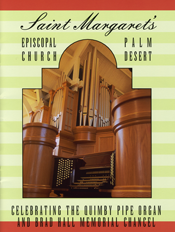
A visitor to the California desert cities two hours east of Los Angeles may find the area, in terms of classical music, a cultural wasteland. That has been my impression. Thus in the present winter season two recitals on the superb Quimby organ at St. Margaret’s Church in Palm Desert (nationally known of late as the locus of Gerald Ford’s first funeral), were well appreciated as they were especially excellent in quality.
In January the talented Richard Elliott, a principal organist and musical director of the Mormon Tabernacle in Salt Lake City, held forth on a Sunday afternoon to a full house of 750 that stood and cheered his performance of Mussorgsky’s Pictures at an Exhibition. Originally written for piano, Pictures thrived in an organ arrangement by J. Guillou and K. John, the myriad colors and dynamic effects achieved by Dr Elliott and the 4,274 pipes of Quimby’s remarkable St. Margaret’s instrument provided a promenade through this dramatic musical gallery tour, which was literally incomparable. The ear was constantly surprised by the enormous variety of instrumental sounds and colors pouring from the various registrations chosen by Dr Elliott. “The Great Gate of Kiev,” resounded magnificently, and coming as it did following a section (“Baba Yaga”) played pianissimo, the audience was left in a state of astonished delight.
Quimby’s big 71-rank, electro-pneumatic slider organ is a bit daring given the size of the church’s auditorium; it is almost, but not quite, too large in sound, when full out, for the hall. Thus, the sonic journey from pianissimo to fortissimo is an exciting trek. The balance of tonal quality from lowest to highest notes is especially pleasing; and to hear the powerful low basso tones rolling through the room was thrilling. Nothing is raw or unrefined, every sound is pure music. Organ builder Michael Quimby, headquartered in Missouri, is a small but highly regarded designer-builder, who is presently engaged in the prestigious assignment of restoring the fire-damaged organ in the Cathedral of St John the Divine, in New York City. When Quimby built the Palm Desert organ, a decade ago, it was his most ambitious undertaking to date, he says. He went to great lengths to study the acoustical problems of the ‘dry’ St. Margaret auditorium, making a special trip to England and France to familiarize himself with instruments that overcame similar challenges.
I want to pause here with a disclaimer – I am not tutored in organ arts or technology and have only a layman’s notion of the skills required to perform as an organ virtuoso. But St. Margaret’s quicksilver Quimby instrument strikes me as of singular quality among church organs I’ve heard. Dedicated in 1998, after three years of manufacture, the four manual, 58 stop, 71 rank instrument is precise but warm in tonal quality, perfectly balanced in pitch and color. It is widely versatile – Bach, Buxtehude and classical pieces sound clean and clear, as they should; César Franck and Elgar are warm, mellow and full-toned, and showmen (if I may take that liberty), such as Widor and Vierne are fleet and sparkling. I am in complete sympathy with Dr. Elliott, who announced before his recital, “the only time I am unhappy at St. Margaret’s is when I have to leave this marvelous instrument.” Elliott’s other selections in his Sunday recital included a ‘Trumpet Voluntary’ of John Stanley; Bach and Handel, as well as Elliott’s own hymn arrangements. The Utah artist played with musical muscularity and poise, and he had the entire program from memory. What a treat to hear him and his unique treatment of various scores on the Quimby instrument. Dr. Elliott is featured in some sixteen CD recordings, and has a new solo recital disc coming out on the Mormon Tabernacle Choir label this year.
As if one good thing begets another, February 13 the Scotland-born music master and organist of Westminster Abbey, London, James O’Donnell, provided St. Margaret’s a quite different program that impressed not only with technical brilliance but with nuanced subtlety and elegance. O’Donnell’s many Hyperion recordings testify to his abilities, if not to the sound of the Quimby instrument. For that one can turn to a JVS Recordings CD of Frank Bridge organ music played on the St. Margaret’s Quimby by the American virtuoso, Todd Wilson of Ohio. Listen to this on a big sound system with an extended low-frequency response and plenty of amplification power, and my favorable adjectives may seem inadequate.
Mr. O’Donnell’s program included Buxtehude and Bach; a French group of Franck, Widor and Vierne; a quick dip into the English masters Stanford, Elgar and Walton, and a charming unexpected piece, “Miroir” by Ad Wammes (b, 1953) that added a touch of impressionistic whimsy. The Scottish artist played with remarkable technical mastery, his musical taste and spirit of the highest order, as would be expected from a man in his exalted position in British music.
When one considers most organ scores are not instructed with registration, thus leaving much of the instrumental colors and sounds to the choice of the performer, the magnitude of musical talent required for organ virtuoso performances is awe inspiring. An organist’s tasks are varied and many, and the artist has an unusual degree of creative input. [For audiophiles, my playback for organ and other ‘large’ material includes Thiel 3.6 speakers, a Threshold amp of 300-watts, and a DA converter by Sonic Frontiers of Canada that includes a vacuum tube stage for warmth, all connected with highly efficient top quality Kimber Kable.] After hearing organ music in Palm Desert’s church of St. Margaret, I shall admit to the sin of envy. The only cure, of course, is to hear more, or so Oscar Wilde might advise. This may happen, as next year is the organ’s tenth year, and John Wright, the church’s music master and resident organist, advises interesting plans are being made.
The CD [JAV120], “Frank Bridge and Friends,” recorded at St. Margaret’s in 2000 and still commercially available, is of unusual interest in itself, not only as a handsome demonstration of the Quimby organ. Most of the rarely-heard music is of English composer Frank Bridge (1879-1941), an important teacher of Benjamin Britten. Other selections are by Sir Edward Cuthbert Barstow, Britten, John Nicholson Ireland, Craig Sellar Lang, Sir William Turner Walton and Percy William Whitlock, all late 19th C. or 20th C. U.K. composers, working at a time when organ was a musical sovereign. As to interest and quality, each composer offers worthwhile material, though now and then the Bridge pieces can turn a tad watery and a slow-paced. I liked John Ireland’s ‘Romance’ for its shape and movement, and Walton’s ‘Popular Song’ will delight those familiar with his setting of the Sitwell poem ‘Façade,’ for which the merry tune was written. The better the audio system used in playing back this recording the finer the music will sound, though even the largest home stereo systems cannot approach the magical presence and full range of sound of a pipe organ such as St. Margaret’s in full cry.
King of instruments, indeed!
J. A. VAN SANT/Santa Fe © 2007