Recently in Performances
English Touring Opera are delighted to announce a season of lyric monodramas to tour nationally from October to December. The season features music for solo singer and piano by Argento, Britten, Tippett and Shostakovich with a bold and inventive approach to making opera during social distancing.
This tenth of ten Live from London concerts was in fact a recorded live performance from California. It was no less enjoyable for that, and it was also uplifting to learn that this wasn’t in fact the ‘last’ LfL event that we will be able to enjoy, courtesy of VOCES8 and their fellow vocal ensembles (more below …).
Ever since Wigmore Hall announced their superb series of autumn concerts, all streamed live and available free of charge, I’d been looking forward to this song recital by Ian Bostridge and Imogen Cooper.
Although Stile Antico’s programme article for their Live from London recital introduced their selection from the many treasures of the English Renaissance in the context of the theological debates and upheavals of the Tudor and Elizabethan years, their performance was more evocative of private chamber music than of public liturgy.
Evidently, face masks don’t stifle appreciative “Bravo!”s. And, reducing audience numbers doesn’t lower the volume of such acclamations. For, the audience at Wigmore Hall gave soprano Elizabeth Llewellyn and pianist Simon Lepper a greatly deserved warm reception and hearty response following this lunchtime recital of late-Romantic song.
For this week’s Live from London vocal recital we moved from the home of VOCES8, St Anne and St Agnes in the City of London, to Kings Place, where The Sixteen - who have been associate artists at the venue for some time - presented a programme of music and words bound together by the theme of ‘reflection’.
'Such is your divine Disposation that both you excellently understand, and royally entertaine the Exercise of Musicke.’
‘And there was war in heaven: Michael and his angels fought against the dragon; and the dragon fought and his angels, And prevailed not; neither was their place found any more in heaven … that old serpent … Satan, which deceiveth the whole world: he was cast out into the earth, and his angels were cast out with him.’
There was never any doubt that the fifth of the twelve Met Stars Live in Concert broadcasts was going to be a palpably intense and vivid event, as well as a musically stunning and theatrically enervating experience.
‘Love’ was the theme for this Live from London performance by Apollo5. Given the complexity and diversity of that human emotion, and Apollo5’s reputation for versatility and diverse repertoire, ranging from Renaissance choral music to jazz, from contemporary classical works to popular song, it was no surprise that their programme spanned 500 years and several musical styles.
The Academy of St Martin in the Fields have titled their autumn series of eight concerts - which are taking place at 5pm and 7.30pm on two Saturdays each month at their home venue in Trafalgar Square, and being filmed for streaming the following Thursday - ‘re:connect’.
The London Symphony Orchestra opened their Autumn 2020 season with a homage to Oliver Knussen, who died at the age of 66 in July 2018. The programme traced a national musical lineage through the twentieth century, from Britten to Knussen, on to Mark-Anthony Turnage, and entwining the LSO and Rattle too.
With the Live from London digital vocal festival entering the second half of the series, the festival’s host, VOCES8, returned to their home at St Annes and St Agnes in the City of London to present a sequence of ‘Choral Dances’ - vocal music inspired by dance, embracing diverse genres from the Renaissance madrigal to swing jazz.
Just a few unison string wriggles from the opening of Mozart’s overture to Le nozze di Figaro are enough to make any opera-lover perch on the edge of their seat, in excited anticipation of the drama in music to come, so there could be no other curtain-raiser for this Gala Concert at the Royal Opera House, the latest instalment from ‘their House’ to ‘our houses’.
"Before the ending of the day, creator of all things, we pray that, with your accustomed mercy, you may watch over us."
The doors at The Metropolitan Opera will not open to live audiences until 2021 at the earliest, and the likelihood of normal operatic life resuming in cities around the world looks but a distant dream at present. But, while we may not be invited from our homes into the opera house for some time yet, with its free daily screenings of past productions and its pay-per-view Met Stars Live in Concert series, the Met continues to bring opera into our homes.
Music-making at this year’s Grange Festival Opera may have fallen silent in June and July, but the country house and extensive grounds of The Grange provided an ideal setting for a weekend of twelve specially conceived ‘promenade’ performances encompassing music and dance.
There’s a “slide of harmony” and “all the bones leave your body at that moment and you collapse to the floor, it’s so extraordinary.”
“Music for a while, shall all your cares beguile.”
The hum of bees rising from myriad scented blooms; gentle strains of birdsong; the cheerful chatter of picnickers beside a still lake; decorous thwacks of leather on willow; song and music floating through the warm evening air.
Performances
01 May 2007
In Barcelona, a Wagner debut without scandals for Àlex Rigola, the rising star in the Catalan school of direction
At Barcelona’s Gran Teatre del Liceu, a sold-out house marked, for two nights in a row, the
weekend introducing la diada de Sant Jordi, the big fiesta celebrated on April 23 in honor of the city’s patron St George.
The Flying Dutchman is a frequent guest in this Mediterranean seaport
since it premiered here in 1885 as L’Holandès errant; not very surprisingly, since Barcelona is
also an early shrine of the Wagner cult in southern Europe. Sure, it’s a long way from Bayreuth:
patrons start clapping right after the overture and occasional breaches of etiquette take place after
favorite numbers, despite rebuking from connoisseurs. Yet the purest of Wagnerites had more
serious grounds for concern this time. The operatic debut of Àlex Rigola, born 1969, since 2003
artistic manager at the trend-making Teatre Liure, made them fear for the worst, as from that
seminary for avant-garde directors came both the talented innovator Lluís Pasqual and his former
assistant Calíxto Bieito (a notorious champion of deconstruction whom less friendly
commentators call “king of Eurotrash”).
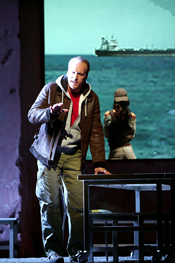
 However, those who were afraid of — or possibly hoped for — one more scandal found
themselves mystified. Rigola’s Dutchman is moderately postmodern, with a definite flavor of
cinema imagery from the 1970s-1990s, but without turning that into a shortcut to relevance. As
stipulated by Wagner the librettist, the action is set on the coast of Norway, where Captain
Daland NOW owns a small plant of canned fish. Thus chorus girls abstain from turning their spinning
wheels while waiting for their betrothed to come back from the sea with costly presents. Donning
aprons and plastic caps, they either sit in the firm canteen peeling bananas and digging into
yogurt tubs, or tarry on the verandah, smoking and flirting in front of an ever-impending seascape
much realistically displayed on laser projection. The Dutchman’s ship, no longer a clipper
mounting “blood-red sails and black masts”, towers as a rusty cargo of humongous dimensions.
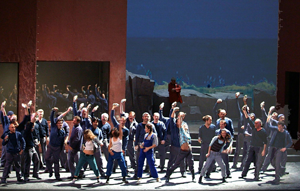
Updating reaches a climax in Act 3, when happy preps with their navels fully exposed dance to
disco rhythms waving beer cans high in the air and cuddling a cute golden retriever. Nina was the
name of that blonde four-legged diva, embodying her (fortunately) dumb role with unshaken
dignity.
However, those who were afraid of — or possibly hoped for — one more scandal found
themselves mystified. Rigola’s Dutchman is moderately postmodern, with a definite flavor of
cinema imagery from the 1970s-1990s, but without turning that into a shortcut to relevance. As
stipulated by Wagner the librettist, the action is set on the coast of Norway, where Captain
Daland NOW owns a small plant of canned fish. Thus chorus girls abstain from turning their spinning
wheels while waiting for their betrothed to come back from the sea with costly presents. Donning
aprons and plastic caps, they either sit in the firm canteen peeling bananas and digging into
yogurt tubs, or tarry on the verandah, smoking and flirting in front of an ever-impending seascape
much realistically displayed on laser projection. The Dutchman’s ship, no longer a clipper
mounting “blood-red sails and black masts”, towers as a rusty cargo of humongous dimensions.
Updating reaches a climax in Act 3, when happy preps with their navels fully exposed dance to
disco rhythms waving beer cans high in the air and cuddling a cute golden retriever. Nina was the
name of that blonde four-legged diva, embodying her (fortunately) dumb role with unshaken
dignity.
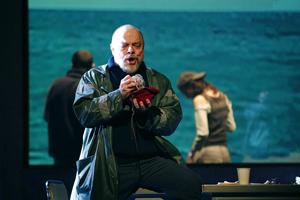
 All in all, the time-machine gimmick worked smoothly enough. Gloomy thrill and rural romance,
hurricanes and country dances mingled in the visuals as they actually do in the amphibious score
produced by the then young Wagner, still hesitating between French opéra-comique and seeds of
his Wort-Ton-Drama to come. First-bill Dutchman Alan Titus, still suffering from a recent
ailment, was not fully up to his signature role, since his beefy bass emerged a bit muddy in the
lower register and feeble in the higher. Skimming the cream from both casts, special honor is due
to Tómas Tómasson, a Dutchman perhaps insufficiently sinister but technically faultless in
managing his baritone-sounding, flexible and alluring instrument, as well as to Susan Anthony.
Her Senta sported girlish innocence and exquisite mezza-voce, though not matched by volume
and resolution in the juiciest dramatic spots. As Daland, Eric Halfvarson impersonated a dapper
sea captain-cum-industrialist, with his noble Sarastro-like utterances unspoiled by the slight
shade of cynicism that the role imposed on him. Both tenors Kurt Streit (Erik) and Norbert Ernst
(the Helmsman) contributed clarion tones and romantic passion to their born losers’ characters
— yet with some bittersweet vibrancy in it. Under the newly appointed principal conductor
Sebastian Weigle, the house ensembles — supplemented by the chamber choir of the Palau de la
Música — offered a forceful, clear-cut rendering throughout the two-and-a-half hour stretch
without any intervals.
All in all, the time-machine gimmick worked smoothly enough. Gloomy thrill and rural romance,
hurricanes and country dances mingled in the visuals as they actually do in the amphibious score
produced by the then young Wagner, still hesitating between French opéra-comique and seeds of
his Wort-Ton-Drama to come. First-bill Dutchman Alan Titus, still suffering from a recent
ailment, was not fully up to his signature role, since his beefy bass emerged a bit muddy in the
lower register and feeble in the higher. Skimming the cream from both casts, special honor is due
to Tómas Tómasson, a Dutchman perhaps insufficiently sinister but technically faultless in
managing his baritone-sounding, flexible and alluring instrument, as well as to Susan Anthony.
Her Senta sported girlish innocence and exquisite mezza-voce, though not matched by volume
and resolution in the juiciest dramatic spots. As Daland, Eric Halfvarson impersonated a dapper
sea captain-cum-industrialist, with his noble Sarastro-like utterances unspoiled by the slight
shade of cynicism that the role imposed on him. Both tenors Kurt Streit (Erik) and Norbert Ernst
(the Helmsman) contributed clarion tones and romantic passion to their born losers’ characters
— yet with some bittersweet vibrancy in it. Under the newly appointed principal conductor
Sebastian Weigle, the house ensembles — supplemented by the chamber choir of the Palau de la
Música — offered a forceful, clear-cut rendering throughout the two-and-a-half hour stretch
without any intervals.
Carlo Vitali