01 May 2007
Miami “Karenina” a dream come true
Colin Graham’s dream of an opera based on Tolstoi’s “Anna Karenina” extends far into the past.
English Touring Opera are delighted to announce a season of lyric monodramas to tour nationally from October to December. The season features music for solo singer and piano by Argento, Britten, Tippett and Shostakovich with a bold and inventive approach to making opera during social distancing.
This tenth of ten Live from London concerts was in fact a recorded live performance from California. It was no less enjoyable for that, and it was also uplifting to learn that this wasn’t in fact the ‘last’ LfL event that we will be able to enjoy, courtesy of VOCES8 and their fellow vocal ensembles (more below …).
Ever since Wigmore Hall announced their superb series of autumn concerts, all streamed live and available free of charge, I’d been looking forward to this song recital by Ian Bostridge and Imogen Cooper.
Although Stile Antico’s programme article for their Live from London recital introduced their selection from the many treasures of the English Renaissance in the context of the theological debates and upheavals of the Tudor and Elizabethan years, their performance was more evocative of private chamber music than of public liturgy.
Evidently, face masks don’t stifle appreciative “Bravo!”s. And, reducing audience numbers doesn’t lower the volume of such acclamations. For, the audience at Wigmore Hall gave soprano Elizabeth Llewellyn and pianist Simon Lepper a greatly deserved warm reception and hearty response following this lunchtime recital of late-Romantic song.
For this week’s Live from London vocal recital we moved from the home of VOCES8, St Anne and St Agnes in the City of London, to Kings Place, where The Sixteen - who have been associate artists at the venue for some time - presented a programme of music and words bound together by the theme of ‘reflection’.
'Such is your divine Disposation that both you excellently understand, and royally entertaine the Exercise of Musicke.’
‘And there was war in heaven: Michael and his angels fought against the dragon; and the dragon fought and his angels, And prevailed not; neither was their place found any more in heaven … that old serpent … Satan, which deceiveth the whole world: he was cast out into the earth, and his angels were cast out with him.’
There was never any doubt that the fifth of the twelve Met Stars Live in Concert broadcasts was going to be a palpably intense and vivid event, as well as a musically stunning and theatrically enervating experience.
‘Love’ was the theme for this Live from London performance by Apollo5. Given the complexity and diversity of that human emotion, and Apollo5’s reputation for versatility and diverse repertoire, ranging from Renaissance choral music to jazz, from contemporary classical works to popular song, it was no surprise that their programme spanned 500 years and several musical styles.
The Academy of St Martin in the Fields have titled their autumn series of eight concerts - which are taking place at 5pm and 7.30pm on two Saturdays each month at their home venue in Trafalgar Square, and being filmed for streaming the following Thursday - ‘re:connect’.
The London Symphony Orchestra opened their Autumn 2020 season with a homage to Oliver Knussen, who died at the age of 66 in July 2018. The programme traced a national musical lineage through the twentieth century, from Britten to Knussen, on to Mark-Anthony Turnage, and entwining the LSO and Rattle too.
With the Live from London digital vocal festival entering the second half of the series, the festival’s host, VOCES8, returned to their home at St Annes and St Agnes in the City of London to present a sequence of ‘Choral Dances’ - vocal music inspired by dance, embracing diverse genres from the Renaissance madrigal to swing jazz.
Just a few unison string wriggles from the opening of Mozart’s overture to Le nozze di Figaro are enough to make any opera-lover perch on the edge of their seat, in excited anticipation of the drama in music to come, so there could be no other curtain-raiser for this Gala Concert at the Royal Opera House, the latest instalment from ‘their House’ to ‘our houses’.
"Before the ending of the day, creator of all things, we pray that, with your accustomed mercy, you may watch over us."
The doors at The Metropolitan Opera will not open to live audiences until 2021 at the earliest, and the likelihood of normal operatic life resuming in cities around the world looks but a distant dream at present. But, while we may not be invited from our homes into the opera house for some time yet, with its free daily screenings of past productions and its pay-per-view Met Stars Live in Concert series, the Met continues to bring opera into our homes.
Music-making at this year’s Grange Festival Opera may have fallen silent in June and July, but the country house and extensive grounds of The Grange provided an ideal setting for a weekend of twelve specially conceived ‘promenade’ performances encompassing music and dance.
There’s a “slide of harmony” and “all the bones leave your body at that moment and you collapse to the floor, it’s so extraordinary.”
“Music for a while, shall all your cares beguile.”
The hum of bees rising from myriad scented blooms; gentle strains of birdsong; the cheerful chatter of picnickers beside a still lake; decorous thwacks of leather on willow; song and music floating through the warm evening air.
Colin Graham’s dream of an opera based on Tolstoi’s “Anna Karenina” extends far into the past.
In 1968 the British-born all-around man of opera began paring the novel down for his mentor Benjamin Britten. The premiere was slated for Moscow’s Bolshoi. However, when Soviet troops marched into Prague that summer, Britten was urged to abandon the project. In 1978 Graham wrote the libretto for Ian Hamilton’s “Anna Karenina,” a work that, following its premiere at English National Opera and a Los Angeles staging, has sunk into oblivion.
Graham’s dream came true only this year, when on April 28 Miami’s Florida Grand Opera staged the world premiere of “Anna Karenina,” now a close collaboration between Graham, librettist and stage director, and American composer David Carlson. It is sad, however, that Graham did not see the new opera, which is all that he might have wished for in success. Ill, but nonetheless deeply involved in the premiere, he died on Good Friday, April 6.
“Anna Karenina,” the crowning glory of the GFO’s first season in Miami’s new Ziff Ballet Opera House, is a memorial and monument to him. In 2001 FGO general director Robert M. Heur was contemplating a new work to celebrate the opening of the company’s new home in Miami’s $500 million Carnival Center for the Performing Arts.
Two years later — encouraged by Graham and FGO music director Stewart Robertson — Heuer commissioned Carlson to write “Anna Karenina.” Carlson, too, had been thinking of a “Karenina” opera since Graham had mentioned his interest at a 1993 meeting in St. Louis.
Graham, obviously very familiar with the Tolstoi by the time of the FGO commission, tailored an amazing libretto for Carlson. He has not merely condensed the 800-page book to fit a 2.5-hour score; he has distilled the essence of the novel by focusing on the two couples at its center: Anna and her lover Vronsky, and the sensitive country boy Levin and his youthful wife Kitty, once madly in love with — but rejected by — Vronsky. Concerned with character and not with history, Graham wisely overlooked Levin’s proto-socialist concern for the working class, the aspect of the novel that kept it in the Soviet canon.
The brief arias written by Graham reach to the marrow of the human experience, and Carlson has woven them into a tapestry of mesmerizing music. Before setting to work on the score, the composer went to Russia to absorb the atmosphere. He heard the bells of St. Petersburg, which echo in the opening bars of the work, and settled on the theme from the Tsarist hymn familiar from Tchaikovsky’s “1812" Overture to give a Russian color to the opera. Variations on the theme become a “Fate” motif that recurs at crucial points in the story. And to achieve the lush sonority demanded by the story he decided upon an orchestra of 19th-century dimensions, which, however, he employs with discipline. In what might be called American verismo, Carlson treats his characters with the tenderness of late Richard Strauss.
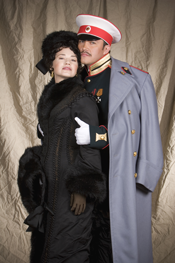
The capacity opening-night audience in the 2400-seat Ziff was spellbound by the work. For the premiere the FGO assembled an ideal cast largely of young singers who in appearance could easily be the persons they play. (Most of them will be on stage in St. Louis.) Kelly Kaduce is an elegant and aristocratic Anna; she portrays the emptiness of her marriage, her surrender to passion and consequent downfall from the heart, remaining always a woman of courage who has the sympathy of the audience. As Anna disintegrates and turns to laudanum Kaduce’s velvet voice takes on an edge of nervousness, insecurity and despair. It is a demanding role and a new triumph for this still youthful American soprano.
Konstantin Levin, the counterweight to Anna, is to a large degree a self-portrait of Tolstoi, and Brandon Jovanovich, tall, lean, blond and bearded, makes him the noblest Russian of them all. Jovanovich, a tenor with baritone heft, includes Pinkerton, Cavaradossi and Werther among his signature roles. As Levin, it is his concern for all that elevates the story from the personal to the universal. Small wonder that he recently received a Richard Tucker Award!
The opera ends not with Anna’s suicide, but with an epilogue, in which it is left to Levin to conclude with Tolstoi’s that “we must learn to know ourselves and to love each other.”
Polish-born Robert Gierlach, a baritone frequently heard as Mozart’s Figaro and Giovanni, makes Vronski’s self-centered undoing credible, while lanky bass-baritone Christian Van Horn is a touch too full-voiced and handsome to be a convincing Karenin. A pudgy nail-biter would fit the role better.
Supporting roles are well sung by Sarah Coburn (Kitty), Christine Abraham (Dolly), William Joyner (Stiva), Dorothy Byrne (Lydia) and Josepha Gayer (Betsy). Special recognition goes to veteran Rosalind Elias as Levin’s aged housekeeper Agafia. Elias made her FGO debut in 1977.
Neil Patel and Robert Perdziola, responsible — respectively — for sets and costumes — have caught the spirit of the opera remarkably with designs of stylized simplicity, yet true to Tolstoi’s time. A revolving stage is used effective for rapid changes of scene that contribute much to the continuity of the staging.
Stewart Robertson extracts sensuous sounds from the FGO orchestra, and a very able Mark Streshinsky stepped in for Colin Graham early in the rehearsal period.
In only a month this production will be on stage at the Opera Theatre of St. Louis and later at Michigan Opera, its third co-commissioner. Happily, Opera America held its annual meeting in Miami on the final April weekend, and that means that the “big brass” of opera in this country — 500 administrators — were present at the premiere of “Anna Karenina.”
One can hope that they shared the enthusiasm of the opening-night audience, who made clear that a great American opera has finally been written. In 2005, by the way, Boris Eifman used music by Tchaikovsky to create an “Anna Karenina” ballet in St. Petersburg.
Wes Blomster