Recently in Performances
English Touring Opera are delighted to announce a season of lyric monodramas to tour nationally from October to December. The season features music for solo singer and piano by Argento, Britten, Tippett and Shostakovich with a bold and inventive approach to making opera during social distancing.
This tenth of ten Live from London concerts was in fact a recorded live performance from California. It was no less enjoyable for that, and it was also uplifting to learn that this wasn’t in fact the ‘last’ LfL event that we will be able to enjoy, courtesy of VOCES8 and their fellow vocal ensembles (more below …).
Ever since Wigmore Hall announced their superb series of autumn concerts, all streamed live and available free of charge, I’d been looking forward to this song recital by Ian Bostridge and Imogen Cooper.
Although Stile Antico’s programme article for their Live from London recital introduced their selection from the many treasures of the English Renaissance in the context of the theological debates and upheavals of the Tudor and Elizabethan years, their performance was more evocative of private chamber music than of public liturgy.
Evidently, face masks don’t stifle appreciative “Bravo!”s. And, reducing audience numbers doesn’t lower the volume of such acclamations. For, the audience at Wigmore Hall gave soprano Elizabeth Llewellyn and pianist Simon Lepper a greatly deserved warm reception and hearty response following this lunchtime recital of late-Romantic song.
For this week’s Live from London vocal recital we moved from the home of VOCES8, St Anne and St Agnes in the City of London, to Kings Place, where The Sixteen - who have been associate artists at the venue for some time - presented a programme of music and words bound together by the theme of ‘reflection’.
'Such is your divine Disposation that both you excellently understand, and royally entertaine the Exercise of Musicke.’
‘And there was war in heaven: Michael and his angels fought against the dragon; and the dragon fought and his angels, And prevailed not; neither was their place found any more in heaven … that old serpent … Satan, which deceiveth the whole world: he was cast out into the earth, and his angels were cast out with him.’
There was never any doubt that the fifth of the twelve Met Stars Live in Concert broadcasts was going to be a palpably intense and vivid event, as well as a musically stunning and theatrically enervating experience.
‘Love’ was the theme for this Live from London performance by Apollo5. Given the complexity and diversity of that human emotion, and Apollo5’s reputation for versatility and diverse repertoire, ranging from Renaissance choral music to jazz, from contemporary classical works to popular song, it was no surprise that their programme spanned 500 years and several musical styles.
The Academy of St Martin in the Fields have titled their autumn series of eight concerts - which are taking place at 5pm and 7.30pm on two Saturdays each month at their home venue in Trafalgar Square, and being filmed for streaming the following Thursday - ‘re:connect’.
The London Symphony Orchestra opened their Autumn 2020 season with a homage to Oliver Knussen, who died at the age of 66 in July 2018. The programme traced a national musical lineage through the twentieth century, from Britten to Knussen, on to Mark-Anthony Turnage, and entwining the LSO and Rattle too.
With the Live from London digital vocal festival entering the second half of the series, the festival’s host, VOCES8, returned to their home at St Annes and St Agnes in the City of London to present a sequence of ‘Choral Dances’ - vocal music inspired by dance, embracing diverse genres from the Renaissance madrigal to swing jazz.
Just a few unison string wriggles from the opening of Mozart’s overture to Le nozze di Figaro are enough to make any opera-lover perch on the edge of their seat, in excited anticipation of the drama in music to come, so there could be no other curtain-raiser for this Gala Concert at the Royal Opera House, the latest instalment from ‘their House’ to ‘our houses’.
"Before the ending of the day, creator of all things, we pray that, with your accustomed mercy, you may watch over us."
The doors at The Metropolitan Opera will not open to live audiences until 2021 at the earliest, and the likelihood of normal operatic life resuming in cities around the world looks but a distant dream at present. But, while we may not be invited from our homes into the opera house for some time yet, with its free daily screenings of past productions and its pay-per-view Met Stars Live in Concert series, the Met continues to bring opera into our homes.
Music-making at this year’s Grange Festival Opera may have fallen silent in June and July, but the country house and extensive grounds of The Grange provided an ideal setting for a weekend of twelve specially conceived ‘promenade’ performances encompassing music and dance.
There’s a “slide of harmony” and “all the bones leave your body at that moment and you collapse to the floor, it’s so extraordinary.”
“Music for a while, shall all your cares beguile.”
The hum of bees rising from myriad scented blooms; gentle strains of birdsong; the cheerful chatter of picnickers beside a still lake; decorous thwacks of leather on willow; song and music floating through the warm evening air.
Performances
11 Jun 2007
Italiana restored: Rossini’s afterthougts staged in Vicenza
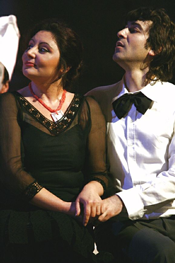
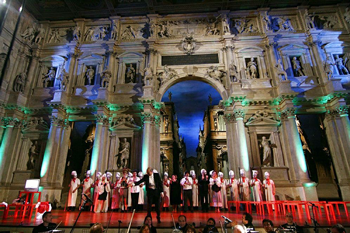
Vicenza’s Teatro Olimpico, a jewel of Renaissance architecture inaugurated in 1585 and seating around 500, hosted in early June a run of three performances of Rossini’s Italiana in Algeri.
For
the cognoscenti, a much anticipated experience, since the production was about the alternative
version staged, under Rossini’s direct control, in the local Teatro Eretenio just three months after
the world premiere in nearby Venice on May 22, 1813. Various period observers, including the
French novelist Stendhal, witness to the craze sparked by Rossini’s oriental fantasy, resulting in
many revivals during the mid-late 1810s. Extramusical circumstances may have played a role,
too.
 “Between 1530 and 1780 there were almost certainly a million and quite possibly as many as a
million and a quarter white, European Christians enslaved by the Muslims of the Barbary Coast”
[which extends from Morocco through modern Libya], reckons Prof. Robert C. Davis. Only in
Algiers there were six “bagnos” (baths) hosting the human prey caught by Barbary pirates during
their raids in the Mediterranean, and even as late in 1830, when the French took over Algiers,
there were still 120 white slaves in the bagno.
“Between 1530 and 1780 there were almost certainly a million and quite possibly as many as a
million and a quarter white, European Christians enslaved by the Muslims of the Barbary Coast”
[which extends from Morocco through modern Libya], reckons Prof. Robert C. Davis. Only in
Algiers there were six “bagnos” (baths) hosting the human prey caught by Barbary pirates during
their raids in the Mediterranean, and even as late in 1830, when the French took over Algiers,
there were still 120 white slaves in the bagno.
Such historical background may qualify L’Italiana in Algeri, loosely based on a real-life incident
involving a lady from Milan, as a conspicuous act of escapism from all-too-present horrors,
while to modern audiences the shadow of the impalement stake, repeatedly waved in front (well,
somewhere else) of poor Taddeo, only amounts to a bawdy phallic gimmick. Stage directors
rarely miss the chance, and Damiano Michieletto was no exception this time. Besides red tables
and modular cubic frames — variously recombined to conjure up Mustafa’s palace, gardens, a
ship etc. — black wooden poles sprouted everywhere. (True, the imposing presence of Palladio’s
three-dimensional sets is a hindrance to any stage designer, thus making minimalism an
unavoidable choice at the Olimpico).
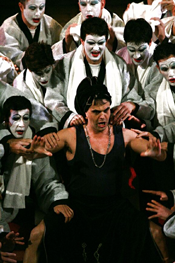
 On the other hand, the acid lighting, the ghoul-like makeup of the eunuchs’ choir, Haly’s fiendish
looks and Mustafa’s rabid behavior conveyed a disquieting atmosphere far from the stock
reading of Rossini’s buffo masterpiece. Only in the finale, with the fugitive Italian slaves
disguised as pizza cooks and green-white-red colors flying around in a reassuring happy end,
some tribute to commonplace was paid. If mildly modernistic and apparently low-budget, the
stage department thus contributed to boost the remarkable musical performance led by Giovanni
Battista Rigon with relentless pulse and unfailing tempo choices. The Orchestra Filarmonia
Veneta “G. F. Malipiero” sounded historically informed in its string section; so did the crisp
woodwinds led by virtuoso oboist and deputy conductor Stefano Romani. Brasses and
percussions (including a rarely-heard chapeau chinois or jingling-Johnny for Janissary local
color) added a brazen touch in the tutti passages, particularly in the finales.
On the other hand, the acid lighting, the ghoul-like makeup of the eunuchs’ choir, Haly’s fiendish
looks and Mustafa’s rabid behavior conveyed a disquieting atmosphere far from the stock
reading of Rossini’s buffo masterpiece. Only in the finale, with the fugitive Italian slaves
disguised as pizza cooks and green-white-red colors flying around in a reassuring happy end,
some tribute to commonplace was paid. If mildly modernistic and apparently low-budget, the
stage department thus contributed to boost the remarkable musical performance led by Giovanni
Battista Rigon with relentless pulse and unfailing tempo choices. The Orchestra Filarmonia
Veneta “G. F. Malipiero” sounded historically informed in its string section; so did the crisp
woodwinds led by virtuoso oboist and deputy conductor Stefano Romani. Brasses and
percussions (including a rarely-heard chapeau chinois or jingling-Johnny for Janissary local
color) added a brazen touch in the tutti passages, particularly in the finales.
In the singing company, the up-and-coming Albanian mezzo Enkelejda Shkosa (Isabella)
displayed buffo stamina alongside impressive coloratura, though her recent weight gain hardly
contributed to the seductive requirements stipulated by her role. Despite a cold start, Lorenzo
Regazzo was a mercurial and domineering Mustafà throughout. If only he could restrain from
cheap effects in the style of third-rate German Kabarett, leading him to unnecessarily tampering
with the pitch. Both Andrea Zaupa, a young and debonair Taddeo, and Chiara Fracasso as Zulma
deserved unconditional praise for their beautiful instruments, mature vocal technique and acting
skills. The same would apply to Luca dell’Amico’s Haly, were it not for a few campish poses
imposed on him by costume designer Manuel Pedretti. Anna Laura Martorana (Elvira) and
Nicola Amodio (Lindoro) took perhaps too many risks with belcanto passagework, but — given
their young age — they may have the potential for further growth.
The main variants in the score involved Isabella’s role. Her substitute cavatina “Cimentando i
venti e l’onde” is studded with exciting virtuoso intricacies right from the start, yet sounds less
effective if compared to the soaring profile of the usual “Cruda sorte”, where the coloratura
batteries are being gradually uncovered after a row of fiery quasi-spoken ejaculations.
Interestingly, both alternative versions were written for the same singer: the Florentine alto (and
Rossini’s mistress) Marietta Marcolini, then in her early thirties. In the aria “Per lui che adoro”,
the core difference was about the accompanying solo instrument — a cello instead of a flute, the
latter being introduced only after 1815. Actually, the lower texture seems to work better: it’s as
much warm, pensive and sexually teasing as the plot requires.
Carlo Vitali