18 Jun 2007
Leipzig Bachfest explores early opera
When opera is the subject, there’s an uneasy embarrassment at Leipzig’s annual 10-day Bach Festival, for opera is a genre that the city’s most famous musical son never embraced.
English Touring Opera are delighted to announce a season of lyric monodramas to tour nationally from October to December. The season features music for solo singer and piano by Argento, Britten, Tippett and Shostakovich with a bold and inventive approach to making opera during social distancing.
This tenth of ten Live from London concerts was in fact a recorded live performance from California. It was no less enjoyable for that, and it was also uplifting to learn that this wasn’t in fact the ‘last’ LfL event that we will be able to enjoy, courtesy of VOCES8 and their fellow vocal ensembles (more below …).
Ever since Wigmore Hall announced their superb series of autumn concerts, all streamed live and available free of charge, I’d been looking forward to this song recital by Ian Bostridge and Imogen Cooper.
Although Stile Antico’s programme article for their Live from London recital introduced their selection from the many treasures of the English Renaissance in the context of the theological debates and upheavals of the Tudor and Elizabethan years, their performance was more evocative of private chamber music than of public liturgy.
Evidently, face masks don’t stifle appreciative “Bravo!”s. And, reducing audience numbers doesn’t lower the volume of such acclamations. For, the audience at Wigmore Hall gave soprano Elizabeth Llewellyn and pianist Simon Lepper a greatly deserved warm reception and hearty response following this lunchtime recital of late-Romantic song.
For this week’s Live from London vocal recital we moved from the home of VOCES8, St Anne and St Agnes in the City of London, to Kings Place, where The Sixteen - who have been associate artists at the venue for some time - presented a programme of music and words bound together by the theme of ‘reflection’.
'Such is your divine Disposation that both you excellently understand, and royally entertaine the Exercise of Musicke.’
‘And there was war in heaven: Michael and his angels fought against the dragon; and the dragon fought and his angels, And prevailed not; neither was their place found any more in heaven … that old serpent … Satan, which deceiveth the whole world: he was cast out into the earth, and his angels were cast out with him.’
There was never any doubt that the fifth of the twelve Met Stars Live in Concert broadcasts was going to be a palpably intense and vivid event, as well as a musically stunning and theatrically enervating experience.
‘Love’ was the theme for this Live from London performance by Apollo5. Given the complexity and diversity of that human emotion, and Apollo5’s reputation for versatility and diverse repertoire, ranging from Renaissance choral music to jazz, from contemporary classical works to popular song, it was no surprise that their programme spanned 500 years and several musical styles.
The Academy of St Martin in the Fields have titled their autumn series of eight concerts - which are taking place at 5pm and 7.30pm on two Saturdays each month at their home venue in Trafalgar Square, and being filmed for streaming the following Thursday - ‘re:connect’.
The London Symphony Orchestra opened their Autumn 2020 season with a homage to Oliver Knussen, who died at the age of 66 in July 2018. The programme traced a national musical lineage through the twentieth century, from Britten to Knussen, on to Mark-Anthony Turnage, and entwining the LSO and Rattle too.
With the Live from London digital vocal festival entering the second half of the series, the festival’s host, VOCES8, returned to their home at St Annes and St Agnes in the City of London to present a sequence of ‘Choral Dances’ - vocal music inspired by dance, embracing diverse genres from the Renaissance madrigal to swing jazz.
Just a few unison string wriggles from the opening of Mozart’s overture to Le nozze di Figaro are enough to make any opera-lover perch on the edge of their seat, in excited anticipation of the drama in music to come, so there could be no other curtain-raiser for this Gala Concert at the Royal Opera House, the latest instalment from ‘their House’ to ‘our houses’.
"Before the ending of the day, creator of all things, we pray that, with your accustomed mercy, you may watch over us."
The doors at The Metropolitan Opera will not open to live audiences until 2021 at the earliest, and the likelihood of normal operatic life resuming in cities around the world looks but a distant dream at present. But, while we may not be invited from our homes into the opera house for some time yet, with its free daily screenings of past productions and its pay-per-view Met Stars Live in Concert series, the Met continues to bring opera into our homes.
Music-making at this year’s Grange Festival Opera may have fallen silent in June and July, but the country house and extensive grounds of The Grange provided an ideal setting for a weekend of twelve specially conceived ‘promenade’ performances encompassing music and dance.
There’s a “slide of harmony” and “all the bones leave your body at that moment and you collapse to the floor, it’s so extraordinary.”
“Music for a while, shall all your cares beguile.”
The hum of bees rising from myriad scented blooms; gentle strains of birdsong; the cheerful chatter of picnickers beside a still lake; decorous thwacks of leather on willow; song and music floating through the warm evening air.
When opera is the subject, there’s an uneasy embarrassment at Leipzig’s annual 10-day Bach Festival, for opera is a genre that the city’s most famous musical son never embraced.
True, in the St. Matthew Passion Bach composed one of the great music dramas of all time, but the opera house itself was an arena alien to him. In Bach’s Baroque age opera was largely a courtly concern, and the Saxon court was down the road in Dresden. Leipzig, mercantile, middle class and Lutheran laced had neither time nor taste for the excesses of entertainment staged in the Catholic capital.
Bachfest 2007, which brought 50,000 Bach fans to Leipzig, corrected this oversimplification of music history.“From Monteverdi to Bach,” the theme of the season, brought a new view of the situation — and with it new music — to light. Indeed, Leipzig had — or had had — an opera, but it folded in 1720, three years before Johann Sebastian Bach arrived as Thomaskantor, the man responsible for music not only at historic St. Thomas Church, but at other churches in the city as well. That opera, nourished at its outset by talent “imported” from Dresden, was founded in 1693 and soon became a venue for young composers who had come to Leipzig to study.
Foremost among them was George Philipp Telemann (1681-1767), who, born four years before Bach, outlived him by another 17. And, as the world well knows, it was only because the then more popular Telemann turned down the job at St. Thomas that Bach was hired. Although Telemann made written reference to 20 operas in his catalogue, until recently only half a dozen arias documented his efforts in the field.
Now, however, an ambitious Michael Maul has proven that some 40 arias in a Frankfurt archive were from Telemann’s “Germanicus,” which was given its modern premiere at the Bachfest ‘07 on June 11 by Gotthold Schwarz and the Saxon Baroque Orchestra. Written in 1704 and revised six years later, “Germanicus” is a tale of love, lust and political intrigue based very loosely on events during the first-century occupation of Teutonic territory by the Romans. Since only arias survive, for recitatives Maul substituted a tongue-in-cheek narrative wittily delivered by actor Dieter Bellmann. Through facial expression and a minimum of gesture a youthful cast made a strong case for the quality of Telemann’s youthful opus. Unusual for that day, librettist for “Germanicus” was Christine Dorothea Lachs, a woman with close connections to musical circles.
Leipzig is the heart of a region rich in music history, and to take advantage of that the Bach Festival stages outings, several of which include recitals on organs from Bach’s day. The season’s focus on Monteverdi took visitors to the tiny 1803 theater in near-by Bad Lauchstädt, designed in part of Goethe and recently restored to his designs for its interior.
On June 12 it was the setting for Monteverdi’s 1640 “Return of Ulysses to his Fatherland” staged by Christophe Rousset, who conducted his early-music ensemble Les Talens Lyriques from the harpsichord. As Penelope and Ulysses Hilary Sommers and Jan Kobow headed a cast of almost 20 amazing singers, who left one wondering how after this highly dramatic achievement Handel could have abandoned himself so completely to routine da capo arias. Rousset founded Les Talens Lyriques in Paris in 1991.
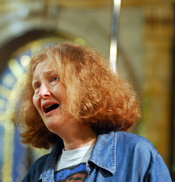 June 16,the penultimate evening of Bachfest ‘07, brought the Yorkshire Bach Choir and Baroque
Soloists to the Michaeliskirche for a performance of Henry Purcell’s “Dido and Aeneas” with
veteran soprano Emma Kirkby as the tragic heroine. Kirkby, a major presence in early music
since her debut in 1973, has a voice magically beyond the reach of time. Her Dido remains of
adolescent tenderness and touching innocence. (And, by the way, it is now Dame Emma.)
June 16,the penultimate evening of Bachfest ‘07, brought the Yorkshire Bach Choir and Baroque
Soloists to the Michaeliskirche for a performance of Henry Purcell’s “Dido and Aeneas” with
veteran soprano Emma Kirkby as the tragic heroine. Kirkby, a major presence in early music
since her debut in 1973, has a voice magically beyond the reach of time. Her Dido remains of
adolescent tenderness and touching innocence. (And, by the way, it is now Dame Emma.)
Bass Stephen Varcoe was — even if a cad — a noble Aeneas, and Helen Neeves a devoted Belinda.
Conductor Peter Seymour, founder of the Yorkshire ensembles, included on the program Daniel Purcell’s “Again the welcome morn we sing” and “Mark how the Lark and Linnet sing” by John Blow, making this concert a generous sampling of English opera in Bach’s day. The above — concert performances all — were accompanied by period-instrument ensembles that documented both the quantity and quality of such players in Europe today.
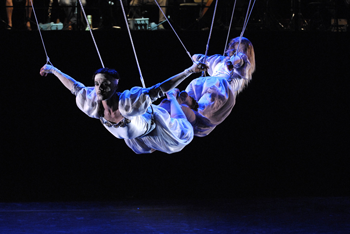
Most unusual staging of the season was Steffan Schleiermacher’s updated version of “The Combat of Tancred and Clorinda,” Monteverdi’s setting for solo voice of a key scene from Tasso’s “Jerusalem Liberated.” Composer-pianist-conductor Schleiermacher, an outstanding figure on Germany’s crossover music scene, is a man well versed in early music, and his “Mackie Messer” approach to this dramatic confrontation, played on the second stage of the Leipzig Opera, was gripping.
While baritone narrator Christopher Jung told the story amid modern instruments — the accordion dominated — the ill-fated lovers were portrayed by dancers who appeared as if marionettes on strings. Schleiermacher paired the brief work with Peter Maxwell Davies’ single-soprano “Miss Donnithorne’s Maggott” under the title “Lost Battles of Love.”
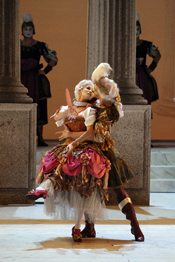
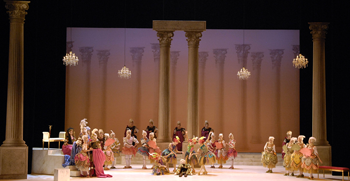 To further underscore the dramatic impulse brought to the arts by the Baroque the Leipzig Opera
staged the first-ever German performance of Jean Georges Noverre’s 1763 ballet “Jason and
Medea.” Danced by the opera’s superb ballet ensemble and directed in Leipzig by Jean Paul
Gravier and Claude Agrafeil, the production, which premiered on June 9, was a revival of a 1992
Strasbourg staging by Sweden’s grand old man of the dance, Ivo Cramer.
To further underscore the dramatic impulse brought to the arts by the Baroque the Leipzig Opera
staged the first-ever German performance of Jean Georges Noverre’s 1763 ballet “Jason and
Medea.” Danced by the opera’s superb ballet ensemble and directed in Leipzig by Jean Paul
Gravier and Claude Agrafeil, the production, which premiered on June 9, was a revival of a 1992
Strasbourg staging by Sweden’s grand old man of the dance, Ivo Cramer.
Jean Joseph Rodolphe’s original score was arranged by England’s Charles Farncombe. In the title roles Martin Chaix and Kiyoko Kimura stressed the grace of dance before ballet went on its toes, and in the fire and fury of Medea’s dance of revenge Kimura made this blood-curdling story the direct antecedent of Samuel Barber’s score on the subject written almost 300 years later.
All Leipzig Opera performances are distinguished by the playing of its pit band, the esteemed Gewandhaus Orchestra. For this performance on 9 July youthful Vincent de Cort conducted with vigor. “You are a Prometheus!” Voltaire once wrote to Noverre. “You form humans and breathe life into them.” In like manner this recreation was a truly Titanic achievement.
Increasingly aware of the importance of outreach programs, the Bachfest this year devoted an entire day to events for children and families. High point of the day was a one-hour reduction of Monteverdi’s “Orfeo” by Taschenoper Lübeck. The “pocket opera” production featured a mere six musicians, some of them doubling as vocalists and instrumentalists.
 Founded in 2005 by students at the Lübeck Conservatory and dedicated to “big opera for little
people,” the talented ensemble brought kids on stage as extras and stage hands, and the entire
audience was rehearsed to appeal to Pluto for the release of Euridice. (Moved by their apprentice
musicianship Pluto pulled out a handkerchief and wept openly in response.)
Founded in 2005 by students at the Lübeck Conservatory and dedicated to “big opera for little
people,” the talented ensemble brought kids on stage as extras and stage hands, and the entire
audience was rehearsed to appeal to Pluto for the release of Euridice. (Moved by their apprentice
musicianship Pluto pulled out a handkerchief and wept openly in response.)
While the “this-isn’t-going-to-hurt” approach that often puts classical music on a par with a visit to the dentist at American kiddie concerts, there was here no talking down to the audience — six is the stated minimum age for admission — nor was there any slapstick. Yet the kids that packed the small Schille – Theaterhaus just minutes from St. Thomas Church were mesmerized by the simple staging that depended on the music — not on carnival-of-the-animals gimmicks — for its magic. Indeed, so fine are these young singers that adults in the audience would have welcomed a complete “Orfeo” by the troupe, whose enthusiasm held listeners in its spell.
The production marked the 400th anniversary of “Orfeo,” the oldest opera in the extant repertory. This impressive cross-section of early opera documented the spectrum of musical expression in the early Baroque, while other performances stressed Bach’s role in bringing the age to its fullest musical flower. And having suggested that the composer’s St. Matthew Passion qualifies as music theater, an “extra” of Bachfest ‘07 was a master class, in which Peter Schreier worked with four young tenors on the role of the Evangelist in the score. Schreier, now 72, was the world’s top performer in this role during the final decades of the 20th century.
Wes Blomster