Recently in Performances
English Touring Opera are delighted to announce a season of lyric monodramas to tour nationally from October to December. The season features music for solo singer and piano by Argento, Britten, Tippett and Shostakovich with a bold and inventive approach to making opera during social distancing.
This tenth of ten Live from London concerts was in fact a recorded live performance from California. It was no less enjoyable for that, and it was also uplifting to learn that this wasn’t in fact the ‘last’ LfL event that we will be able to enjoy, courtesy of VOCES8 and their fellow vocal ensembles (more below …).
Ever since Wigmore Hall announced their superb series of autumn concerts, all streamed live and available free of charge, I’d been looking forward to this song recital by Ian Bostridge and Imogen Cooper.
Although Stile Antico’s programme article for their Live from London recital introduced their selection from the many treasures of the English Renaissance in the context of the theological debates and upheavals of the Tudor and Elizabethan years, their performance was more evocative of private chamber music than of public liturgy.
Evidently, face masks don’t stifle appreciative “Bravo!”s. And, reducing audience numbers doesn’t lower the volume of such acclamations. For, the audience at Wigmore Hall gave soprano Elizabeth Llewellyn and pianist Simon Lepper a greatly deserved warm reception and hearty response following this lunchtime recital of late-Romantic song.
For this week’s Live from London vocal recital we moved from the home of VOCES8, St Anne and St Agnes in the City of London, to Kings Place, where The Sixteen - who have been associate artists at the venue for some time - presented a programme of music and words bound together by the theme of ‘reflection’.
'Such is your divine Disposation that both you excellently understand, and royally entertaine the Exercise of Musicke.’
‘And there was war in heaven: Michael and his angels fought against the dragon; and the dragon fought and his angels, And prevailed not; neither was their place found any more in heaven … that old serpent … Satan, which deceiveth the whole world: he was cast out into the earth, and his angels were cast out with him.’
There was never any doubt that the fifth of the twelve Met Stars Live in Concert broadcasts was going to be a palpably intense and vivid event, as well as a musically stunning and theatrically enervating experience.
‘Love’ was the theme for this Live from London performance by Apollo5. Given the complexity and diversity of that human emotion, and Apollo5’s reputation for versatility and diverse repertoire, ranging from Renaissance choral music to jazz, from contemporary classical works to popular song, it was no surprise that their programme spanned 500 years and several musical styles.
The Academy of St Martin in the Fields have titled their autumn series of eight concerts - which are taking place at 5pm and 7.30pm on two Saturdays each month at their home venue in Trafalgar Square, and being filmed for streaming the following Thursday - ‘re:connect’.
The London Symphony Orchestra opened their Autumn 2020 season with a homage to Oliver Knussen, who died at the age of 66 in July 2018. The programme traced a national musical lineage through the twentieth century, from Britten to Knussen, on to Mark-Anthony Turnage, and entwining the LSO and Rattle too.
With the Live from London digital vocal festival entering the second half of the series, the festival’s host, VOCES8, returned to their home at St Annes and St Agnes in the City of London to present a sequence of ‘Choral Dances’ - vocal music inspired by dance, embracing diverse genres from the Renaissance madrigal to swing jazz.
Just a few unison string wriggles from the opening of Mozart’s overture to Le nozze di Figaro are enough to make any opera-lover perch on the edge of their seat, in excited anticipation of the drama in music to come, so there could be no other curtain-raiser for this Gala Concert at the Royal Opera House, the latest instalment from ‘their House’ to ‘our houses’.
"Before the ending of the day, creator of all things, we pray that, with your accustomed mercy, you may watch over us."
The doors at The Metropolitan Opera will not open to live audiences until 2021 at the earliest, and the likelihood of normal operatic life resuming in cities around the world looks but a distant dream at present. But, while we may not be invited from our homes into the opera house for some time yet, with its free daily screenings of past productions and its pay-per-view Met Stars Live in Concert series, the Met continues to bring opera into our homes.
Music-making at this year’s Grange Festival Opera may have fallen silent in June and July, but the country house and extensive grounds of The Grange provided an ideal setting for a weekend of twelve specially conceived ‘promenade’ performances encompassing music and dance.
There’s a “slide of harmony” and “all the bones leave your body at that moment and you collapse to the floor, it’s so extraordinary.”
“Music for a while, shall all your cares beguile.”
The hum of bees rising from myriad scented blooms; gentle strains of birdsong; the cheerful chatter of picnickers beside a still lake; decorous thwacks of leather on willow; song and music floating through the warm evening air.
Performances
21 Jun 2007
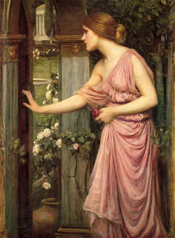
Lully’s Psyché at Boston Early Music Festival
There’s not much point in presenting Lully’s Psyché (in its North American premiere no less) unless you’re going to give it something vaguely like the grandeur Louis XIV could command in 1678.
In a down-home way, Boston’s biennial Early Music Festival achieved this to a remarkable
extent: instrumentalists and singers from the front ranks of antique performing practice led by
BEMF’s longtime opera conductors, Paul O’Dette and Stephen Stubbs, the staging glamorous
but basic, with elaborate dance interludes that were always a significant part of (often the
principal excuse for) opera in France, costumes worthy of a costume ball at Versailles, and
elaborate stage machinery — there’s a whole lot of flying going on, and entrances are made from
above as often as from the wings.
Opera is not a word Lully or his collaborators used for such pieces, and indeed at that point no
one in France was quite sure what “opera” meant. Tragédie lyrique, a sung and acted drama, was
the thing. Lully’s dignified and magical creations soon circulated about Western Europe. Much
of the singing is declamation of stately rather than lyrical melody, a grand manner passed on via
Rameau to Gluck, Berlioz and Poulenc. (Wagner made effective use of it too.) This can be
unsettling to the average operagoer, accustomed to the song-like manner of Italian opera; but the
appreciative audience at the jewel-box Cutler Majestic Theater, accustomed to the stylistic
vagaries of older music, ate it up. What gave more pause is another enduring eccentricity of
French style: the equal rights accorded to ballet. There are dances throughout Psyché, and the
piece concludes with a good half hour of it. This was very prettily achieved in the court manner,
but the Boston audience wearied about halfway through the long finale. This is not to fault Lucy
Graham, the choreographer, who found exceptional variety in the fixed gestures and poses of
court dance, and introduced several whimsical interludes, including a ten-minute “commedia
dell’ arte” mimed by the traditional Italian figures. (The enormous and obviously devoted
production team included a “Vocal and Gesture Coach.”)
The story is the late classical myth of Psyche (“Soul”), the mortal so beautiful that a jealous
Venus vows to destroy her. Venus’s son (L’Amour in the French version), charged with the girl’s
destruction, falls for her himself and carries her off to a magical palace where, however, she is
forbidden to see what he looks like. Of course, she cheats (cf. Lohengrin and Bluebeard) — in
Psyché, it’s because Venus tricks her into doing so — and he leaves her. To get him back, Psyche
must descend to the Underworld to fetch Venus a box of beauty from its queen, Proserpine. Of
course, she peeks into the box and is lost — but this time the gods relent, Jupiter promotes her to
goddess, and all ends happily with the Soul mated to Divine Love. (The subtext, as program
essays made plan, concerned the love affair of Louis XIV and Madame de Montespan.)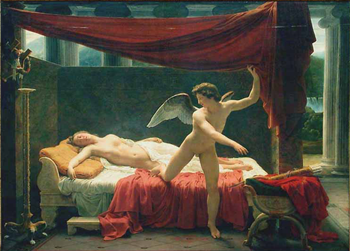
Among the singers, as was only proper, the finest had the largest parts: Carolyn Sampson, the
pretty Psyché, who sang and acted her long role with conviction and sweet, untiring tone, and
Karina Gauvin, as Venus, the opera’s heavy, a role she acquitted with great verve. The episodic
narrative included many charming episodes, wittily staged — for instance a marital spat between
Gauvin and Colin Balzer, whose lyrical tenor seemed far too attractive for Vulcan, the
hardworking smith-god: “You always side with lovers and against husbands,” he sang to her, and
the joke was as good in 2007 as in 1678. Lully wrote the Furies — usually visualized as
shrieking women — for three low male voices, and the production accordingly presented three
men in black, seventeenth-century drag to berate the heroine for intruding upon the dead.
L’Amour was acted and, for a line or two, sung, by a winged child actor in order to conform to
Cupid’s traditional iconography, but for the wedding night the god magically adopted the form of
a full-grown tenor the better to sing duets with. Of the mostly able singers in the many smaller
roles, countertenor José Lemos as Silenus had a ravishing sound one would be eager to encounter
again.
John Yohalem