05 Jun 2007
Pasatieri’s return to opera impressive
The June 2 world premiere of “Frau Margot” at the Fort Worth Opera might be regarded as “an historic return,” for this is Thomas Pasitieri’s first opera in 18 years.
English Touring Opera are delighted to announce a season of lyric monodramas to tour nationally from October to December. The season features music for solo singer and piano by Argento, Britten, Tippett and Shostakovich with a bold and inventive approach to making opera during social distancing.
This tenth of ten Live from London concerts was in fact a recorded live performance from California. It was no less enjoyable for that, and it was also uplifting to learn that this wasn’t in fact the ‘last’ LfL event that we will be able to enjoy, courtesy of VOCES8 and their fellow vocal ensembles (more below …).
Ever since Wigmore Hall announced their superb series of autumn concerts, all streamed live and available free of charge, I’d been looking forward to this song recital by Ian Bostridge and Imogen Cooper.
Although Stile Antico’s programme article for their Live from London recital introduced their selection from the many treasures of the English Renaissance in the context of the theological debates and upheavals of the Tudor and Elizabethan years, their performance was more evocative of private chamber music than of public liturgy.
Evidently, face masks don’t stifle appreciative “Bravo!”s. And, reducing audience numbers doesn’t lower the volume of such acclamations. For, the audience at Wigmore Hall gave soprano Elizabeth Llewellyn and pianist Simon Lepper a greatly deserved warm reception and hearty response following this lunchtime recital of late-Romantic song.
For this week’s Live from London vocal recital we moved from the home of VOCES8, St Anne and St Agnes in the City of London, to Kings Place, where The Sixteen - who have been associate artists at the venue for some time - presented a programme of music and words bound together by the theme of ‘reflection’.
'Such is your divine Disposation that both you excellently understand, and royally entertaine the Exercise of Musicke.’
‘And there was war in heaven: Michael and his angels fought against the dragon; and the dragon fought and his angels, And prevailed not; neither was their place found any more in heaven … that old serpent … Satan, which deceiveth the whole world: he was cast out into the earth, and his angels were cast out with him.’
There was never any doubt that the fifth of the twelve Met Stars Live in Concert broadcasts was going to be a palpably intense and vivid event, as well as a musically stunning and theatrically enervating experience.
‘Love’ was the theme for this Live from London performance by Apollo5. Given the complexity and diversity of that human emotion, and Apollo5’s reputation for versatility and diverse repertoire, ranging from Renaissance choral music to jazz, from contemporary classical works to popular song, it was no surprise that their programme spanned 500 years and several musical styles.
The Academy of St Martin in the Fields have titled their autumn series of eight concerts - which are taking place at 5pm and 7.30pm on two Saturdays each month at their home venue in Trafalgar Square, and being filmed for streaming the following Thursday - ‘re:connect’.
The London Symphony Orchestra opened their Autumn 2020 season with a homage to Oliver Knussen, who died at the age of 66 in July 2018. The programme traced a national musical lineage through the twentieth century, from Britten to Knussen, on to Mark-Anthony Turnage, and entwining the LSO and Rattle too.
With the Live from London digital vocal festival entering the second half of the series, the festival’s host, VOCES8, returned to their home at St Annes and St Agnes in the City of London to present a sequence of ‘Choral Dances’ - vocal music inspired by dance, embracing diverse genres from the Renaissance madrigal to swing jazz.
Just a few unison string wriggles from the opening of Mozart’s overture to Le nozze di Figaro are enough to make any opera-lover perch on the edge of their seat, in excited anticipation of the drama in music to come, so there could be no other curtain-raiser for this Gala Concert at the Royal Opera House, the latest instalment from ‘their House’ to ‘our houses’.
"Before the ending of the day, creator of all things, we pray that, with your accustomed mercy, you may watch over us."
The doors at The Metropolitan Opera will not open to live audiences until 2021 at the earliest, and the likelihood of normal operatic life resuming in cities around the world looks but a distant dream at present. But, while we may not be invited from our homes into the opera house for some time yet, with its free daily screenings of past productions and its pay-per-view Met Stars Live in Concert series, the Met continues to bring opera into our homes.
Music-making at this year’s Grange Festival Opera may have fallen silent in June and July, but the country house and extensive grounds of The Grange provided an ideal setting for a weekend of twelve specially conceived ‘promenade’ performances encompassing music and dance.
There’s a “slide of harmony” and “all the bones leave your body at that moment and you collapse to the floor, it’s so extraordinary.”
“Music for a while, shall all your cares beguile.”
The hum of bees rising from myriad scented blooms; gentle strains of birdsong; the cheerful chatter of picnickers beside a still lake; decorous thwacks of leather on willow; song and music floating through the warm evening air.
The June 2 world premiere of “Frau Margot” at the Fort Worth Opera might be regarded as “an historic return,” for this is Thomas Pasitieri’s first opera in 18 years.
And the work has all the markings of a masterpiece; indeed, it gives rise to the hope that he has another opera up his sleeve.
The composer of a spate of operas, Pasatieri is best known for “The Seagull,” premiered at the Houston Grand Opera in 1984. A few years later he put opera aside and moved to Hollywood. (If you’ve seen “American Beauty,” “Fried Green Tomatoes” or “Magnolia” you’ve heard him — probably without realizing it.)
“Frau Margot” is a collective endeavor that involved the talents of many people over a long period of time. “Nest egg” was a report brought to librettist and director Frank Corsaro from Vienna by Leonard Bernstein. The then young conductor/composer had visited Helene Berg, widow of composer Alban Berg, whose opera “Lulu” was left incomplete when he died in 1935. Bernstein - like many others - sought permission to finish the score from Berg’s sketches for a third act. (Performances of the completed two acts had become common.)
Frau Berg refused after consulting with her late husband through a sèance, the Internet of that age of rampant spiritualism. (A good bit of laudanum helped her make the connection.) The widow refused permission — as she continued to do until her death in 1978.
Corsaro made a play of Bernstein’s story and called it “Lyric Suite,” the title of Berg’s most performed chamber work. However, given the near-universal aversion to dissonant music, he was unable to find a producer. On a visit to New York in 2003 Pasatieri told Corsaro, the director of the Houston “Seagull” and several other works by the composer, that he wanted to return to opera. Corsaro gave him his play. Then FWO general director Darren Woods ran into Corsaro and Pasatieri at a party. Woods was seeking a project for “down the road,” and “Frau Margot” was commissioned.
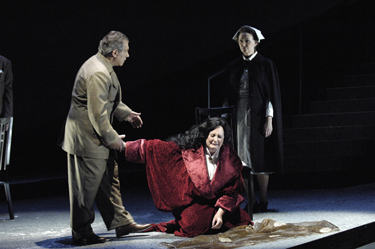 Corsaro then turned his drama into a detective story, a Gothic tale of a widow’s murder of a
former mistress of her husband. (It was long suspected that Frau Berg kept the “Lulu” fragment
under wraps because it documented her husband’s extra-marital activity.) Corsaro gave the
characters fictional names and began the new version with an investigation of the murder,
followed by a flashback to the Bernstein story. The young composer shared the beds of both the
widow and of Kara Sondstrom, who had been the mistress of the deceased master. He set the
story in Amsterdam, which, however, is clearly a facade for Freud’s Vienna with its seething,
all-pervasive sexuality. In that l’art pour l’art age “reality” had become an elusive concept that
allows us — as Hugo von Hofmannsthal, the greatest poet of the age, said — “to play theater —
play the characters in our own dramas.”
Corsaro then turned his drama into a detective story, a Gothic tale of a widow’s murder of a
former mistress of her husband. (It was long suspected that Frau Berg kept the “Lulu” fragment
under wraps because it documented her husband’s extra-marital activity.) Corsaro gave the
characters fictional names and began the new version with an investigation of the murder,
followed by a flashback to the Bernstein story. The young composer shared the beds of both the
widow and of Kara Sondstrom, who had been the mistress of the deceased master. He set the
story in Amsterdam, which, however, is clearly a facade for Freud’s Vienna with its seething,
all-pervasive sexuality. In that l’art pour l’art age “reality” had become an elusive concept that
allows us — as Hugo von Hofmannsthal, the greatest poet of the age, said — “to play theater —
play the characters in our own dramas.”
At first glance it might seem that the librettist muddied the waters needlessly with his additions to music history. Things were complex enough in the Berg household without emendations. Yet even the shadow of lesbianism that darkens the co-dependency that bind Margot to Kara is no more than a reflection of the obsession of fin-de-siècle Vienna with matters of the flesh. About the city at that time Viennese author Stefan Zweig wrote that “the air felt perfumed and unhealthy; a dishonest morality hung over us like a nightmare.” And man-about-town Karl Kraus commented that Vienna was “spiritually bankrupt.” And it was in spite — or perhaps precisely because — of that it was also the scene of a golden age in the arts.
With amazing success Pasatieri has captured all this in a score of a voluptuous splendor that suggests Klimt’s gilded paintings set to music. And this is what makes “Frau Margot” a masterpiece, for the composer has not only laid bare the nervous mental machinations of his characters; he has rendered turn-of-the-century Vienna with its undertow of threatening darkness audible. A muted sadness speaks from the libretto’s reference to “the hope for that love that sustains the fragile heart and makes life durable.” This melancholy sounds again from the final confession of the major male characters in the opera: “I have not lived the life I meant to live.” “Life and death,” Corsaro writes, “are one and the same.” Small wonder that Pasatieri’s gorgeous music speaks with heavy eyelids.
The score — three hours with two intermissions — pulses with an uninterrupted rapture that draws listeners into the music, putting them — as it were — on stage in the middle of the action. Two changes, however, must be made. The “barber-shop” quartet of waiters in Act One breaks with the style of the work and should be excised. And the spoof of ageing divas was especially tasteless when such senior sopranos as Catherine Malfitano and Evelyn Lear — both with long-standing connections to the FWO — were in the audience for the premiere in Fort Worth’s handsome Bass Performance Center.
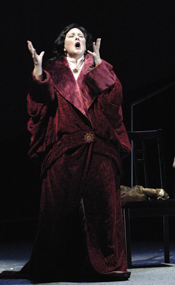
“Frau Margot” was written for Lauren Flanigan, who in the title role could easily be taken for one of Klimt’s well-born models. And her fundamentally lyric soprano has just the dramatic heft that the part demands. “Stumbling along in her loneliness,” as the libretto says, she was here a stunning incarnation of the uneasy splendor of the age.
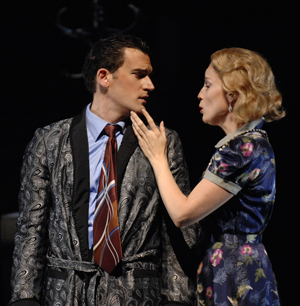 As Kara Sondstrom, the friend who betrayed Margot, Patricia Risley provided exactly the
contrast between the two women required by the score. And baritone Morgan Smith as Ted
Steiner, the composer who had set out to complete the unfinished opera in question, is young,
handsome and innocent enough to get caught in this spider web of erotic desire without full
awareness of what stood before him.
As Kara Sondstrom, the friend who betrayed Margot, Patricia Risley provided exactly the
contrast between the two women required by the score. And baritone Morgan Smith as Ted
Steiner, the composer who had set out to complete the unfinished opera in question, is young,
handsome and innocent enough to get caught in this spider web of erotic desire without full
awareness of what stood before him.
The “who-done-it?” frame within which the story is told was nicely provided by Canadian bass-baritone Daniel Okulitch, and Alan Glassman had the required maturity to make his unrequited love for Margot touching.
The single set by Alison Nalder was entirely in black and white with scene changes achieved through enlarged background projections of buildings and people. Costumes true to the period were by Steven Bryant.
FWO music director Joseph Illick, involved in early workshops on the score, demonstrated a refined understanding of the work, and members of the Fort Worth Symphony outdid themselves in recreating the lush “feel” of the story’s era.
“Frau Margot” has been the centerpiece of Fort Worth Opera’s 60th anniversary celebration, which has witnessed a total reshaping of the company’s season. In recent years FWO has spaced three productions during the fall/winter season. Now it has consolidated them in a three-week early summer festival that focuses special attention on both the FWO and its home city.
“Frau Margot” has alternated on stage with “Madama Butterfly” and “Falstaff,” and in a joint enterprise with the city’s Cliburn Concerts the festival included a gala performance Rossini’s Petite Messe Solennelle. (Fort Worth is home to pianist Van Cliburn and the international competition that honors him.) In 1981 FWO commissioned a children’s opera from Thomas Pasatieri and that adds yet another layer of meaning to his “return” to opera — and Fort Worth — with “Frau Margot.”
Pasatieri, born in 1945, was a prodigy both as pianist and composer. He studied in France with Nadja Boulanger and earned the first doctorate given by the Juilliard School.
Footnote: It was an open secret in imperial Vienna that Helene Berg was the child of Kaiser Franz Joseph I, whose mistress her mother had been. A singer of note, she was cut from the same cloth as femme fatale Alma Mahler. Indeed, it seems that Corsaro and Pasatieri have given Frau Margot something of the allure of the legendary Alma.
Wes Blomster