Okay, here is an
Italian opera played to German speakers, and they chose to do this scene in
English. We were apparently at stag night on a Universal
studios tour of the Wild West sound stage.
A young woman dressed as a dance hall hostess (think Miss Kitty), tells
them to take their seats in the bleachers, chats them up, telling them they
are going to see a piece by Gee-Ah-Koh-Moh Puke-Chee-Nee,
and then finally (with a Texas accent that is lost in print) shouts
[I am not making this up!!]:
Would y’all like to see some Indians? (Yeeeeeaaaah)
Would y’all like to see some . . .cowboys? (Yeeeeeeeaaaaaaaaaaah)
Would y’all like to see. . . . some motherfuckin’
GUNS?!?! (Yeeeeeeeeeeeeaaaaaaaah)
Then the music began.
It was all but impossible to tell who was who at first. The Wild West
sound stage crew were enacting a mish-mosh “show” for these
tourists that had precious little to do with the story or character
relationships. Minnie arrived on a trapeze flown in from above, dressed as a
blond circus girl in tights and spangly bodice, not unlike Mae West in
“Diamond Lil.”
She sang her bible reading scene without bible, from the trapeze, making
no sense. Dick Johnson arrived on a horse, and just sat around for a long
time, and since there was another guy on a horse next to him, no one paid him
any mind.
Rance was an Asian baritone (this becomes important later), in fact there
were lots of Asians in the Stuttgart cast. Maybe they work cheap? There were
so many distractions, I don't know where to begin: Uncle Sam on stilts with a
cane that shot confetti repeatedly, a living Statue of Liberty, minor
soloists amplified with hand held mikes like a lounge act, a stunning cowgirl
“extra” who turns out to be Wowkle, the sullen Indian squaw, for
God’s sake. At one point a miner had an extended solo and I could not
find him on the stage. Could not. I heard him, but could not find him in the
melee.
During Johnson’s extended solo during the duet, a Union soldier (!)
does a handstand and then walks on his hands across the entire apron of the
stage. When Minnie sings, a giant crate is delivered center stage, and the
miners (or whoever they are) open it, and then one by one they mug and camp
and “take” their way down a trapdoor while she and Johnson are
singing their duet. Oh, and they shot cap guns a lot. And there were
confederate flags hung all over the house. (It’s the California Gold
Rush (1849-50)! Hellooooooo!!)
And one miner got hung by the neck but instead of staying dead, they gave
him a guitar which he played. There is a “well-hung” joke there
somewhere but I haven't figured it out yet.
When the waltz started, first two quite amorous men started dancing, then
others, and then some sound stage director (I guess), started making
amplified German announcements/directions of what they should do, over the
music.
By Act II, we are in the split level dressing trailer of Miss Minnie.
First, party girl Wowkle enters with a miner and a huge carnival teddy bear,
with which she has sex on the sofa. This turns into a three-way when Miner
Man pulls down teddy’s boxers (although not his own), and enters teddy
from the rear. When Minnie comes in and throws them out, the duo become
paparazzi, annoyingly photographing everything for the rest
of the act. Everything. Did I mention for the rest of the act?
Minnie changes into a silver lame dress slit up to her hip, and swaps wigs
to complete a redheaded Rita Hayworth look. She has apparently invited
Johnson over to dinner which, she proudly shows him, is a green Jello mold.
Which she puts in the microwave. Sing sing sing sing – DING! The cooking is
finished. It looks none the worse for wear, so she carves it and serves it as
though it were a roast. And they eat it with knives and forks like good
Europeans.
Then, obviously she has another culinary surprise in store for him, and
she brings out an identical red Jello mold which they giggle over like middle
schoolers, poking it and pulling bits loose with their fingers. Of course,
then all hell breaks loose, and some 50’s Vegas thugs (including Rance)
arrive brandishing pistols. Costumes get a little weirder here with lots of
“Gangsta Wrap.”
One of Rance’s side kicks sits down and starts enjoying leftover
Jello, which annoys the hell out of the Sheriff. So he picks up handfuls of
it and stuffs it in the guy’s mouth and holds it shut until he
swallows. (I am not making this up.) This may be the very
first time in operatic history that Jello was a major prop.
The famous poker scene consists of Minne and Rance staring each other down
while Minne throws cards at him and in the air, until she throws the
remainder at him as she exclaims “Three aces and a pair.” And
then they both break character and laugh laugh laugh laugh laugh, like they
had some “in” joke. Then Minnie sobs uncontrollably until we
transition to some nether region for Act III.
All the cast save the leads are now wearing colorful Mexican tourist
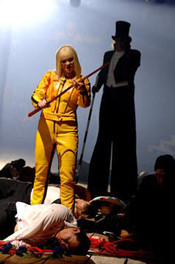
sombreros, and are shrouded in a mist. Uncle Sam on stilts is back as some
miner or another on stilts, in a tuxedo. He must be a symbol. Of. . .?????
Johnson is finally captured house right with three red ropes, and dragged
on stage. As he sings his gallows aria (nowhere near one), the rest of the
cast shoot and kill each other rather noisily in pantomimed slo-mo and drop
dead to the floor. The tenor could have had a sparkler in his teeth and no
one would have noticed. Stilts Man sprinkles them all with glitter. Fairy
Dust? Who knows?
Finally, Rance (here’s the Asian motif) starts to execute Johnson
with a Samurai sword, but lo, Minnie appears with her own Samurai sword,
dressed like she had just come from a callback audition for the “The
Fantastic Four.” They spar and she kills him, with Rance lingering a
long time with the damn sword stuck under his armpit. The dead all sing (to
audience laughs), then get up.
They all exit, leaving Minnie and Johnson splitting and singing how they
are together.
Lights out. Audience boos.
What a mess. I think there actually may be a workable concept in all this,
but it is so busy, so unfocused, and so self-indulgent that it does not come
close to being representative of this piece. Fanciulla is still a
caviar piece, and needs to be attractively produced to win favor with an
audience. Being all over the map did not win this work any new fans.
And sadly, the leads were not up to par. The Russian soprano should stop
and fix her problems. The baritone was okay, and the Asian tenor was the best
of the lot, but lisped much of his Italian like he was Castilian. I have a
hard time believing that any one of them would have gotten to the Met Council
finals. And the conducting was dry and correct, when it needed to have
Puccini Passion.
Anyhow, there is my take on Bieito’s “Fanciulla.” I
wouId not be in a hurry to see a production of his again. Or to go to
Stuttgart Opera again anytime soon.
James Sohre