However, in the case of one
ill-conceived production (Monteverdi’s “Orfeo”), “don’t
look at all” might have been better advice.
Glass: Orphee
To start with the best, Phillip Glass’ “Orphee” based on the
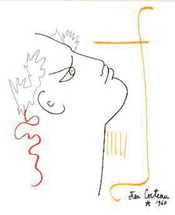
Cocteau film is a hypnotic, brooding piece set in the confines of a trendy
luxury apartment where truly spooky things keep happening. The piece is
referred to as a “meditation on the relationship between the artist and
death.” The signature repetitive arpeggiated harmonies, pulsing
rhythmic stings, and alternating arching vocal melodies and repeated pitches
were all there, and this was very very enjoyable Glass.
After a boozy confrontation at a chi-chi cocktail party, the eerie traffic
death of an upstart young rival poet “Cegeste,” sets the wheels
in motion for the appearance of “La Princesse” (Lisa Saffer in an
exciting, high-flying performance) and her handsome chauffeur
“Heurtebise” (Jeffrey Lentz in yet another superb and understated
portrayal). There is much blurring of lines between the underworld, life,
spirituality, and death in a fluid script/score that tumbles forward from one
compelling scenario to another. Who’s alive? Who’s dead? Who’s next? Who
knows? Wonderfully unsettling and ambiguous stuff.
Philip Cutlip and Caroline Worra each contributed solid singing and
dramatic commitment as the title role and his doomed spouse. If the vocal
writing for these two seemed a little more generic, both fleshed out their
portrayals with fire and commitment. All of the smaller roles were cast from
strength, notable highlights being Christopher Job’s “Poet” and
the “Judge” of Christopher Temporelli, two of the Young American
Artists who were excellent in all of their weekend-long assignments. The
spot-on atmospheric designs, superbly calculated stage direction (what
beautiful stage pictures were created with such an
“inevitability” about them!), and the controlled conducting of
Anne Manson combined to make a solid case for this intriguing piece.
Offenbach: Orpheus in the Underworld
Too bad that the quality level took a step down with a rather lackluster
mounting of Offenbach’s “Orpheus in the Underworld.” Major
exceptions should be stated up front: Joyce Castle (Public Opinion) and Jake
Gardner (Jupiter) performed with skill and comic nuance, sang well, and
comported themselves like the seasoned pros that they are. They were matched
by a wonderfully fey, wonderfully sung “Mercury” from tenor
Joseph Gaines, who by the way, also gave a lovely Young Artist’s recital at
week’s end accompanied by Timothy Hoekman.
The mostly witty set designs were sadly not matched by the garish,
over-the-top costumes that strained to be funny, but at best were silly, and
at worst were highly unflattering. The stilted declamatory speaking style
sapped the comic life from a duff translation, and there was just not another
performer (save the three mentioned) really capable of a star turn, in a
piece that calls for nothing but little star turns.
The small-voiced and ill-mannered “Cupid” of Joelle Harvey
fared better on her second set piece when there was a solid scenery flat
behind her to help float her sound over the footlights. I had the feeling
that Donna Smith’s (best of the lot) “Venus,” Ellen Wieser’s
“Diana,” and Susan Jean Hellman’s "Minerva” all had better
performances in them, strapped as they were by cliched character concepts and
poorly chosen stage placement. Kurt Lehmann’s "Orpheus” and the
“Aristeus/Pluto” from Marc Heller were rather clunky and did not
help matters, nor did the limp conducting of Jean-Marie Zeitouni (which
gained a little more sparkle in Act II).
Little of the “humor” was character-based, so all of the
schtick and takes and mugging and over-staging seemed to me slathered-on,
half-hearted silliness. The choice to make “Eurydice’s”
(pleasing-voiced Jill Gardner) home in Hades a bright red brothel did not
help matters, and the motley, unfocused “decadent” orgy at
operetta’s end was a mess of visual images and been-there, seen-that
“drunken,” mock-salacious cross-dressing choristers. Save it for
the Mummers Parade, please!
Oddly, with everything else over-staged and micro-managed, the one
selection that should have had some well-choreographed flair, the famous
Can-Can, was curiously flat. A few nice cartwheels from the dancing duo and
invited “guests” were just not enough. If this piece of fluff
indeed has a shelf life, it needs a far more imaginative “take”
to make its intended effect.
Gluck/Berlioz: Orphee et Eurydice
The Gluck/Berlioz “Orphee et Eurydice” was treated to a
gorgeous production, lovingly conceived and designed, masterfully directed,
and beautifully sung. Male soprano Michael Maniaci as “Orphee”
seems to have it all: good looks, a uniquely beautiful instrument and
responsive technique, passionate and affecting phrasing, and commanding stage
presence. If the very lowest notes of the role were only touched upon, this
is still a most impressive instrument, and a major star performance that was
cheered to the rafters.
He was ably partnered by the touching, well-voiced “Eurydice”
of Amanda Pabyan. Young Artists Brenda Rae as “L’Amour” and
Caitlin Lynch as “Une Ombre Heureuse” made substantial
contributions, as did the entire youthful ensemble, whether cavorting as
peasants, writhing as Furies, or peopling Elysian Fields.
The handsome set, lighting, and period costumes in neutral grays, beiges,
and browns were greeted with applause at curtain-rise, and the visual
delights were sustained throughout with simple but highly effective scenic
effects.
Director Lillian Groag used meaningful movement to create pleasing stage
pictures, and well-chosen blocking underscored the tragedy without
distracting from it. Two dancers were employed in various guises to provide
visual variety. In a clever final “instant replay” of the whole
story at opera’s close, the duo portrayed that “Eurydice” was not
in fact redeemed a second time, but rather remained lifeless, as
“L’Amour” blithely exits leaving us without a Deus (Dea?) Ex
Machina. Having observed this dance, "Orphee” stands up bewildered as
the curtain falls. It was a neat tweak to the happy ending Gluck
manufactured, leaving us to wonder if our heroine was really left standing. .
.or not.
Monteverdi: Orfeo
That leaves the maddening 400-anniversary year production of Monteverdi’s
"Orfeo.” Maddening, mostly because musically it was just stunning.
Indeed, I am not sure it could have been bettered. Superb orchestral playing
under Antony Walker supported uniformly excellent singing: correctly
stylized, invested with passion, well ornamented, and immaculately prepared.
But. . .this was without a doubt the ugliest and poorest realization of an
operatic piece I have ever seen. Yes, ever. In fact, I am not sure what it
“meant,” but let me try to share some impressions.
The set appeared to be a Soviet-era-like overblown public building with
beige marble walls, and (shades of Sartre) no exit, save some open windows,
chest-level, through which singers entered and in which they occasionally
posed, somewhat as living statuary. Costumes were all over the place in
period, perhaps to suggest universality, or perhaps to say “who gives a
toss what you think.” Everyone is lounging around smoking. Is it an
opium den? A day room in a frat house? Break time at a communist party
meeting? Who cares?
The set was filled with faded sofas, over-stuffed chairs, settees, and
sofas which appeared to have been gathered by going “junking” on
bulk garbage pick-up day in Cooperstown. Ugly ugly ugly. At curtain rise,
“La Musica” is dressed in a purple sequined. . .what? Chorus girl
costume? “Orfeo” is slumped despondently in an armchair, in blue
jeans, a tee shirt, horn-rimmed glasses, and. . . what is that around his
waist? A prayer shawl? His sister’s macrame project? What?
The incoherent presentation was quite devoid of a transparent
through-line. “La Musica” (well sung by Juliet Petrus) just
couldn’t stand up straight, or at all, for almost the whole of the opera and
kept crawling, falling, tottering, and lurching around seemingly at will.
When “Orfeo” and his two buds are happily celebrating in the
fields, they behave as three unruly pre-schoolers jumping up and down on the
furniture inanely.
White-robed “Euridice” (Megan Monaghan) disappears with our
hero to have a liaison behind a sofa, before it being declared in a
pseudo-wedding scene that they have not yet consummated their relationship.
With the many doublings and with no costume changes, it was difficult to tell
who most of the singers were at any given time. I can say that among all the
terrific soloists, Katherine Rohrer gave a peerless performance of the
Messenger’s sad tidings, exceedingly well internalized and characterized.
Shortly thereafter, when our heroine is sent to Hades, she is forced to
stand against the upstage center wall with her hands out to her sides, and
"they” proceed to duct tape her arms to the wall with great fanfare,
ripping off big, loud, long strips of tape in a loooooooooong silence after
Act One’s music had ended, until the curtain oh-so-slowly descended.
“Orfeo” having put on a grey hooded sweatshirt, pulling it
tightly closed over his face (as I wish I could have done), and slumping to
the ground, was left on the apron for the interval.
A Vox Populi check at intermission did not find happy opera-goers, to say
the least. One women in a refreshment line declared this to be a “two
ice cream bar intermission.” The curtain rose in silence for Act Two to
reveal that much much more tape had been applied to poor “E.”
Enough tape that I wished I had stock in Home Depot. At last, the girl-taping
was finished and the beautiful music began anew, only to be accompanied by
one last loooong rip of tape as the river Styx was created with one single
line of duct tape suspended across the stage.
Fast forward to our hero being presented by a teetering “La
Musica” with a beat-up music stand down center which holds the score
for his lament. In a moment blessedly free of hi jinks, tenor Michael
Slattery presented a memorable, raw, emotions bared account. His was a superb
vocal realization throughout. He apparently overcomes his fear of duct tape
to break through the “river” and tear his love off the wall with
no little effort. But, gee, she seems to like the wall, and tears herself
free of him, only to return to stand again in front of it,
“stuck” in the habit, if not by the tape.
More shuffling and hurling of chairs, more smoking, more ensemble members
awkwardly heaving themselves up and onto the window sills.
“Orfeo” at last finds the wing chair in which he began the opera.
Dragging it down center, he now cowers in it, “Euridice” frozen
in place, with “La Musica” having gained her equilibrium just in
time to spin in mindless circles right of center. . .long silence as we
watch. . .watch. . .waaaaaaatch. . .and curtain.
I have yet to find someone who has an idea of what this was about. I do
know it was willfully ugly, distracting, and irrelevant to the piece. A good
director edits, illuminates, supports, and clarifies the authors’ intent. On
this occasion, I am afraid director Christopher Alden, who has done some good
work in the past, tripped over his concept and we were all the losers for
it.
Someone suggested “at least you can close your eyes and listen to
the excellent music.” You know how many CD’s I can buy for the $99.50 I
paid for this visually insulting “production”? I can close my
eyes at home by myself, thank you. Theatre should be a satisfying community
experience. This not being heavily-subsidized Stuttgart, Berlin, or Munich, I
am not sure the Glimmerglass public will support more of this type of vanity
production. I certainly hope not.
As one fleeing patron spouted: “You really shouldn’t mix duct tape
and opera.”
James Sohre