His death at 95 on February 1 made the CCO staging both an act of homage and
an object of special interest to opera goers. It was thus the conversation
piece of this celebratory season. And although CCO general and artistic
director Pelham (“Pat”) Pearce admitted that at first examination of the
1954 score he was “underwhelmed,” the company went overboard to mount a
production that seemed designed to revive interest in Menotti and perhaps
correct the view offered in a July Opera News obituary by Barry Singer that
he was “the most prolific, widely performed and widely disdained”
composer in all of opera.
On the heels of her 2005 directorial debut with “Madama Butterfly” the
CCO brought veteran soprano Catherine Malfitano back to Colorado to stage
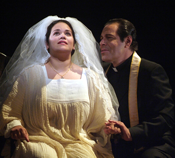
“Saint.” Annina, the ill and visionary orphan whose story the opera
tells, had played a significant part in the soprano’s career. When she sang
the role at Wolf Trap in 1973, Julius Rudel, chief of New York City Opera,
was in the audience and engaged her to sing Annina with that company the
following season. The production was seen on public television when it was
revived in 1978. (Malfitano, by the way, made her professional debut in a CCO
“Falstaff” in 1972.) Thus the summer production was an act of faith for
Malfitano, who further came up with the concept for handsome sets,
effectively realized by Wilson Chin.
Yet even Malfitano’s belief in “Saint” could not triumph over the
feeling that the opera is justifiably absent from the repertory today.
Indeed, this was clearly a case, in which the staging was superior to the
work, upon which the company lavished such affection. “Saint” got off to
a magnificent start. Ill and orphaned Annina, sumptuously sung by a
convincingly adolescent Christina Martos, was an engaging study in a faith so
absolute that it led to stigmata, to the wounds of Christ bleeding in her. On
the other hand, her brother Michele, a macho product of New York’s Little
Italy as portrayed by Derek Taylor, was ridden by doubt. The two, it is
generally agreed, are metaphors for two sides of Menotti’s own tormented
soul.
The composer’s verismo and his choral writing are up there with
Puccini, and the power of the first act elevated expectations. Things paled,
however, and melodrama took over with Michele’s murder of girl friend
Desideria, passionately sung by Kirstin Chávez. The sub-plot won the upper
hand, as Menotti inched towards liturgy in the remainder of the work. Annina
died as she took the veil, something her fugitive brother tried to prevent,
and, while the virtual on-stage canonization of the young woman might have
wowed the Sunday-school set, it left the unchurched waiting for the curtain
to fall.
“Saint” ended up being too much, rather than too little, and doubters
were disturbed by the ease with which Menotti was content to let the mighty
final chorus obscure the question of what happens to murderer-on-the lamb
Michele. Might the composer have done better to delete the murder and develop
the incest motif so obviously present in the sibling relationship? And
although Menotti is certainly right in questioning the mob that would exploit
Annina, this perspective of the plot is obscured by his post-Puccini
choruses.
“Saint” is a dark work, in which Menotti, his own librettist, stirs in
the complex depths of the soul, but fails to put his findings together
convincingly. The resolution - Annina almost sprouts angelic wings on stage -
is contrived; the audience is browbeaten by the sheer power of Menotti’s
music, but left without answers to the essential questions involved. Indeed,
the best - and most moving - music heard at the CCO on the July 21 opening
night was Samuel Barber’s Adagio for Strings, played by an octet from the
pit orchestra in an outdoor courtyard as a memorial to Menotti.
In the brief work Barber, first a fellow student at Curtis, then
Menotti’s long-time companion, wrote music of amazing clarity and
cleanliness - quite the opposite of Menotti’s overwrought score that
followed on stage. “Saint” brought Menotti his second Pulitzer (the first
was awarded for “Amahl and the Night Visitors” in 1951), yet the Central
City staging makes clear why the work is so seldom encountered today. The CCO
has further staged Menotti’s “Amelia Goes to the Ball” with Eleanor
Steber in 1951 and “The Medium” in 1979.
A personal recollection:
Italian-born and Curtis-educated Menotti was his own man in opera. He
wrote for Broadway during decades in which academic atonality dominated
serious music and in “Amahl” written for television, he created what
remains today the most-performed American opera. The world owes him much as a
composer also active as a director and architect of the Spoleto Festival,
first in Italy and then in Charleston, South Carolina. We were hardly
buddies, yet for several years Gian Carlo Menotti was a presence in my life,
and I - in a modest way - in his.
It was one of those right-place, right-time scenarios that have enriched
my life. For many years I wrote a weekly column for a major newspaper chain.
This gave me “visibility,” and musical organizations were eager to be the
subject of my articles. A special fruit of this chapter of my life was a
close and warm association with Spoleto USA, the American “half” of the
Festival of Two Worlds, founded by Menotti in Italy in 1956 and then
“imported” to Charleston, S.C. 11 years later.
During the decade before his somewhat operatic departure from Charleston,
I interviewed Menotti by phone each spring about the up-coming season - he
was usually then at home in his Scottish castle, where Prince Charles and the
late Queen Mum were frequent guests. And in the first days of the season,
which begins the last week in May, Menotti invited the critics present to
breakfast in the garden of Charleston Place Hotel, his home in the city.
Not content to be only Spoleto’s founder and artistic director Menotti
further made his mark by directing Mozart’s “Figaro” and Wagner’s
“Parsifal” during my years at the festival. And he laid weight on being a
man-about-town, cropping up suddenly in the midst of performances in the many
historic venues used by the program. And I often encountered him “off
stage” at the lavish late-night parties staged in the gardens of the
well-maintained mansions on Charleston’s historic peninsula.
He radiated charm and charisma and - thanks largely to daily swim sessions
- on his 80th birthday he could easily have been taken for 65.Yet Menotti was
a difficult person who - in Charleston at least - became his own worst enemy.
As the years piled up, the question of administrative succession at Spoleto
grew pressing and it was complicated by Menotti’s insistence that his
adopted son Francis follow him as artistic director of the festival both in
Charleston and in Italy.
Those who had long supported Spoleto in Charleston felt that Francis, a
difficult person, was not the man for the job. During negotiations often
confrontational and even hostile Menotti threatened to move the American
festival elsewhere - Savannah, just down the coast, was mentioned as a new
site. And when Menotti finally did depart from Charleston he insisted for a
time that the name “Spoleto” was his personal property.
Happily, Spoleto USA has done very well without Menotti, while word from
Italy indicates that son Francis is no great success there. My life was made
richer through my association with Menotti, with whom I had little contact
following the death of his American press agent shortly after he left
Charleston. It was sad indeed that things ended in that wonderful, historic
city as they did, but it was clear that the time had come for Menotti to go.
Nonetheless, today Spoleto USA, the country’s top all-arts festival, is a
major monument to Menotti; even if his many operas are not often performed,
he was an active presence on the art scene of the world for over half a
century.
Wes Blomster