Recently in Performances
English Touring Opera are delighted to announce a season of lyric monodramas to tour nationally from October to December. The season features music for solo singer and piano by Argento, Britten, Tippett and Shostakovich with a bold and inventive approach to making opera during social distancing.
This tenth of ten Live from London concerts was in fact a recorded live performance from California. It was no less enjoyable for that, and it was also uplifting to learn that this wasn’t in fact the ‘last’ LfL event that we will be able to enjoy, courtesy of VOCES8 and their fellow vocal ensembles (more below …).
Ever since Wigmore Hall announced their superb series of autumn concerts, all streamed live and available free of charge, I’d been looking forward to this song recital by Ian Bostridge and Imogen Cooper.
Although Stile Antico’s programme article for their Live from London recital introduced their selection from the many treasures of the English Renaissance in the context of the theological debates and upheavals of the Tudor and Elizabethan years, their performance was more evocative of private chamber music than of public liturgy.
Evidently, face masks don’t stifle appreciative “Bravo!”s. And, reducing audience numbers doesn’t lower the volume of such acclamations. For, the audience at Wigmore Hall gave soprano Elizabeth Llewellyn and pianist Simon Lepper a greatly deserved warm reception and hearty response following this lunchtime recital of late-Romantic song.
For this week’s Live from London vocal recital we moved from the home of VOCES8, St Anne and St Agnes in the City of London, to Kings Place, where The Sixteen - who have been associate artists at the venue for some time - presented a programme of music and words bound together by the theme of ‘reflection’.
'Such is your divine Disposation that both you excellently understand, and royally entertaine the Exercise of Musicke.’
‘And there was war in heaven: Michael and his angels fought against the dragon; and the dragon fought and his angels, And prevailed not; neither was their place found any more in heaven … that old serpent … Satan, which deceiveth the whole world: he was cast out into the earth, and his angels were cast out with him.’
There was never any doubt that the fifth of the twelve Met Stars Live in Concert broadcasts was going to be a palpably intense and vivid event, as well as a musically stunning and theatrically enervating experience.
‘Love’ was the theme for this Live from London performance by Apollo5. Given the complexity and diversity of that human emotion, and Apollo5’s reputation for versatility and diverse repertoire, ranging from Renaissance choral music to jazz, from contemporary classical works to popular song, it was no surprise that their programme spanned 500 years and several musical styles.
The Academy of St Martin in the Fields have titled their autumn series of eight concerts - which are taking place at 5pm and 7.30pm on two Saturdays each month at their home venue in Trafalgar Square, and being filmed for streaming the following Thursday - ‘re:connect’.
The London Symphony Orchestra opened their Autumn 2020 season with a homage to Oliver Knussen, who died at the age of 66 in July 2018. The programme traced a national musical lineage through the twentieth century, from Britten to Knussen, on to Mark-Anthony Turnage, and entwining the LSO and Rattle too.
With the Live from London digital vocal festival entering the second half of the series, the festival’s host, VOCES8, returned to their home at St Annes and St Agnes in the City of London to present a sequence of ‘Choral Dances’ - vocal music inspired by dance, embracing diverse genres from the Renaissance madrigal to swing jazz.
Just a few unison string wriggles from the opening of Mozart’s overture to Le nozze di Figaro are enough to make any opera-lover perch on the edge of their seat, in excited anticipation of the drama in music to come, so there could be no other curtain-raiser for this Gala Concert at the Royal Opera House, the latest instalment from ‘their House’ to ‘our houses’.
"Before the ending of the day, creator of all things, we pray that, with your accustomed mercy, you may watch over us."
The doors at The Metropolitan Opera will not open to live audiences until 2021 at the earliest, and the likelihood of normal operatic life resuming in cities around the world looks but a distant dream at present. But, while we may not be invited from our homes into the opera house for some time yet, with its free daily screenings of past productions and its pay-per-view Met Stars Live in Concert series, the Met continues to bring opera into our homes.
Music-making at this year’s Grange Festival Opera may have fallen silent in June and July, but the country house and extensive grounds of The Grange provided an ideal setting for a weekend of twelve specially conceived ‘promenade’ performances encompassing music and dance.
There’s a “slide of harmony” and “all the bones leave your body at that moment and you collapse to the floor, it’s so extraordinary.”
“Music for a while, shall all your cares beguile.”
The hum of bees rising from myriad scented blooms; gentle strains of birdsong; the cheerful chatter of picnickers beside a still lake; decorous thwacks of leather on willow; song and music floating through the warm evening air.
Performances
16 Aug 2007
Monteverdi’s “L’Orfeo”, Glimmerglass 2007 — Slattery rises to Alden’s challenging concept
The first masterpiece in the history of opera. That’s a tall order to live up to for any company and for any band of singers, especially those at the beginning of their careers.
But that’s what Glimmerglass Opera is all
about — pushing young singers on the cusp of international careers into the
limelight with challenges of this sort of calibre. Luckily for them, this is
an opera that has enjoyed a wealth of thought-provoking productions all
around the world in the past two decades, and an audience now much more at
ease with early 17th century musical forms than at any time since
L’Orfeo’s first performance 400 years ago.
To quote Gustav Leonhardt, Monteverdi “turned a page of musical history
and started to write a new chapter full of daring harmonies and (previously)
unheard human passions.” Unfortunately there is a dearth of instructions from the composer and so
nothing is writ in stone — yet, down through the years and certainly in the
many 20th and 21st century recordings of L’Orfeo, all
sorts of ideas as to how this juxtaposition of instrument and voice might be
realised have been attempted. However, one thing is certain: he demanded the
supremacy of the individual human voice in its eternal quest for
psychological and dramatic truth. So that too has to be a priority of any
staging: the voices and the story they tell must shine clear and unobstructed
by any misguided directorial conceits.
On that subject, this production directed by one of opera’s current
enfant terribles, Chris Alden, certainly tried the patience of many in the
audience. Having attended its premier at Opera North in England last year, I
was intrigued to see how Alden’s conceits had travelled to this very
different house, and different singers. I wrote then: “You don’t get very
much more classic than the opera that virtually invented the art-form, and
Christopher Alden has most decidedly set out to challenge a few well-worn
notions of this favola in musica.” Indeed he does, and on second
acquaintance, I can’t say that I’m any more enamoured than I was first
time around. It’s patchy; and although the idea of Orfeo as a troubled
artist/singer in some sort of faux ducal palace works very well, the eliding
of certain essential parts of the story — such as Eurydice’s rescue and
second death — just jar the sensibilities too much, as do many of the bits
of rather tired post-modernistic little “business” that the singers have
to carry. Endless yards of sticky tape (to confine Eurydice to Hades and also
to represent the Styx and now played more for laughs) and dozens of un-lit
cigarettes get boring so quickly. Having said that, as this is the
Glimmerglass Orpheus festival, in celebration of the great story’s many
transmogrifications, perhaps the challenging Alden approach is what’s
needed to keep the adrenaline running?
The pivotal and dominating role is of course that of Orfeo himself, where
muse and myth fuse into the legendary singer who descended into the
underworld to bring back his dead wife Eurydice, yet failed in the final
moments. The essential difference between first run in Leeds, and here was
the Orfeo. Paul Nilon in England concentrated on projecting a quite limpid,
gentle, musical soul whose journey and eventual failure seemed oh-so-human
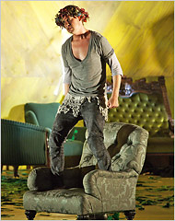
and sympathetic. Here, Michael Slattery, a young American tenor and Juilliard
graduate, was a very different kettle of fish. Resembling more a wild, wilful
and wasted rock star of the 80's or 90's, his lithe body often seeming to
project emotion and nervous energy as clearly as his admirably coloured
tenor. His second act vocal climax, the virtuosic "Possente spirto", where
the singer has to “audition” his way past Caronte at the gates of Hell,
is 10 minutes of some of the most difficult vocal writing that Monteverdi (or
his contemporaries) ever committed to paper. Slattery’s performance was a
lesson in dramatic singing - the young poet/singer grew more desperate, more
anxious, as his words seemed to fail him in his quest. If some tonal beauty
was lost in the service of the drama, then it was a risk worth taking.
He was well supported by some spirited and effective singing from the rest
of the cast, who doubled as the Chorus, although some were more committed to
(and comfortable with) early music performance practice than others. Of note
were Megan Monaghan as Eurydice/Speranza and bass Christopher Temporelli as
Pastore 4/Pluto.
Matching them and Slattery in musical commitment was the orchestra under
Antony Walker whose strong musical sense and understanding of idiom enabled
the period instrument-augmented Glimmerglass Opera Orchestra to sound
remarkably “authentic”. At this sort of festival with five widely varying
works in repertory through the summer, one cannot expect scholarly exactitude
from the players or the instruments they use — but with some clever
adjustments (such as substituting the original cornetti with muted piccolo
trumpets) and additions (three theorbos to augment the continuo
accompaniment) Walker and his players gave a most satisfactory approximation
to the real thing.
© Sue Loder 2007
Performances continue August 14th, 17th, 20th, 23rd, and 25th.
For tickets (limited availability): Glimmerglass Opera Box Office
(607) 547-2255 and more information from the website: http://www.glimmerglass.org