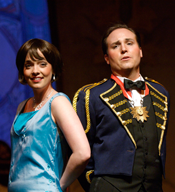
The audience is almost as ancient as the
repertory, and as faithful as fairy tale royalty. (Matinees sell out; license
plates document the region, from Georgia to Wisconsin.) The performers,
however, are young and enthusiastic, and production values (aside from some
desperate excuses for baroque court wigs) impressive. The old scores brim
with melody and sentiment, are played by a full orchestra, and are all sung
in English by a chorus that refuses to stand and deliver — they can all
dance up a storm, and they do. Delectable waltzes, polkas, and czardas flood
sultry Midwest evenings. It’s a wonderful cause and a wonderful
occasion, and I wish I’d enjoyed the performances more than I did.
Operetta in its heyday was the less serious, more popular, highly
localized form of musical play — and to this day translation is a
problem. Offenbach has always had difficulties coming off outside France,
Gilbert and Sullivan never appealed in France, and zarzuela is confined to
Spanish-speaking lands. But when the United States was full of immigrants,
there was a large audience for foreign product, which inspired local product.
Broadway operetta came of age with the runaway success of Lehar’s
Merry Widow in 1905; then an Irishman, Victor Herbert, and two
transplanted Austrians, Romberg and Friml, covered the twenties, but local
boys like Kern and Rodgers soon proved they could handle it.
Zeller’s biggest hit, Der Vogelhändler, opened in Vienna in
1891 and was playing New York — in English — before the year was
out. Kálmán reigned with Lehar — and was every bit as good — in
Vienna and Budapest from before World War I till World War II, but his shows
were as likely to premiere in New York, London, or Zurich. (He died in 1953
in Paris, at work on his last, Arizona Lady — yes,
they’ve staged it in Wooster.)
The reason pre-war operettas, with rare exceptions like Show Boat
and G&S, no longer hold the stage here, aside from the unfashionable
style of the music and the idiocy of most of the plots, is that singers no
longer know how to sing them. Voices that should fill a room with an achingly
romantic waltz sound shrill or shaky or simply unsensuous with microphones,
while the voice with a mic sounds ridiculous singing over a full orchestra
without one. Broadway singers depend on mics today to a disgraceful extent,
even in the tiniest theaters — they are no longer trained to project,
and they no longer try to. A recent evening of grand old American operetta
standards performed by young Broadway performers at New York’s Town
Hall (which the unamplified voice can easily fill) proved a disaster:
squealing sopranos, dull baritones, lyrics inaudible or else blasting our
ears when they did use mics. OLO performs in a 394-seat house, and a singer
who can’t fill that size room should probably not be singing outside
the shower. And yet, over and over again, the lyrics of the soloists could
scarcely be heard — even in Row H center — and the big sensual
voices for which this repertory was created were not on hand. Part of the
problem may lie with an overly loud orchestra, but surely someone in the
company can point this out to the conductors and take it down a few notches.
Or was it that, like Broadway performers today, the singers were
concentrating too hard on their dancing to bother putting a lyric across?
Were they that embarrassed by the translations? Operetta translations are
often grotesque … but I couldn’t hear enough to determine if
that was true at either of the performances I attended.
Der Vogelhändler and Die Herzogin von Chicago appealed
to me precisely because I’d never heard them before, and both scores
had been warmly recommended over the years. Each boasts a wealth of melody
that puts anything now on Broadway to shame, but that’s almost a given.
Both have cardboard characters and ridiculous plots in which true love,
frustrated, conquers in the end. In Der Vogeländler (The
Bird-Seller, sometimes Englished as The Tyrolean), Suzanne Woods as the
Princess-in-disguise got her voice and her points across, notably in the
show’s hit tune, “If You Give Roses in Tyrol,” but winsome
Karla Hughes and comic Sandra Ross vanished into the woodwork as soon as the
band struck up. The sprightly duet of two corrupt professors was probably
comic, but not a word reached the ears. Paul Hindemith (no, really,
that’s his name) and Todd Strange made likeable comic villains, and the
latter was occasionally loud enough — because he screamed. Peter Foltz
made a capable title character, Zeller’s attempt to give Papageno more
sentiment and some spine.
Emmerich Kálmán’s Die Herzogin von Chicago (The Duchess of
Chicago) dates from 1928, when the youth of Budapest and Vienna were gaga for
jazz — had any American shows reached Central Europe yet? The dance
tunes certainly had. Nothing daunted, Kálmán cannily wrote a jazz operetta,
inserting fox trots, Charlestons, saxophones and snippets of Rhapsody in
Blue among the waltzes and sentimental serenades. The wisp of a plot
concerns a bankrupt Balkan prince who falls for the spoiled daughter of an
American millionaire. She won’t marry a man who won’t do the
Charleston and he won’t marry a girl who won’t waltz — even
if she has just purchased his decrepit family castle for six million
smackers. True love naturally conquers, in a spirit of musical compromise.
The staging was, once again, enthusiastic to a degree, with full marks for
dancing choristers and the orchestra pouring forth delicious tune upon tune.
The Duchess, “Mary Lloyd,” was played by Danielle Knox, who looks
like the millions she spends, acts and dances with flare, and has terrific
legs, of which we saw a great deal — all requirements for a 1928
operetta diva. But when she sang, alas, not a word reached the ear. Her
prince (and real-life husband — scuttlebutt has it they met while
performing at the festival) was Grant Knox, whose voice is not beautiful but
whose diction was the clearest all weekend. The rival princess was neither
singer nor actress nor beauty, and smirking Jacob Allen, a tap dancing
American entrusted with the comic duties, lacked the energy to carry the
evening. The most expert and stylish performances — but alas no singing
— came from Gary Moss, playing the caddish fathers of both
lovers.
There’s such a treasure of music at OLO, and such a blessed
enthusiasm for it, that one would like to have the company at one’s
mercy, to test whether the orchestra really does need a more controlling hand
than it gets from its conductors, or if the theater acoustics are defective,
or if it’s the fault of the singers — many of whom have studied
in opera programs and surely could project if they wanted to —
that the experience was so unsuccessful. Regulars around me (though, when
asked, they admitted they couldn’t get the words either) seemed very
happy with what they were getting, but I doubt a theatrical
experience of this order will appeal to youngsters introduced to the operetta
repertory by such presentations. This is as sad a conclusion as one of
Lehar’s pessimistic endings.
John Yohalem