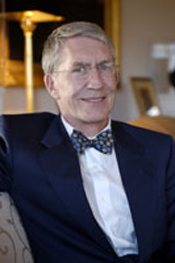
His
departure, regardless of who succeeds him, suggests a significant order for
change in the 50-year-old New Mexico opera festival, for Gaddes was trained
in the traditions of founder John O. Crosby, and has essentially continued
the Crosby management.
To his credit, Gaddes improved general quality, especially in musical
matters, for he retained several competent new conductors, a reform Crosby
never managed. Eminent critic Martin Bernheimer long since pointed out that
the quality of musical direction under Crosby, especially including his own
prosaic efforts in the pit, was the main reason SFO never reached the level
or repute of a Salzburg or Glyndebourne. A telling point.
It is important, also, to acknowledge that several of Gaddes’s seasons have offered the finest evenings in the opera house I have experienced with this company. Among the best shows of the Gaddes years were: The quirky, but memorable and beautifully sung La clemenza di Tito (2002) — a remarkable and elegant achievement; the innovative, dramatically devastating Wozzeck (2001), and the daring and creative production of Ades’ The Tempest (20006), stand-outs in a succession of good shows. These productions out shown anything seen during the Crosby years, and I have been attending SFO since 1969.
Improved orchestral performance was much apparent when Amsterdam-based
maestro Kenneth Montgomery lifted his baton on Richard Strauss’s
Daphne. The large orchestra bloomed beautifully, filling the
2200-seat auditorium with authoritative, indeed authentically lush, German
opera sound. If Montgomery did not give the shape and nuance to
Daphne’s score that a Boehm or Sawallisch would have, the reading
was competent and solid. Such quality did not entirely encompass the stage,
unfortunately. Plump tenors with slim voices can be rather off-putting, and
in the case of Garrett Sorenson singing Leukippus and Scott MacAllister as
Apollo, both unbecomingly costumed, the result was a drag on the show.
Happily, comely Erin Wall, with a far-reaching, bright soprano, easily
delivered the goods as Daphne, and Matthew Best and Meredith Arwady, as her
parents, sang well and true. Allen Moyer’s simple raked stage, a unit set
furnished with a few boulders and clump of laurel trees at center, was
low-keyed but effective; the dull-toned, colorless costumes of Jane Greenwood
evaporated. I would have preferred Strauss’s more interesting
Capriccio over Daphne (a shepherd girl who transforms into
a laurel tree rather than submit to the lusty Apollo), if one must do his
rarities. But SFO is known for this opera, having played four productions
since giving its North American premiere in 1964.
Excellent musical direction continued with Jean-Philippe Rameau’s 1745
near-vaudeville, Platée, under the baton of the English baroque
specialist Harry Bicket. It turned out to be best of the summer in a
boundlessly inventive and amusing production by the brilliant French
director-designer, Laurent Pelly, who has enjoyed several other successes at
SFO. Platée is a farce of mis-behavior of the Greek gods, and hence
of human nature. Never mind the plot; it was a charming series of splendid,
energetic dance numbers, largely of modern style, achieved by fourteen
talented young dancers, the best I’ve seen on the Santa Fe stage,
inter-mixed with vocal numbers and ensembles in good French baroque mode.
Jupiter was able over the evening to prove to his wife Juno he had not been
unfaithful (bit of irony here!), by taking up with a decided plain-favored
‘swamp nymph,’ one Platée, who believes herself to be beautiful and
irresistible to men. By show’s end, she found out otherwise and retired to
the swamp to mend her feelings.
The stand-out star of Platée was French comprimario tenor/actor
Jean-Paul Fourchécourt – a minor voice, but a major comic talent; he
brought off the difficult title role with panache. One was able to laugh at
him/her (he was in drag as the frog lady), yet find sympathy in the end for
Platée’s misery in being rejected. The other artists will forgive me if I
cannot mention them all, but it would not do to overlook Laura Scozzi, the
French choreographer, who gave us a top quality dance show. Music director
Bicket’s 34-piece orchestra included period instruments such as recorders,
a small guitar and a theorbo, a deep voiced lute that lent authenticity to
orchestral sound. Bicket lately conducted Handel at the Metropolitan Opera
and will do the same in season 2008 at Santa Fe. He is an uncommonly talented
conductor, and one could see (and hear) the orchestra’s pleasure in
performing with him.
Puccini’s La bohème received thirteen performances over the
summer, healing the box office, and pleasing full houses. I heard the second
cast August 14, the tenth performance; it seemed to have fallen into routine.
Much of the problem was the lack of voltage from the pit, where the orchestra
sounded a bit bored under the direction of Corrado Rovaris, a conductor from
Italy who had done well conducting Simon Boccanegra three seasons
ago. The singers were adequate but unexceptional. Mimi was a sympathetic lady
from Lucca, Serena Farnocchia, perhaps a shade mature for the part, but she
knew her business and was touching in an understated death scene; good
Italian provincial. Tenor Dimitri Pittas displayed a lovely vocal quality as
Rodolfo, but looked like a sack of potatoes with bad posture and far too much
avoir du pois to be a romantic lead. A much publicized recording artist, the
sprightly soprano Nicole Cabell, had generous high-B’s as Musetta, though
her mid and low voice had little weight. A smallish young man with a big
name, Alexander Vinogradov, as Colline, displayed a considerable bass voice,
warm and dark. He needs maturity, but bears watching, as does a tenor who
sang the tiny part of Parpignol, Ryan Smith, who sounded bright and
interesting. Other singers were Markus Beam, Timothy Nolen (an expert comic
as Benoit), James Westman and Wilbur Pauley. The elderly audience applauded
scenery and stood to cheer the cast at the end of the show.
The recent season was not one of Santa Fe’s best (we have already
reported on Mozart’s Cosi fan tutte and Tan Dun’s Tea: Mirror of the
Soul). Next year’s list is more interesting, with masterworks of
Britten, Mozart and Verdi, as well as Handel’s Radamisto and
admired Finnish-French composer Kaija Saariaho’s Adriana Mater, in
its North American premiere. Beyond that, with new management coming in,
Santa Fe Opera may take a different tack. One has to recall the aborted plans
of New York Philharmonic-designate Alan Gilbert, who had worked as Music
Director for three years to bring festival Wagner and other innovations to
SFO before he was, apparently, dismissed. Gilbert’s debut at the
Metropolitan Opera next season conducting Adams’s Dr Atomic has lately been
announced.
© 2007 J. A. Van Sant