Recently in Performances
English Touring Opera are delighted to announce a season of lyric monodramas to tour nationally from October to December. The season features music for solo singer and piano by Argento, Britten, Tippett and Shostakovich with a bold and inventive approach to making opera during social distancing.
This tenth of ten Live from London concerts was in fact a recorded live performance from California. It was no less enjoyable for that, and it was also uplifting to learn that this wasn’t in fact the ‘last’ LfL event that we will be able to enjoy, courtesy of VOCES8 and their fellow vocal ensembles (more below …).
Ever since Wigmore Hall announced their superb series of autumn concerts, all streamed live and available free of charge, I’d been looking forward to this song recital by Ian Bostridge and Imogen Cooper.
Although Stile Antico’s programme article for their Live from London recital introduced their selection from the many treasures of the English Renaissance in the context of the theological debates and upheavals of the Tudor and Elizabethan years, their performance was more evocative of private chamber music than of public liturgy.
Evidently, face masks don’t stifle appreciative “Bravo!”s. And, reducing audience numbers doesn’t lower the volume of such acclamations. For, the audience at Wigmore Hall gave soprano Elizabeth Llewellyn and pianist Simon Lepper a greatly deserved warm reception and hearty response following this lunchtime recital of late-Romantic song.
For this week’s Live from London vocal recital we moved from the home of VOCES8, St Anne and St Agnes in the City of London, to Kings Place, where The Sixteen - who have been associate artists at the venue for some time - presented a programme of music and words bound together by the theme of ‘reflection’.
'Such is your divine Disposation that both you excellently understand, and royally entertaine the Exercise of Musicke.’
‘And there was war in heaven: Michael and his angels fought against the dragon; and the dragon fought and his angels, And prevailed not; neither was their place found any more in heaven … that old serpent … Satan, which deceiveth the whole world: he was cast out into the earth, and his angels were cast out with him.’
There was never any doubt that the fifth of the twelve Met Stars Live in Concert broadcasts was going to be a palpably intense and vivid event, as well as a musically stunning and theatrically enervating experience.
‘Love’ was the theme for this Live from London performance by Apollo5. Given the complexity and diversity of that human emotion, and Apollo5’s reputation for versatility and diverse repertoire, ranging from Renaissance choral music to jazz, from contemporary classical works to popular song, it was no surprise that their programme spanned 500 years and several musical styles.
The Academy of St Martin in the Fields have titled their autumn series of eight concerts - which are taking place at 5pm and 7.30pm on two Saturdays each month at their home venue in Trafalgar Square, and being filmed for streaming the following Thursday - ‘re:connect’.
The London Symphony Orchestra opened their Autumn 2020 season with a homage to Oliver Knussen, who died at the age of 66 in July 2018. The programme traced a national musical lineage through the twentieth century, from Britten to Knussen, on to Mark-Anthony Turnage, and entwining the LSO and Rattle too.
With the Live from London digital vocal festival entering the second half of the series, the festival’s host, VOCES8, returned to their home at St Annes and St Agnes in the City of London to present a sequence of ‘Choral Dances’ - vocal music inspired by dance, embracing diverse genres from the Renaissance madrigal to swing jazz.
Just a few unison string wriggles from the opening of Mozart’s overture to Le nozze di Figaro are enough to make any opera-lover perch on the edge of their seat, in excited anticipation of the drama in music to come, so there could be no other curtain-raiser for this Gala Concert at the Royal Opera House, the latest instalment from ‘their House’ to ‘our houses’.
"Before the ending of the day, creator of all things, we pray that, with your accustomed mercy, you may watch over us."
The doors at The Metropolitan Opera will not open to live audiences until 2021 at the earliest, and the likelihood of normal operatic life resuming in cities around the world looks but a distant dream at present. But, while we may not be invited from our homes into the opera house for some time yet, with its free daily screenings of past productions and its pay-per-view Met Stars Live in Concert series, the Met continues to bring opera into our homes.
Music-making at this year’s Grange Festival Opera may have fallen silent in June and July, but the country house and extensive grounds of The Grange provided an ideal setting for a weekend of twelve specially conceived ‘promenade’ performances encompassing music and dance.
There’s a “slide of harmony” and “all the bones leave your body at that moment and you collapse to the floor, it’s so extraordinary.”
“Music for a while, shall all your cares beguile.”
The hum of bees rising from myriad scented blooms; gentle strains of birdsong; the cheerful chatter of picnickers beside a still lake; decorous thwacks of leather on willow; song and music floating through the warm evening air.
Performances
28 Aug 2007
The Dream of Gerontius Opens Elora Summer Festival
Written in 1900, Elgar’s Gerontius expresses the universal and existentialist struggle of death and rebirth. The allegorical significance of the piece touches on a need for faith, self-discovery, and acceptance of the world around us.
The Elora Festival, noted for the collaborative efforts of
many great performers and organizations opened its 2007 festival with
Elgar’s magnificent creation. Noel Edison masterfully directed the Elora
Festival Singers, the Toronto Mendelssohn Choir, and the Elora Festival
Orchestra with brilliance, aesthetic dedication, and a tender yet strict
hand. The sensitivity he allotted the soloists is to be commended and his
understanding of the deeper meaning of this piece brilliantly shone in his
exquisite control of the orchestral fabric. The overture began with warm and
burnished hues, painfully weeping celli and well-balanced dark
ombra. The Elgarian timbres were specifically expressed by each
orchestral section, most specifically in the strings as they exemplified the
ethereal and transcendent space Elgar demanded in order to create the
vastness of his masterpiece. Edison paid intelligent heed to the dynamic
inflection and allowed the orchestra to create layered effects leading to
Gerontius’ beautiful entry cry of “Jesu, Maria—I am near to
death.”

Noel Edison, Artistic Director of the Elora Festival
Gerontius, sung with elegance and the purity of lyricism by Irish-Canadian
tenor, Michael Colvin, is a taxing role that requires an almost Verdian
thrust but also the most expansive sense of lyrical control. Colvin’s
diction was brilliant and his use of text was especially moving. A free and
impressive upper register, the squillo of his tenore bruciato added
to the dramatic presence of Gerontius. Although this is a concert work,
Colvin was continually in character and indeed most musically presented.
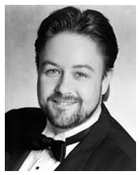
Tenor, Michael Colvin was a sensitive and believable Gerontius.
The combined choruses blended well, with precise diction. Each section
represented an individual unit that contributed to the larger whole and there
was never a sense of unbalance. Edison led them beautifully toward their
inflection of “Of all that makes me man….and crueler still, a fierce and
restless fright begins to fill the mansion of my soul,” where Elgar at once
transforms the music by imbuing atonal suggestions, with turbulent and
exciting orchestration leading into an ethereal moment of relaxation.
The entrance of the priest was significant and wonderfully approached by
bass-baritone, Tyler Duncan. Perhaps the most impressive performer of the
group, his voice spun almost impeccably and was never pushed but floated on
the breath with precision and musical inflection. Impressive indeed for a
lower voice type to exude this type of elegance, there was never any
heaviness and if so it was created by timbre, not pushing or sometimes, what
I call, “barking” baritones.
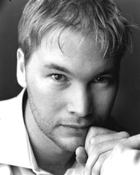
Tyler Duncan (bass-baritone) was the surprise of the evening.
A most memorable moment at the point where Gerontius’ words mimic those
of Christ in his last moments, “Into Thy hands, O Lord, into Thy
hands…” was so utterly moving that every hair on one’s head stood
completely erect. Duncan’s expression of the Priests, “Go forth in the
name…” was well-expressed as one of Elgar’s most majestic melodies.
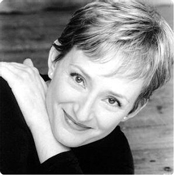
Canadian mezzo, Kimberly Barber astonishingly represented God’s Angel.
Part II offered a most expressive response to Part I and much of that is
owed to the performance of the Angel by mezzo-soprano, Kimberly Barber. Her
presence on-stage was riveting and even though she was not in costume one saw
her presence as the Angel, purely and physically. Her eyes never wavered in
their expressive depth and she captivated. Her’s was the presence of calm
and salvation. Her voice blended liquidly with the chorus of Angelicals her
inflection and diction was precise. Her sound was never pushed and her rich
and luscious mezzo was used in a dramatic way, never singing just to project
but rather to express the meaning of the musical lines and the Angel’s
important message. Her “Softly and Gently,” was truly one of the most
compassionate and hair-raising moments of the entire performance. As she
sang, “In my most loving arms I now enfold thee, and o’er the penal
waters, as they roll, I poise thee, and I lower thee, and hold thee,” she
moved many in the audience to tears. Barber enfolded us with her eloquence
and in the end one forgot that this was a singer performing a musical role,
but really Elgar’s Angel.
Mary-Lou P. Vetere, 2007