But despite
magnificent singing by a huge contemporary-clad cast and the superlative
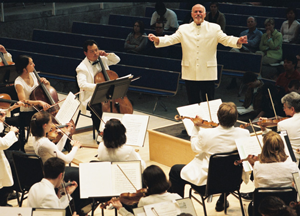
musicianship of Cavalli scholar Jane Glover as conductor of a pocket-size
early-instrument ensemble the promise did not hold.
Advances on the production, plus two lengthy hand-wringing essays in the
Aspen program book, focused not on the opera, but on its seemingly mysterious
history. In brief: Cavalli, long the darling of his day in opera-mad Venice,
looked back on over 30 successes when “Eliogabalo” was all set for a
carnival-season premiere in the city. Then the work was not merely cancelled,
but replaced by an opera on the same decadent Roman emperor by Giovanni
Antonio Boretti. And to make the substitution still more painful to the aging
Cavalli his librettist Aurelio Aureli wrote a new text for Boretti. The
manuscript of “Eliogabalo” — sketches of a score, as was the habit in
that day of agile improvisation — was filed away in the Venice Marciana
Library and forgotten for over three centuries. Cavalli wrote another two
operas — both lost — and died in 1676.
“Eliogabalo” emerged from oblivion in 1998 when an edition of the
score by Roberto Solchi attracted the attention of Europe’s major master of
Baroque opera Rene’ Jacobs, who made it the basis of a staging at
Brussel’s La Monnaie in 2004. That production, essentially the world
premiere of the work, moved on to Innsbruck and Paris and was
enthusiastically celebrated by incense-burning critics throughout Europe.
Indeed, Opernwelt, Germany’s leading opera periodical, declared it
“the rediscovery of the year.”
It is impossible, of course, to compare the Aspen production with a
staging that one knows only from written reports; one feels, however, that
something was lost in crossing the Atlantic. Aspen was in no way behind
Brussels in scholarship. British-born Glover, in her fifth season as music
director of Chicago’s Music of the Baroque, wrote her dissertation on
Cavalli and published a book on him in 1978. And she undertook her own
realization of the edition of the score by Harvard’s Italian-born Mauro
Calcagno, another leading authority in the field.
The Aspen production was, to be sure, impressive in its solid musicianship
and in the work of a huge cast thoroughly schooled in Baroque vocal
performance practices. It did, however, not radiate the excitement that one
recalls from “Giasone,” and in outright fun it was light years behind the
staging of Jean-Philippe Rameau’s 1745 “Platée” on stage at the Santa
Fe Opera this summer. Even armed with a detailed guide through the contorted,
convoluted and complicated plot and English titles it’s not easy to follow
the story of depravity, intrigue and perversion that “Eliogabalo”
tells.
As briefly as possible: Eliogabalo — in history the boy emperor
Heliogabalus who corrupted Rome from 418 to 422 — is aided by
co-conspirator underlings Lenia and Zotico in his quest for bedmates. Out to
seduce Gemmira, he orders the murder of his cousin Alessandro to whom she is
betrothed to achieve his goal. Five-watt-bulb Atilia is after Alessandro, and
boy-about-palace Nerbulone finds himself in the middle of this mess. In the
final act Eliogabalo is knifed offstage and — only the Baroque could manage
a happy end after so much senseless misery, and Alessandro, the new emperor,
is united with Gemmira and Eritea finds a mate in Giuliano.
Gender, of course, isn’t merely bent in Baroque stagings these days;
it’s thrown on the floor and stamped upon, and that allows the director
free choice of voices for a production. Yet director Edward Berkeley,
long-standing mastermind of opera at Aspen, might have gone off the deep end
in casting women in seven leading roles in “Eliogabalo.” That in itself
resulted in a lack of contrast that contributed to the tedium of the two
hour, 40 minute performance.
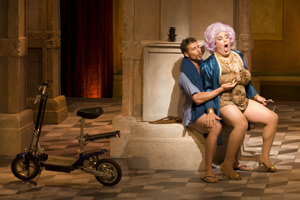
The lower register was thus left entirely to tenor Alex Mansoori, who
stole whatever show there is to steal as Dame Edna look-alike Lenia, and to
be-Speedoed baritone David Keck as court glamour boy. As the bi-sexual
cross-dressing title figure mezzo Cecelia Hall was appropriately louche in
both male and female attire, while soprano Christin Wismann brought happily
contrasting dignity to Alessandro. Ariana Wyatt’s brilliant soprano
combined with her natural beauty to make Gemmira a credible object for
Eliogabalo’s raging hormones, and business-suited Ellen Putney Moore
employed her dark-hued mezzo wonderfully to offer insight into Giuliano’s
conflict-ridden soul.
Top vocal honors, however, went to Paris Hilton look-alike Carin Gilfry,
whose well-honed mezzo made Atilia credibly human. (The only moral being in
the cast was the white doggie that Gilfry carried.) Arthur Rotch’s
scaled-down ruin of a triple-arched Roman gate proved a perfect set for the
many on-stage machinations in “Eliogabalo,” and the superb 14-member
chorus brought additional color to the cross-dressing central to the
production. (Unusual in today’s Baroque stagings was the inclusion of only
one countertenor in the cast, and he was relegated to the chorus.)
Overall, however, the opening performance in Aspen’s historic Wheeler
Opera House on August 14 came across much more as a magnificently prepared
academic study than a knock-out evening at the opera. Rather than biting
nails about the possible injustice done Cavalli in the 1667 cancellation,
Aspen might better have considered that “Eliogabalo” was written at a
time when opera was in transition, moving from the largely through-composed
stile representativo of Monteverdi (presumably Cavalli’s teacher)
to the contrast between recitative and aria that was soon to be Handel’s
glory. The “star” singer was emerging, and both audience and artists were
eager for change. One returns to the conclusion that works residing in
oblivion are right where they belong.
Wes Blomster
![Alexander Mansoori (Lenia) and Ariana Wyatt (Flavia Gemmira) [Photo: Alex Irvin]](http://www.operatoday.com/Eliogabalo.png)