Subscribe to
Opera Today

Receive articles and news via RSS feeds or email subscription.


twitter_logo[1].gif


9780521746472.png

Recently in Performances

The Importance of Being Earnest, Covent Garden

The Importance of Being Earnest , Gerald Barry’s fifth opera, was commissioned by the Los Angeles Philharmonic Orchestra and the Barbican, and was first performed in concert, Thomas Adès conducting the London premiere.

Death in Venice by ENO

‘Beauty is the one form of spirituality that we experience through the senses.’ In Thomas Mann’s, Death in Venice, Plato’s axiom stirs the hopes of the aging, intellectually stale poet, Gustav von Aschenbach, that he may rekindle his creativity.

Madama Butterfly, Opera Holland Park

There is a sense in which it all began in London, Puccini having been seized in 1900 with the idea of an opera on this subject after watching David Belasco’s play here.

An Evening of Zarzuela and Latin American Music at Los Angeles Opera

The tenor that the audience most wanted to hear, Plácido Domingo, opened the vocal program with “Junto al puente de la peña” (Next to the rock bridge) from La Canción del Olvido (The song of Oblivion) by José Serrano. He sounded rested and his voice soared majestically over the orchestra.

Così fan tutte in San Francisco

Tucked away somewhere in the San Francisco Opera warehouse was an old John Cox production of Così fan tutte from Monte Carlo. Well, not that old by current standards at San Francisco Opera.

Rossini Maometto Secondo Garsington Opera at Wormsley

Rossini's Maometto Secondo is a major coup for Garsington Opera at Wormsley, confirming its status as the leading specialist Rossini house in Britain. Maometto Secondo is a masterpiece, yet rarely performed because it's formidably difficult to sing. It's a saga with some of the most intense music Rossini ever wrote, expressing a drama so powerful that one can understand why early audiences needed "happy endings" to water down its impact

Peter Grimes in Concert

I suppose it was inevitable that, in this Britten Centenary year, the 66th Aldeburgh Festival would open with Peter Grimes.

Die Entführung aus dem Serail, Garsington Opera at Wormsley

Die Entführung aus dem Serail at Garsington Opera at Wormsley isn’t Mozart as you’d expect but it’s true to the spirit of Mozart who loved witty, madcap japes.

Le nozze di Figaro, Glyndebourne

What a pity! On a glorious — well, by recent English standards — summer’s day, there can be few more beautiful English countryside settings than Glyndebourne, with the added bonus, as alas much of the audience appears to understand it, of an opera house attached.

Queens, Heroines and Ladykillers

Described by one critic as “cosmically gifted”, during her tragically short career, American mezzo-soprano Lorraine Hunt Lieberson amazed and delighted audiences with the spellbinding beauty of her singing and the astonishing honesty of her performances.

Alzira by Chelsea Opera Group

“I wrote it almost without noticing.” So Verdi declared when reminded of his eighth — and perhaps least frequently performed, opera, Alzira. One might say that, since he composed the work, no-one else has much noticed either.

Les Contes d’Hoffmann in San Francisco

Just when you thought the protagonist was Hoffmann! Who, rather what stole the show?

La Tosca in Los Angeles

When is verismo verily veristic? Or what is a virginal girl dressed in communion white doing in the two murderous acts of the Los Angeles Opera’s current production of Tosca? And why does she sing the shepherd's song?

Lohengrin, Welsh National Opera

Wagner’s Lohengrin is not an unfamiliar visitor to the UK thanks, in the main, to Elijah Moshinsky’s perennial production at Covent Garden.

Philip Glass: The Perfect American

Philip Glass's The Perfect American at the ENO in London is a visual treat, but the libretto is mind-numbingly anodyne.

Jonathan Dove’s Mansfield Park

Jonathan Dove's Mansfield Park, with libretto by his regular collaborator Alasdair Middleton, has the remarkable distinction of being the first completed operatic adaptation of any Jane Austen novel to be staged.

Wagner 200th Anniversary Concert

London’s two principal opera companies have offered a baffling near-silence as their response to Wagner’s two-hundredth anniversary.

Toronto’s Triple Success

If a recent trio of musically superlative performances at Canadian Opera Company is indicative of their norm, the casting director should get a hefty bonus.

Alessandro Scarlatti’s Il Trionfo dell’Onore

Just when you imagine you’ve got the operatic time-line fixed in your mind in a clean sweep of what goes where and when and how, you hear another work from another forgotten corner of the repertory that upends one’s conclusions.

Handel’s Rodrigo by Operamission

Nothing inspires fable quite like defeat. The great riddle of Spanish history is how the Christian Visigoths managed to lose the Iberian peninsula to the Moors in one small battle in 711 and took eight hundred years to get it back.

OPERA TODAY ARCHIVES »

Performances

Petra Maria Schnitzer (Elisabeth) & James Rutherford (Wolfram von Eschinbach). Photo by Terrence McCarthy courtesy of San Francisco Opera.
19 Sep 2007

Music Triumphs in S.F. Tannhauser

For those who can’t (or won’t) see the forest of an opera for the trees of performance minutiae, here’s the word about the San Francisco Opera’s new production of Wagner’s “Tannhauser” that opened tonight:

Richard Wagner: Tannhauser

Above: Petra Maria Schnitzer (Elisabeth) & James Rutherford (Wolfram von Eschinbach)
All photos by Terrence McCarthy courtesy of San Francisco Opera.


Donald Runnicles’ Opera Orchestra and Ian Robertson’s Opera Chorus give a magnificent account of the music, which is among Wagner’s most sweeping and bewitching. Runnicles and General Manager David Gockley have assembled an outstanding cast for this, the first new production of Gockley’s 20-month-old intendancy, and the cast delivered the goods, in an ensemble performance of international stars, the like of which has not been heard in these parts for some time.

However demanding and difficult the opera may be vocally and instrumentally, this tale of the 13th century minstrel torn between Venus’ earthly, “sinful” and Elisabeth’s idealized, redemptive love is a near-impossible bear when it comes to staging, especially in the 1861 Paris version and its extended ballet scene.

On that point, Graham Vick’s overbusy, occasionally just plain silly direction will be discussed (and derided) heatedly. Attention-diverting production excesses, especially the primitive overuse of awkward missionary positions, seem close to some of those under Gockley’s predecessor, Pamela Rosenberg.
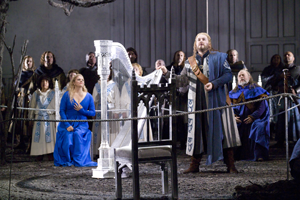
Tannhauser_SFO_2.pngPetra Maria Schnitzer (Elisabeth) & Eric Halfvarson (Landgraf Hermann)

There is a wealth of greatness squeezed in the four-hour performance that unfortunately opens with a ballet that’s a mix of Pina Bausch, Greco-Roman wrestling, and a Groucho Marx routine, and ends with little boys emerging from the stage floor as if in a prairie dog hunting game.

But music, the essential component of the evening, triumphs over it all, making the stage monkey business almost immaterial. Runnicles’ customarily outstanding direction of Wagner holds true here, with rock-solid tempi, balances, sterling support for the voices, and wonderful control of (the many) climactic passages where he avoids “burping” the orchestra, presenting powerful, convincing, steady high points instead.

The Opera Chorus, handicapped by Vick’s requirement to wave arms, roll on the floor, and act ecstatic or possessed at the most inappropriate moments, gave a memorably solid, beautiful performance, holding back (for good or ill) from blowing the walls down when it had the chance.

Peter Seiffert — a large man and no actor — was vocally sensational in the title role, fulfilling the dual and conflicting requirements of heroic and lyric tenor. His Rome Narrative was powerful, if rather dry. Warmth and beauty, on the other hand, characterized Petra Maria Schnitzer’s Elisabeth; vocally and dramatically, she gave a true star performance, especially in the difficult third act, creating an affecting “female Parsifal,” waiting for him in vain.

Mezzo Petra Lang was the bold Venus, singing well, but not quite at her best. The young English baritone James Rutherford made a memorable San Francisco debut as Wolfram, with a meaningful, moving Song to the Evening Star. All the principals, except for Eric Halfvarson’s mighty Landgrave (and fine horsemanship atop the white quarter horse Alloy), had their local debut in this production.

Vocally, one of the most striking performances of the evening came from a young singer in a three-minute role. Having been made to sit on stage motionless for almost an hour, Adler Fellow Ji Young Yang sangthe Shepherd’s aria with affecting brilliance, exhibiting both musical intelligence and peerless communication of emotions. When she sang of the sun’s warmth (“da strahlte warm die Sonnen”), you could feel the bright light, the nourishing heat. An extraordinary talent.

Ron Howell’s choreography for Venusberg — women in long, clinging white shifts, men naked to the waist — was angular, clinically (and unsuccessfully) sexual, and altogether distracting from some of the most sensual music ever written. The Opera’s program notes decried productions with “unfortunate (and justly parodied) exaggerations... cheap eroticism and a kind of corybantic, danced Kama Sutra” of the scene — describing perfectly what took place in the War Memorial.
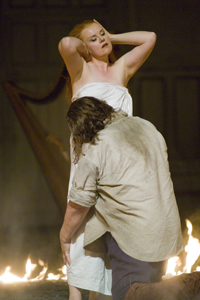
Tannhauser_SFO_3.pngPetra Lang (Venus) and Peter Seiffert (Tannhäuser)

Stage directors have forever tried to “improve” on Elisabeth’s quiet, offstage death as she is sacrificing her life for Tannhauser’s salvation Vick’s direction on that point will cause much controversy, but in fact it makes sense, while remaining true to the meaning of the text. In a kind of assisted suicide, Wolfram reluctantly, gently, lovingly snaps Elisabeth’s neck when she begs for death, and he goes on to sing to the Evening Star: “Wie Todesahnung, Damm’rung deckt die Lande...” (“As a presentiment of death, twilight covers the land”).

Paul Brown’s stage design uses a hangar-like unit set, with large windows, all scenes enhanced by opulent costumes. Brown and Vick are provoking the audience to shout “fire!” in a crowded theater by using up gallons of propane that flares as a large circle on the ground, as branches of a tree, for long periods.

But just how crowded was the theater? A startling fact from opening night, something clearly indicating what a tough row Gockley must hoe to attract audiences back to the War Memorial: in this once-Wagner mad town, on the opening night of a major new Wagner production, the second balcony — with its affordable seats and best acoustic in the house — was half empty. Wagner fans, opera lovers: you don't know what you're missing.

Janos Gereben © 2007
Send to a friend

Send a link to this article to a friend with an optional message.

Friend's Email Address: (required)

Your Email Address: (required)

Message (optional):