Rome’s Teatro Tordinona was the ordering venue, thus bringing gender ambiguity to a peak, due to the papal ban preventing women from appearing onstage in the Holy City. What the original Roman audience actually saw and
heard was a bunch of seven castrati, partly disguised as ladies in androgynous
warriors’ costumes, partly as heroes of Ancient Greece - all of them warbling
in soprano and alto pitches around one single tenor impersonating the most macho
character imaginable, Hercules. To make things even worse, on the podium stood a
Catholic priest, Vivaldi himself, acting in the many capacities of composer, conductor,
solo violinist - and probably also stage director. Suspension of disbelief, albeit on
the basis of lip-service to morals, was apparently much needed…
The pendulum has now swung so far that, having to dispense with the unavailable castrati,
Fabio Biondi selected no less than five ladies, plus one countertenor - and yes! two
tenors, one of them very high-pitched — for the world premiere revival of the
same opera. Since not any complete score of it is extant, Biondi undertook one more
labor, that is tentatively reconstructing one from the sets of detached arias preserved
in the libraries of Paris, Münster, Turin and several other locations, then
discarding and substituting some of them for the sake of inner balance and, last but not
least, composing all the missing recitatives. This bears witness to the situation
recently described by the Vivaldi scholar Michael Talbot: “Today, there is not
one performable Vivaldi opera that someone has not staged somewhere, and those still
desirous of novelty for its own sake are now forced to explore the margins of his
operatic output where fragmentary works or works of multiple authorship reside. Even
there, it has grown hard to discover material for a genuine prima
assoluta”.
Was the whole painstaking process worth trying? Judging from the results, it was.
Vivaldi’s Ercole according to Biondi (different reconstructions might
be attempted, and probably will, sooner or later) fits well into the general pattern of
Venetian baroque opera prior to the Metastasio-Hasse-Farinelli revolution, which was due
to start very soon, in the late 1720s. It exhibits most features thereof: mainly the
intricacies in the plot and sub-plots, which result in mixed styles of singing, ranging
from quasi-comic through amorous, to utterly heroic or tragic, sometimes all within the
same character. In other words, variety pays a premium over dramatic consistency or
psychological credibility. Thus, for instance, the title-role Ercole aptly delivers a
row of warlike and menacing arias as he keeps clubbing his way to the final triumph;
nevertheless, he also produces himself in a sort of love lesson paternally delivered to
Martesia, an Amazon princess who ignores the very basics of marriage and wavers between
the competing Greek princes Alceste and Telamone, both in love with her. Enhanced by the
charm of Vivaldi’s compelling rhythms, unison accompaniments, colorful
orchestral palette, all that amounted to some three hours of sheer, if not particularly
highbrow, entertainment. Needless to say, lovers’ complaints,
warriors’ bravados, last-minute rescues — and an unusually high rate
of battle scenes involving brasses and kettledrums — led to the unavoidable
happy end, when peace was restored and sealed with a double marriage.
Among the singing company, high praise was due to both Amazon queens (and sisters), mezzo
Romina Basso as Antiope and soprano Roberta Invernizzi as Ippolita, for their unfailing
intonation and agility, clear diction, style competence and acting stamina. The same was
true for Laura Polverelli in the trousers role of Alceste, prince of Sparta, as well as
for tenor Carlo Allemano in the title-role, who displayed a doughy quasi-baritone
register and a bodily appearance well matching the muscular demi-god he was supposed to
impersonate. Pity that the young and lovely soubrette Stefanie Irányi as
Martesia, reportedly impaired by a cold, was a bit short of breath now and then. Nor did
the mellifluous Catalan countertenor Jordi Domènech (Teseo), just perfect as
a subdued lover, sound fully up to the requirements of an hero, mainly because of
lacking dynamic variety. Both Emanuela Galli as Orizia and Mark Milhofer as Telamone got
going very hard, yet their vocal technique still needs some refinement in order to meet
the stipulations of this particular repertoire.
In the (Vivaldi-like) double bill of conductor and first violin, occasionally also
grabbing the viola d’amore, Biondi led the performance with a relentless
overall pulse, a nuanced choice of tempi and, most notably, a careful insight into the
singers’ needs for breath and action — nowadays not a terribly
common feature among opera conductors, whether of period bands or regular pit
orchestras. His Europa Galante sounded like a large multi-register theorbo struck by a
single hand: an amazing outcome, considering the frequent turnover of instrumentalists
within its ranks. Biondi has clearly got a signature sound, one of the most exciting in
the early music scene today — to say nothing of his individual prowess on the
baroque violin.
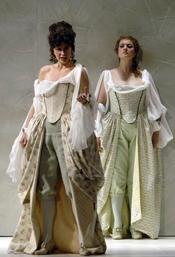
Generally appreciated were the costumes, a mixture of fanciful 18th-century fashions and
military paraphernalia much in the guise of Kubrick’s Barry Lyndon.
Some disappointment was instead caused by the fixed set which, according to ongoing
anticipations, was due to be part of an historically informed staging care of the Arts
Faculty, University of Venice, under the supervision of Walter Le Moli, a respected
professional. Actually, it was all about huge square portals in the mould of stock
Neoclassic, providing functional in-and-out access to the backstage. No machines, no
decorations, no spectacular effects whatsoever.
***
The same set was re-used for the ensuing Bajazet, less
than a novelty for early opera freaks since Biondi’s award-winning recording
released in 2005 by Virgin, yet still a rarely staged title. (Back in 1994, this writer
attended a fully-staged production under the alternative title Il Tamerlano
— at Verona’s Teatro Filarmonico where it originally had premiered
in 1735, but the singers were hardly historically informed).
As it turned out, the present Venice production was only
semi-staged, with the characters dressed in modern black attires as if for a formal
cocktail party, and all of the action revolving, in a rather indecipherable manner,
around a Victorian-style couch in red velvet. Once again, the real centerpiece was the
singing cast, studded with heavier sounding women’s voices. The barbaric
warlord Tamerlano was Daniela Barcellona, towering for her imposing physical shape no
less than for the force and precision of her deep mezzo. As the destitute Little Orphan
Asteria, Marina De Liso unfolded hot temperament and versatility in her four widely
diverse arias. As Prince Andronico, Lucia Cirillo delivered a passionate rendering of
“La sorte mia spietata”, a Vivaldi borrowing from Hasse’s
Siroe. Notoriously, Bajazet is a thoroughgoing pasticcio, in which
several arias are favorites of the singers themselves, a.k.a. arie di baule,
mostly in the ‘new’ Neapolitan style. This doesn’t apply
to the unfortunate Bajazet, who, besides one exciting showpiece from Vivaldi’s
own Motezuma (“Dov’è la figlia?”), is
just allotted a row of angry utterances or frantic vocal gesticulations with very little
thematic substance in them. Despite that, tenor Christian Senn emerged with full honors
from his unrewarding part.
The sole survivor from the 2005 recording was Vivica Genaux,
in the not-so-important role of Irene. However, her appearance raised an unprecedented
salvo of curtain calls among the demanding operagoers of Venice. Clad in a funereal
black attire vaguely resembling a chador, the Alaskan mezzo machine-gunned an
incredible amount of vocal pyrotechnics in “Qual guerriero in campo
armato”, the treacherous coloratura piece written by Riccardo Broschi for his
brother Farinelli, bristling with inter-registral leaps extending over two and a half
octaves and featuring endless florid passages in semiquavers. In contrast, another
Farinelli suitcase aria, “Sposa, son disprezzata” (by Geminiano
Giacomelli), gave evidence for her deep dramatic potential and faultless legato
technique. During the intermissions, there was much arguing among the patrons about the
frantic quivering motions of her lips and lower jaw. While some cognoscenti tended to
identify a technical device for hitting each note more clearly and precisely
(“finding the position”), others called that a disturbing mess or a
pointless mannerism. The dispute was solved by an old gentleman who suggested with a
meek smile: “Perhaps she’s not from Alaska, but from somewhere in
the outer space: the Planet of Steel Nightingales...”.
Carlo Vitali © 2007