![Alice Coote (Carmen) and Julian Gavin (Don José) [Copyright English National Opera and Tristram Kenton]](http://www.operatoday.com/CARMEN_JULIANGAVIN%2BALICECOO.png)
02 Oct 2007
Carmen at ENO
There is a certain onerous responsibility in developing a new production of Carmen at a major house.
English Touring Opera are delighted to announce a season of lyric monodramas to tour nationally from October to December. The season features music for solo singer and piano by Argento, Britten, Tippett and Shostakovich with a bold and inventive approach to making opera during social distancing.
This tenth of ten Live from London concerts was in fact a recorded live performance from California. It was no less enjoyable for that, and it was also uplifting to learn that this wasn’t in fact the ‘last’ LfL event that we will be able to enjoy, courtesy of VOCES8 and their fellow vocal ensembles (more below …).
Ever since Wigmore Hall announced their superb series of autumn concerts, all streamed live and available free of charge, I’d been looking forward to this song recital by Ian Bostridge and Imogen Cooper.
Although Stile Antico’s programme article for their Live from London recital introduced their selection from the many treasures of the English Renaissance in the context of the theological debates and upheavals of the Tudor and Elizabethan years, their performance was more evocative of private chamber music than of public liturgy.
Evidently, face masks don’t stifle appreciative “Bravo!”s. And, reducing audience numbers doesn’t lower the volume of such acclamations. For, the audience at Wigmore Hall gave soprano Elizabeth Llewellyn and pianist Simon Lepper a greatly deserved warm reception and hearty response following this lunchtime recital of late-Romantic song.
For this week’s Live from London vocal recital we moved from the home of VOCES8, St Anne and St Agnes in the City of London, to Kings Place, where The Sixteen - who have been associate artists at the venue for some time - presented a programme of music and words bound together by the theme of ‘reflection’.
'Such is your divine Disposation that both you excellently understand, and royally entertaine the Exercise of Musicke.’
‘And there was war in heaven: Michael and his angels fought against the dragon; and the dragon fought and his angels, And prevailed not; neither was their place found any more in heaven … that old serpent … Satan, which deceiveth the whole world: he was cast out into the earth, and his angels were cast out with him.’
There was never any doubt that the fifth of the twelve Met Stars Live in Concert broadcasts was going to be a palpably intense and vivid event, as well as a musically stunning and theatrically enervating experience.
‘Love’ was the theme for this Live from London performance by Apollo5. Given the complexity and diversity of that human emotion, and Apollo5’s reputation for versatility and diverse repertoire, ranging from Renaissance choral music to jazz, from contemporary classical works to popular song, it was no surprise that their programme spanned 500 years and several musical styles.
The Academy of St Martin in the Fields have titled their autumn series of eight concerts - which are taking place at 5pm and 7.30pm on two Saturdays each month at their home venue in Trafalgar Square, and being filmed for streaming the following Thursday - ‘re:connect’.
The London Symphony Orchestra opened their Autumn 2020 season with a homage to Oliver Knussen, who died at the age of 66 in July 2018. The programme traced a national musical lineage through the twentieth century, from Britten to Knussen, on to Mark-Anthony Turnage, and entwining the LSO and Rattle too.
With the Live from London digital vocal festival entering the second half of the series, the festival’s host, VOCES8, returned to their home at St Annes and St Agnes in the City of London to present a sequence of ‘Choral Dances’ - vocal music inspired by dance, embracing diverse genres from the Renaissance madrigal to swing jazz.
Just a few unison string wriggles from the opening of Mozart’s overture to Le nozze di Figaro are enough to make any opera-lover perch on the edge of their seat, in excited anticipation of the drama in music to come, so there could be no other curtain-raiser for this Gala Concert at the Royal Opera House, the latest instalment from ‘their House’ to ‘our houses’.
"Before the ending of the day, creator of all things, we pray that, with your accustomed mercy, you may watch over us."
The doors at The Metropolitan Opera will not open to live audiences until 2021 at the earliest, and the likelihood of normal operatic life resuming in cities around the world looks but a distant dream at present. But, while we may not be invited from our homes into the opera house for some time yet, with its free daily screenings of past productions and its pay-per-view Met Stars Live in Concert series, the Met continues to bring opera into our homes.
Music-making at this year’s Grange Festival Opera may have fallen silent in June and July, but the country house and extensive grounds of The Grange provided an ideal setting for a weekend of twelve specially conceived ‘promenade’ performances encompassing music and dance.
There’s a “slide of harmony” and “all the bones leave your body at that moment and you collapse to the floor, it’s so extraordinary.”
“Music for a while, shall all your cares beguile.”
The hum of bees rising from myriad scented blooms; gentle strains of birdsong; the cheerful chatter of picnickers beside a still lake; decorous thwacks of leather on willow; song and music floating through the warm evening air.
There is a certain onerous responsibility in developing a new production of Carmen at a major house.
The theatre will always be full; the audience will contain both opera aficionados who need something they haven’t seen a million times before, and the newcomers who are the holy grail of the opera house’s marketing strategy and who need to be given a reason to return to see other operas in future. There are really two ways one can go — either a fairly traditional staging or an innovative reinterpretation — but above all, it’s important to achieve the near-impossible aim of being all things to all people. The drama needs to be compelling, and preferably interesting too.
It was common knowledge that film director Sally Potter, whose new production opened English National Opera’s 2007/08 season, was to go down the ‘innovative reinterpretation’ route. As such, it was inevitable that this most familiar of operas would be removed from its familiar setting in order to rid it of its well-worn stereotypes.
So where was it set? Good question. The first act, with its music full of sunshine and midday heat, was set in some dimly-lit wasteland populated by security guards (in place of soldiers) and cheap whores (in place of cigarette girls). Who were they to us? It was impossible to recognise these people or to empathise with them — and it was impossible to follow the thread of the drama, as the decision to cut all dialogue reduced the opera-comique structure to a song-and-dance show.
It became clear later on that we were probably supposed to be in Britain: in the final act we headed for the customary Spanish bullring, with the chorus as a horde of boorish British tourists (enabled by Christopher Cowell’s very liberal translation). So why, for the first three acts, were none of the characters recognisable to a British audience — and what on earth was a star Spanish toreador (David Kempster) doing in a bar in an English back street? Surely the coincidental appearance of a key character in an entirely unlikely situation is one of the most enduring of operatic clichés, and therefore anathema to Potter’s concept (it didn’t appear to be intentionally ironic). The third act of course took place at an airport, the home of the present-day smuggler; you can imagine why three girls might have a go at fortune-telling to pass the time, but not why one of their number might take it quite so seriously.
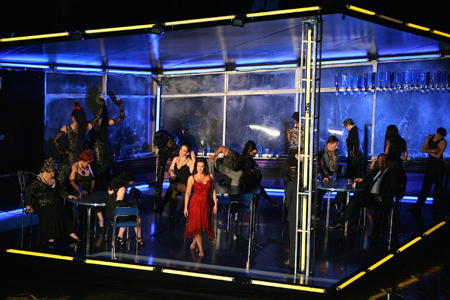 Fullstage with Alice Coote (Carmen) in foreground
There were some striking moments - tellingly, they were those where the singers were left to sing, as if in concert, against an almost plain backdrop. Micaela and José’s duet benefitted from this; so did Micaela’s aria, lustrously sung by the young American soprano Katie van Kooten in her company debut. The final scene was quite riveting, with José maniacally terrifying and Carmen an emotional wreck.
Fortunately there was also plenty of energy in the music. ENO’s new Music Director, Edward Gardner, conducted with poised tension and enjoyed the climaxes, and there was a lot of fine singing, not least in the title role. According to the press release and some of the advance publicity, Alice Coote was recovering from a viral infection — there was no announcement before the performance, and she sounded on fair if not top form. The problem was that she was seriously miscast. Although the veiled smokiness of her mezzo brings something very alluring to the role, it’s not a voice equal to the weight of the music and, more troublingly, her body language simply didn’t match it. She moved awkwardly, and was not helped by her costumes — for most of the opera she was incongruously dressed like a traditional Carmen. Opposite her, Julian Gavin was a blazingly passionate and believable Don José once he got going, but David Kempster failed to bring the necessary vocal suavity to Escamillo.
Ironically, the operatically-inexperienced Potter’s intention to escape cliché resulted in a production in the manner of many of ENO’s productions of the past few years (bearing a particularly strong resemblance to David Freeman’s controversial Otello in 1998) punctuated by some Spanish flavour supplied by unremarkably-choreographed tango dancing. Whatever the intention, a disservice was done to the piece, and to opera buffs and newcomers alike. Although the third and fourth acts worked reasonably well on their own terms, it was Sally Potter’s Carmen, not Bizet’s.
Ruth Elleson © 2007