01 Oct 2007
JANÁČEK: Jenůfa
Across the country from Los Angeles, the Metropolitan Opera has opened its 2007-08 season with big stars (Netrebko, Alagna, Dessay, Giordani) in juicy, melodic operas by Donizetti and Gounod.
English Touring Opera are delighted to announce a season of lyric monodramas to tour nationally from October to December. The season features music for solo singer and piano by Argento, Britten, Tippett and Shostakovich with a bold and inventive approach to making opera during social distancing.
This tenth of ten Live from London concerts was in fact a recorded live performance from California. It was no less enjoyable for that, and it was also uplifting to learn that this wasn’t in fact the ‘last’ LfL event that we will be able to enjoy, courtesy of VOCES8 and their fellow vocal ensembles (more below …).
Ever since Wigmore Hall announced their superb series of autumn concerts, all streamed live and available free of charge, I’d been looking forward to this song recital by Ian Bostridge and Imogen Cooper.
Although Stile Antico’s programme article for their Live from London recital introduced their selection from the many treasures of the English Renaissance in the context of the theological debates and upheavals of the Tudor and Elizabethan years, their performance was more evocative of private chamber music than of public liturgy.
Evidently, face masks don’t stifle appreciative “Bravo!”s. And, reducing audience numbers doesn’t lower the volume of such acclamations. For, the audience at Wigmore Hall gave soprano Elizabeth Llewellyn and pianist Simon Lepper a greatly deserved warm reception and hearty response following this lunchtime recital of late-Romantic song.
For this week’s Live from London vocal recital we moved from the home of VOCES8, St Anne and St Agnes in the City of London, to Kings Place, where The Sixteen - who have been associate artists at the venue for some time - presented a programme of music and words bound together by the theme of ‘reflection’.
'Such is your divine Disposation that both you excellently understand, and royally entertaine the Exercise of Musicke.’
‘And there was war in heaven: Michael and his angels fought against the dragon; and the dragon fought and his angels, And prevailed not; neither was their place found any more in heaven … that old serpent … Satan, which deceiveth the whole world: he was cast out into the earth, and his angels were cast out with him.’
There was never any doubt that the fifth of the twelve Met Stars Live in Concert broadcasts was going to be a palpably intense and vivid event, as well as a musically stunning and theatrically enervating experience.
‘Love’ was the theme for this Live from London performance by Apollo5. Given the complexity and diversity of that human emotion, and Apollo5’s reputation for versatility and diverse repertoire, ranging from Renaissance choral music to jazz, from contemporary classical works to popular song, it was no surprise that their programme spanned 500 years and several musical styles.
The Academy of St Martin in the Fields have titled their autumn series of eight concerts - which are taking place at 5pm and 7.30pm on two Saturdays each month at their home venue in Trafalgar Square, and being filmed for streaming the following Thursday - ‘re:connect’.
The London Symphony Orchestra opened their Autumn 2020 season with a homage to Oliver Knussen, who died at the age of 66 in July 2018. The programme traced a national musical lineage through the twentieth century, from Britten to Knussen, on to Mark-Anthony Turnage, and entwining the LSO and Rattle too.
With the Live from London digital vocal festival entering the second half of the series, the festival’s host, VOCES8, returned to their home at St Annes and St Agnes in the City of London to present a sequence of ‘Choral Dances’ - vocal music inspired by dance, embracing diverse genres from the Renaissance madrigal to swing jazz.
Just a few unison string wriggles from the opening of Mozart’s overture to Le nozze di Figaro are enough to make any opera-lover perch on the edge of their seat, in excited anticipation of the drama in music to come, so there could be no other curtain-raiser for this Gala Concert at the Royal Opera House, the latest instalment from ‘their House’ to ‘our houses’.
"Before the ending of the day, creator of all things, we pray that, with your accustomed mercy, you may watch over us."
The doors at The Metropolitan Opera will not open to live audiences until 2021 at the earliest, and the likelihood of normal operatic life resuming in cities around the world looks but a distant dream at present. But, while we may not be invited from our homes into the opera house for some time yet, with its free daily screenings of past productions and its pay-per-view Met Stars Live in Concert series, the Met continues to bring opera into our homes.
Music-making at this year’s Grange Festival Opera may have fallen silent in June and July, but the country house and extensive grounds of The Grange provided an ideal setting for a weekend of twelve specially conceived ‘promenade’ performances encompassing music and dance.
There’s a “slide of harmony” and “all the bones leave your body at that moment and you collapse to the floor, it’s so extraordinary.”
“Music for a while, shall all your cares beguile.”
The hum of bees rising from myriad scented blooms; gentle strains of birdsong; the cheerful chatter of picnickers beside a still lake; decorous thwacks of leather on willow; song and music floating through the warm evening air.
Across the country from Los Angeles, the Metropolitan Opera has opened its 2007-08 season with big stars (Netrebko, Alagna, Dessay, Giordani) in juicy, melodic operas by Donizetti and Gounod.
But at the Dorothy Chandler, the Los Angeles Opera chose to commence their season with two unquestionable masterpieces of darker colors, less likely to be thought of as “crowd-pleasers.” Beethoven’s Fidelio premiered first, with a stunning cast of relatively new names (Anja Kampe and Klaus Florian Vogt).
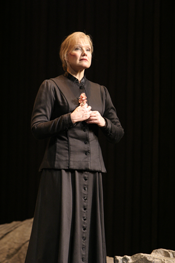
On September 27th Janáček’s Jenůfa opened, with the great and glorious Karita Mattila in the lead. Seen at the second performance on Sunday, 30 September, Oliver Tambosi’s now well-traveled production provided a reliable if not exactly memorable staging for a high-powered musical success. Music Director James Conlon appeared again at the pre-lecture (as is very much his wont), to speak with revivalist passion about the merits of Janacek’s opera, now over a century old and yet still not quite beloved enough to make such urgent declarations of merit unnecessary. But as Conlon said, once the audience is in the house for a performance, the opera makes its own case, and better than any speaker can.
Sunday’s performance certainly won over the matinee crowd. At intermission some members spoke admiringly about the dramatic vocals, while wondering about the significance of Tambosi’s core concept: a boulder breaking through the ground in act one, crowding the stage in act two, and broken into rocks and stones for the final act. As the beautiful Jenůfa hides in her step-mother’s house, scarred by her frustrated admirer Laca and recovering from the delivery of the child she produced with the handsome scoundrel Števa, she cries out that she feels as if a stone is crushing her. Apparently that one line provided for Tambosi his entry into the heart of the drama, but when the boulder becomes the primary visual reference, the literal depiction of the metaphor reduces the complexity of the drama, rather than supporting it. The tension of act two, at any rate, certainly does not benefit from giving some of the less serious members of the audience the temptation to giggle, as characters feel their way around the huge boulder in their living room.
But the roar of adulation that greeted the singers and conductor Conlon at the end of the afternoon proved that even the questionable qualities of Tambosi’s setting could not lessen the impact of this performance. Mattila owns the title role, and she remains in her glorious prime. An athletic performer, she could subtly suggest Jenůfa’s youth just through her posture, while incautiously throwing herself around the stage in the dynamic second act. Then in the third, after her almost hysterical outburst at the discovery of the body of her child (murdered by her step-mother in a desperate bid to save her stepdaughter from a shamed and lonely life), Mattila projected a wise and loving forgiveness, even standing stock still. Her singing approached the flawless, with only one high climax finding her reaching up a bit tentatively. Tambosi’s set does have the virtue of high walls, intersecting at the rear, which projects the voices out into the huge space of the Dorothy Chandler. Mattila had the power when she needed it, and could pull back into shades of detail as needed. She is, quite simply, an astounding artist.
As the step-mother Kostelnička, Eva Urbanová came through where it mattered most, in the powerhouse histrionics of act two. Not the actress that Mattila is, Urbanová nevertheless has the sort of edgy, penetrating vocal production perfect for the role, and her commitment helped make the audience understand both the cruel reasoning behind her decision to kill her stepchild and the ability of Jenůfa to forgive her.
The plain but honest quality of Kim Begley’s voice perfectly suits the character of Laca, as does his masculine appearance, which contrasts well with the boyish but callow handsomeness of Jorma Silvasti’s Števa. Silvasti was a late replacement for the young tenor Joseph Kaiser, who took a prime assignment at the Metropolitan. Perhaps this change was just as well, as the trip of Mattila, Begley, and Silvasti made a convincing assembly of peers, all of approximately the same age and all well experienced in their roles.
The LAO orchestra has not played a Janáček score for well over a decade, and Conlon has some more work to do to make the players fully comfortable with the spiky idiom of the composer. With Conlon’s impassioned leadership, Sunday’s performance still had all the power needed, especially for the heart-tugging lyrical outburst at the climax. Act one, however, felt a bit tentative.
So after two very successful productions of Fidelio and this Jenůfa, LAO will return to the tried and true with productions of Don Giovanni and Puccini’s ubiquitous Bohemians, under other conductors. Conlon returns in the 2008 half of the season, with Tristan und Isolde, Otello, and this season’s edition of Conlon’s “Recovered Voices” series, a double-bill of Zemlinsky and Ullman one-acts. All in all, LAO can’t compete with the Met for star-power or technical innovation, but when it comes down to the actual performance, the company may never have been better.
Chris Mullins