Subscribe to
Opera Today

Receive articles and news via RSS feeds or email subscription.


twitter_logo[1].gif


UCP_9780226043425.gif

Recently in Performances

Wozzeck at ENO

“Man is an abyss. It makes one dizzy to look into it.” So utters Georg Büchner’s Woyzeck, repeating what was also a recurring motif in the playwright’s own letters.

Mulhouse: Rare Britten Well Done

National Opera Company of the Rhine has marked this year’s Benjamin Britten celebration with a remarkably compelling, often gripping new production of the seldom-seen Owen Wingrave.

Frankfurt's Intriguing Idomeneo

Once upon a time, Frankfurt Opera had the baddest ass reputation in Germany as “the” cutting edge producer of must-see opera.

Rigoletto at Lyric Opera of Chicago

Productions of Giuseppe Verdi’s Rigoletto can serve as a vehicle for individual singers to make a strong impression and become afterward associated with specific roles in the opera.

Britten Sinfonia with Ian Bostridge

Just in case we were not aware that the evening’s programme was ‘themed’, the Britten Sinfonia designed a visual accompaniment to their musical exploration of night, sleep and dreams.

Aida, Manitoba Opera

Poor Aida! She never seems to have anything go her way.

Superlative singing: Don Carlo, Royal Opera House

Is it possible to upstage Jonas Kaufmann? Kaufmann was brilliant in this Verdi Don Carlo at the Royal Opera House, London, but the rest of the cast was so good that he was but first among equals. Don Carlo is a vehicle for stars, but this time the stars were everyone on stage and in the pit. Even the solo arias, glorious as they are, grow organically out of perfect ensemble. This was a performance that brought out the true beauty of Verdi's music.

Sarah Connolly: French Song at Wigmore Hall

The big names were absent: Duparc, D’Indy, Debussy, Ravel … and while Fauré, Chausson, Roussel and several members of Les Six put in an appearance, in less than familiar guises, this survey of French song of the early 20th century and interwar years deliberately took us on a journey through infrequently travelled terrain.

Rare restoration: Handel’s Esther 1720

Composed between 1718 and 1720, Handel’s Esther is sometimes described as the ‘first English Oratorio’, but is in fact a hybrid form, mixing elements of oratorio, masque, pastoral and opera.

The Damnation of Faust, London

Hector Berlioz's légende dramatique, La Damnation de Faust, exists somewhere between cantata and opera. Berlioz's flexible attitude to dramatic form made the piece unworkable on the stages of early 19th century Paris and his music is so vivid that you wonder whether the piece needs staging at all.

Elizabeth Connell Memorial Concert, St John's Smith Square

St. John’s Smith Square was the site of Elizabeth Connell’s final London concert, intended as a farewell to London on her moving to Australia. It was rendered ultimately final by her unexpected death.

Aida with all the Trimmings, Even a Blue Silk Elephant!

With the building of the Suez Canal, Egypt became more interesting to Western Europeans. Khedive Ismail Pasha wanted a hymn by Verdi for the opening of a new opera house in Cairo, but the composer said he did not write occasional pieces.

Die Zauberflöte, Royal Opera

Back for its fourth revival, David McVicar’s 2003 production of Mozart’s Die Zauberflöte has much charm, beauty and artistry.

The Marriage of Figaro Ends Season at Arizona Opera

Wolfgang Amadeus Mozart's opera The Marriage of Figaro has a libretto by Lorenzo daPonte based on the French play La folle journée, ou le Mariage de Figaro (The Crazy Day or the Marriage of Figaro) by Pierre Caron de Beaumarchais (1732-1799).

Baden’s Flute Goes Barefoot in the Park

For its world class Easter Festival, Baden-Baden mounted a Die Zauberflöte that owed more to the grey penitential doldrums of Lent than to the unbridled jubilance of re-birth.

Bonjour M. Gauguin in Berkeley

Once Berkeley Opera, renamed West Edge Opera, this enterprising company offers the Bay Area’s only serious alternative to corporate opera, to wit Bonjour M. Gauguin.

Mahler Lieder, Wigmore Hall

In the first of pianist Julius Drake’s three-part series, ‘Perspectives’, our gaze was directed at Gustav Mahler’s eclectic musical responses to human experiences: from the trauma and distress of anguished love to the sweet contentment of true friendship, from the agonised introspection of the artist to the diverse dramas of human interaction.

Cinderella Goes to the Opera

The Los Angeles opera company marketed its spring production of Rossini's La Cenerentola as Cinderella though there is no opera by that name. The libretto of La Cenerentola is not the Cinderella story we know.

Die Walküre, Paris

The Paris Opéra has not staged a full Ring Cycle since 1957, but its current season will conclude with a correction of this grand operatic gap.

Manon Lescaut, Washington National Opera

Washington National’s 2012-2013 season continues this spring with a production of Giacomo Puccini’s first successful opera.

OPERA TODAY ARCHIVES »

Performances

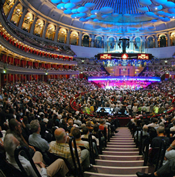
The Royal Albert Hall, Home of the Proms!, Image © BBC
22 Oct 2007

Opera at the BBC Proms 2007

Glyndebourne Festival Opera’s guest appearance is an annual fixture at the Proms, and this year the work of choice was Verdi’s Macbeth, in a semi-staged performance on July 24th based on Richard Jones’s new production for this year’s Festival.

The Royal Albert Hall: Home of the Proms!
Image © BBC


The opera was done in a hybrid edition in which the familiar 1865 score gives way to the 1847 finale following ‘Pietà, rispetta, amore’, thus keeping all the later version’s best music and gaining a more theatrical, less ‘operatic’ ending.

Indeed, it had been a theatrically-compelling staging — at its Glyndebourne home. However its bulky sets and large-scale choreography simply wouldn’t have been viable in the limited dimensions and exposed nature of the Royal Albert Hall platform. Consequently Geoffrey Dolton’s semi-staged adaptation retained little of the original, and had it not been for the tartan costumes which provided such a clear indication of family allegiances, it might as well have been given in concert.

On its own terms, however, the musical performance was very strong, led by Vladimir Jurowski whose conducting had rhythmic delicacy and dramatic sweep. Voices which sound thrillingly huge in Glyndebourne’s intimate and forgiving acoustic can struggle to make an impression in the cavernous Royal Albert Hall, but as Lady Macbeth, Sylvie Valayre was notable here for her strength and lyricism, and Stanislav Shvets for a portentous yet introverted account of Banquo. Strong performances too came from Andrzej Dobber in the title role, and Peter Auty as a young Macduff who is matured by his personal tragedy.

On to August 12th and this season’s operatic highlight: a concert performance of Götterdämmerung, the culmination of the first “Ring cycle” in the Proms’ 113-year history - in reality, performances of the four operas by four different companies over the space of four years. After visits from Simon Rattle with the Orchestra of the Age of Enlightenment, Antonio Pappano with a semi-staged adaptation from the Royal Opera, and Christoph Eschenbach with the Orchestre de Paris, the baton was handed to Donald Runnicles and the Proms “house band”, the BBC Symphony Orchestra, for the final instalment in a concert performance.

It was a terrific ensemble effort by all concerned, speaking volumes about Runnicles’ rapport with the orchestra. Christine Brewer (a regular guest performer with the BBCSO) was a radiant, committed Brünnhilde. Stig Andersen gave a muscular performance as Siegfried albeit with a couple of botched top notes, and John Tomlinson’s Hagen was a triumph of characterisation and malevolent stage presence. Of the supporting cast, the Scottish mezzo Karen Cargill gave a notably excellent performance as Waltraute; her focused, dramatic sound and expansive phrasing will surely stand her in good stead for similar repertoire in the future. Only the Norns — Andrea Baker, Natascha Petrinsky and Miranda Keys — sounded as though they had not been employed with the success of the ensemble in mind, and even this is no reflection on the individual singers.

This performance was a great achievement and, like all successful Wagner performances, succeeded in making six hours go by in the blink of an eye.

August 20th brought a performance of Duke Bluebeard’s Castle by the Philharmonia Orchestra under Christoph von Dohnányi, in a concert whose first half featured Webern’s orchestration of part of Bach’s ‘Musical Offering’ and a recently-assembled concert suite from Thomas Adès’s 1995 opera Powder Her Face. Contemporary music, even going back as far as Bartók, simply doesn’t seem to pull in the crowds at the Proms; the hall was almost empty. This cannot have done much for the morale of the orchestra or soloists, but this Bluebeard performance would surely have been disappointing in any case. Charlotte Hellekant was miscast as Judit, her glacial poise giving no indication of the warmth she promises to bring to her chilly new home. Correspondingly there was scant evocation of this in the orchestral playing, and little sense of the richly-drawn individual musical worlds to be found behind each of the seven doors. The orchestral balance was all wrong too, swamping Falk Struckmann’s intelligent, generous-voiced Bluebeard.

In the final week of the season, James Levine and the Boston Symphony Orchestra visited for two evenings — an orchestral concert as well as a concert performance of Berlioz’s La damnation de Faust with the Tanglewood Festival Chorus. This performance fell on September 6th, the day Luciano Pavarotti died, and the performance was dedicated to his memory.

Vocally the highlight was Yvonne Naef’s glorious mezzo in her fevered, introverted account of ‘D’amour l’ardente flamme’, but elsewhere there were a few problems. As Faust, Marcello Giordani had a tendency to strain, while as Méphistophélès, the veteran José van Dam sounded a touch threadbare. The real strengths in the principal ensemble lay elsewhere; the dynamic between Faust and Méphistophélès was well-developed, and the characters were finely-drawn and well rounded. This was, after all, a late date in the orchestra’s tour calendar, so the opera (or rather the ‘dramatic legend’) came to London fully ripe. This experience was evident too in the disciplined and vivid singing of the chorus, and in the wonderful orchestral playing especially in some of the solo woodwind.

Ruth Elleson © 2007
Send to a friend

Send a link to this article to a friend with an optional message.

Friend's Email Address: (required)

Your Email Address: (required)

Message (optional):