15 Oct 2007
Philip Glass celebrates 70th with compelling new opera
SAN FRANCISCO — “My subject is war and the pity of war, and the poetry is in the pity.”
English Touring Opera are delighted to announce a season of lyric monodramas to tour nationally from October to December. The season features music for solo singer and piano by Argento, Britten, Tippett and Shostakovich with a bold and inventive approach to making opera during social distancing.
This tenth of ten Live from London concerts was in fact a recorded live performance from California. It was no less enjoyable for that, and it was also uplifting to learn that this wasn’t in fact the ‘last’ LfL event that we will be able to enjoy, courtesy of VOCES8 and their fellow vocal ensembles (more below …).
Ever since Wigmore Hall announced their superb series of autumn concerts, all streamed live and available free of charge, I’d been looking forward to this song recital by Ian Bostridge and Imogen Cooper.
Although Stile Antico’s programme article for their Live from London recital introduced their selection from the many treasures of the English Renaissance in the context of the theological debates and upheavals of the Tudor and Elizabethan years, their performance was more evocative of private chamber music than of public liturgy.
Evidently, face masks don’t stifle appreciative “Bravo!”s. And, reducing audience numbers doesn’t lower the volume of such acclamations. For, the audience at Wigmore Hall gave soprano Elizabeth Llewellyn and pianist Simon Lepper a greatly deserved warm reception and hearty response following this lunchtime recital of late-Romantic song.
For this week’s Live from London vocal recital we moved from the home of VOCES8, St Anne and St Agnes in the City of London, to Kings Place, where The Sixteen - who have been associate artists at the venue for some time - presented a programme of music and words bound together by the theme of ‘reflection’.
'Such is your divine Disposation that both you excellently understand, and royally entertaine the Exercise of Musicke.’
‘And there was war in heaven: Michael and his angels fought against the dragon; and the dragon fought and his angels, And prevailed not; neither was their place found any more in heaven … that old serpent … Satan, which deceiveth the whole world: he was cast out into the earth, and his angels were cast out with him.’
There was never any doubt that the fifth of the twelve Met Stars Live in Concert broadcasts was going to be a palpably intense and vivid event, as well as a musically stunning and theatrically enervating experience.
‘Love’ was the theme for this Live from London performance by Apollo5. Given the complexity and diversity of that human emotion, and Apollo5’s reputation for versatility and diverse repertoire, ranging from Renaissance choral music to jazz, from contemporary classical works to popular song, it was no surprise that their programme spanned 500 years and several musical styles.
The Academy of St Martin in the Fields have titled their autumn series of eight concerts - which are taking place at 5pm and 7.30pm on two Saturdays each month at their home venue in Trafalgar Square, and being filmed for streaming the following Thursday - ‘re:connect’.
The London Symphony Orchestra opened their Autumn 2020 season with a homage to Oliver Knussen, who died at the age of 66 in July 2018. The programme traced a national musical lineage through the twentieth century, from Britten to Knussen, on to Mark-Anthony Turnage, and entwining the LSO and Rattle too.
With the Live from London digital vocal festival entering the second half of the series, the festival’s host, VOCES8, returned to their home at St Annes and St Agnes in the City of London to present a sequence of ‘Choral Dances’ - vocal music inspired by dance, embracing diverse genres from the Renaissance madrigal to swing jazz.
Just a few unison string wriggles from the opening of Mozart’s overture to Le nozze di Figaro are enough to make any opera-lover perch on the edge of their seat, in excited anticipation of the drama in music to come, so there could be no other curtain-raiser for this Gala Concert at the Royal Opera House, the latest instalment from ‘their House’ to ‘our houses’.
"Before the ending of the day, creator of all things, we pray that, with your accustomed mercy, you may watch over us."
The doors at The Metropolitan Opera will not open to live audiences until 2021 at the earliest, and the likelihood of normal operatic life resuming in cities around the world looks but a distant dream at present. But, while we may not be invited from our homes into the opera house for some time yet, with its free daily screenings of past productions and its pay-per-view Met Stars Live in Concert series, the Met continues to bring opera into our homes.
Music-making at this year’s Grange Festival Opera may have fallen silent in June and July, but the country house and extensive grounds of The Grange provided an ideal setting for a weekend of twelve specially conceived ‘promenade’ performances encompassing music and dance.
There’s a “slide of harmony” and “all the bones leave your body at that moment and you collapse to the floor, it’s so extraordinary.”
“Music for a while, shall all your cares beguile.”
The hum of bees rising from myriad scented blooms; gentle strains of birdsong; the cheerful chatter of picnickers beside a still lake; decorous thwacks of leather on willow; song and music floating through the warm evening air.
SAN FRANCISCO — “My subject is war and the pity of war, and the poetry is in the pity.”
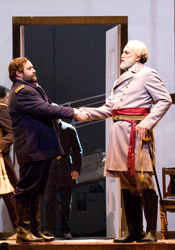
Philip Glass might well have prefaced his new opera “Appomattox” with Wilfred Owen’s words that Benjamin Britten chose to introduce his War Requiem in 1962. For although “Appomattox,” given its world premiere at the San Francisco Opera here on October 5, is in no way a pacifist pamphlet, it reaffirms the commitment to peace and to non-violence that Glass first expressed in his Ghandi opera “Satyagraha” three decades ago. Happily, however, there is nothing tendentious about “Appomattox,” an extended account of the 1865 meeting between Generals Ulysses S. Grant and Robert E. Lee that seemingly ended the Civil War.
Seemingly — for here the concern of Glass and his librettist, British playwright and screenwriter Christopher Hampton, looks beyond Lee’s surrender of his army at Appomattox Court House to underscore the wounds of that war that remain unhealed today, 150 years after the meeting of the two generals. Glass counterpoints this historic event with the massacre of black militia by Louisiana racists in 1873, the murder of civil rights worker Jimmie Lee Jackson by Alabama State Troopers in 1965 and the hate-filled words of Edgar Ray Killen, the Klan member convicted only in 2005 for his role involved in the slaughter of a trio of civil rights workers 40 years earlier. (Glass’ ballad for Jackson — the composer calls it “a Bob Dylan song” — will undoubtedly have a life of its own beyond the opera.) “War is always sorrowful. Never has so much blood been drained. Let this be the last time,” sing the women who open — and later close - “Appomattox.”
And Grant and Lee, portrayed here as men of dignity, moral stature and generous spirit, are determined that the conflict that took over 600,000 lives should be the last war. “How we end the war today will still be felt a hundred years from now,” Grant says, while Glass’ music makes the general’s words unmistakably ominous. Grant is sung by bass Andrew Shore, Lee by bass baritone Dwayne Croft and Lincoln by bass Jeremy Galyon, low voices all that underscore the sorrow of the tale as Glass tells it. Indeed, it was the failure of that dream that accounts for the dark undertow of the new opera, for the optimism that Ghandi’s non-violence once inspired in Glass is no longer present here.
In this ahistoric age Grant and Lee are little more than cardboard cutouts on the distant horizon of fourth-grade history. Glass, however, brings them to life as men of character and intellect and it is this that gives “Appomattox” its aura of human warmth. Grant, although unkempt, scruffy and fresh from battle, is not the bumpkin as which he is often portrayed, and Lee is every inch a Southern gentleman and aristocrat. (The scene, in which Lee is dressed on stage for the crucial meeting, recalls Don Giovanni’s preparation for the “Champagne” aria.) The respect of the two men for each other — and their shared concern for their mission — is genuine. And their wives, along with Lee’s daughter Agnes, Mrs. Lincoln and her soothsaying seamstress, are late descendants of Euripides’ Trojan women after the sack of their city, for they sense the ominous side of the “peace” about to be concluded. It is they who see the inhuman dimension of the war and lament its consequences.
All five women are impressively sung by SFO Adler fellows Rhoslyn Jones, Elza van den Heever, Ji Young Yang, Heidi Melton and Kendall Gladen. Impressive also is the ability that Glass has now developed to make words fully comprehensible — even without resorting to the titles now traditional everywhere. “The tessitura, or placement of the voice, will determine a lot about comprehensibility,” the composer says. “For example, in English the final consonants often indicate the meaning of a vowel. So if you go very high with the voice it becomes difficult to understand the words. “What you’re looking for is a style of singing that is melodic but stays well within the range of spoken voice.”
One thing most will learn from the opera is that Appomattox Court House is not the seat of local government that the name commonly implies, but rather an entire small town, in which the generals met in the living room of Wilmer McLean. Designer Riccardo Hernandez has recreated this modest room — complete with period furniture — for the second act of “Appomattox.” Overall, however, Hernandez’ finest work is the curtain of glass and steel that the audience sees upon entering the War Memorial Opera House for this production. It is — literally — a cutting-edge expression of the nature of war. On the other hand, for the destruction of Richmond he takes his cues from Cecil B. DeMille and detracts from Glass’ score with realistic artillery and fireworks.
“Appomattox” is in a sense Glass own celebration of his 70th birthday, which took place in January. And in a superbly informative interview with his team in the SFO program book, he makes note of the distance he has traveled since the 1989 production of “Satyagraha” here. “It was the very night of the crackdown on the Tiananmen Square protests in China,” he recalls. “And I’ve moved away from the optimism you see in my early works.” He states that the world has become a threatening place and laments that such statesmen as Grant and Lee have been replaced today by mere politicians. And Grass’ style has changed markedly from the repetitive patterns of his nascent minimalism.
“Appomattox” is at times richly melodic, and orchestral interludes - such as the music that marks the destruction of Richmond — is highly dramatic in its descriptive force. This is not to say that this is a perfect work; the chorus of black Union soldiers, for example, should be shortened. To dwell on shortcomings, however, is to overlook the grand achievement of “Appomattox” and to fail to be moved by its absolute integrity and the intensity of its message.
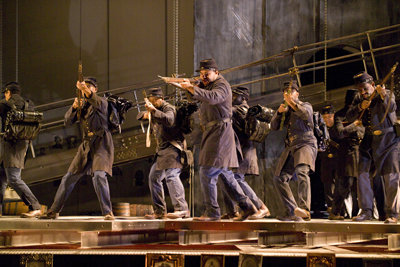 The Union Army’s XXV Corps
Philip Glass has been his own man since the beginning, and his concern for the war between the States dates back to “CIVIL warS,”, his collaboration with Robert Wilson for 1984 Los Angeles Olympics. To measure him by the ruler defined by Mozart ignores the originality of a man who has contributed to every known genre and — in his collaborations with poet Allen Ginsberg and his operas built upon Jean Cocteau films, to mention only two examples — he has created some of his own. And, as librettist Woodruff observes, in “Appomattox” Glass has dealt meaningfully with a chapter in history that “still sits in the middle of the psyche of the American people in an iconic way; the resonance between that moment in history and the succeeding moments of violence and violation of that pact.”
Originally a commission for the Houston Grand Opera, David Gockley brought “Appomattox” with him when he became general director of the San Francisco Opera in 2006. It is thus his first SFO commission. Although there are at present no plans for staging “Appomattox” elsewhere, the work seems destined for great popularity. Indeed, it seems safe to say that with the new work Philip Glass has created an operatic companion piece to “Gone with the Wind.”
Wes Blomster