Recently in Performances
English Touring Opera are delighted to announce a season of lyric monodramas to tour nationally from October to December. The season features music for solo singer and piano by Argento, Britten, Tippett and Shostakovich with a bold and inventive approach to making opera during social distancing.
This tenth of ten Live from London concerts was in fact a recorded live performance from California. It was no less enjoyable for that, and it was also uplifting to learn that this wasn’t in fact the ‘last’ LfL event that we will be able to enjoy, courtesy of VOCES8 and their fellow vocal ensembles (more below …).
Ever since Wigmore Hall announced their superb series of autumn concerts, all streamed live and available free of charge, I’d been looking forward to this song recital by Ian Bostridge and Imogen Cooper.
Although Stile Antico’s programme article for their Live from London recital introduced their selection from the many treasures of the English Renaissance in the context of the theological debates and upheavals of the Tudor and Elizabethan years, their performance was more evocative of private chamber music than of public liturgy.
Evidently, face masks don’t stifle appreciative “Bravo!”s. And, reducing audience numbers doesn’t lower the volume of such acclamations. For, the audience at Wigmore Hall gave soprano Elizabeth Llewellyn and pianist Simon Lepper a greatly deserved warm reception and hearty response following this lunchtime recital of late-Romantic song.
For this week’s Live from London vocal recital we moved from the home of VOCES8, St Anne and St Agnes in the City of London, to Kings Place, where The Sixteen - who have been associate artists at the venue for some time - presented a programme of music and words bound together by the theme of ‘reflection’.
'Such is your divine Disposation that both you excellently understand, and royally entertaine the Exercise of Musicke.’
‘And there was war in heaven: Michael and his angels fought against the dragon; and the dragon fought and his angels, And prevailed not; neither was their place found any more in heaven … that old serpent … Satan, which deceiveth the whole world: he was cast out into the earth, and his angels were cast out with him.’
There was never any doubt that the fifth of the twelve Met Stars Live in Concert broadcasts was going to be a palpably intense and vivid event, as well as a musically stunning and theatrically enervating experience.
‘Love’ was the theme for this Live from London performance by Apollo5. Given the complexity and diversity of that human emotion, and Apollo5’s reputation for versatility and diverse repertoire, ranging from Renaissance choral music to jazz, from contemporary classical works to popular song, it was no surprise that their programme spanned 500 years and several musical styles.
The Academy of St Martin in the Fields have titled their autumn series of eight concerts - which are taking place at 5pm and 7.30pm on two Saturdays each month at their home venue in Trafalgar Square, and being filmed for streaming the following Thursday - ‘re:connect’.
The London Symphony Orchestra opened their Autumn 2020 season with a homage to Oliver Knussen, who died at the age of 66 in July 2018. The programme traced a national musical lineage through the twentieth century, from Britten to Knussen, on to Mark-Anthony Turnage, and entwining the LSO and Rattle too.
With the Live from London digital vocal festival entering the second half of the series, the festival’s host, VOCES8, returned to their home at St Annes and St Agnes in the City of London to present a sequence of ‘Choral Dances’ - vocal music inspired by dance, embracing diverse genres from the Renaissance madrigal to swing jazz.
Just a few unison string wriggles from the opening of Mozart’s overture to Le nozze di Figaro are enough to make any opera-lover perch on the edge of their seat, in excited anticipation of the drama in music to come, so there could be no other curtain-raiser for this Gala Concert at the Royal Opera House, the latest instalment from ‘their House’ to ‘our houses’.
"Before the ending of the day, creator of all things, we pray that, with your accustomed mercy, you may watch over us."
The doors at The Metropolitan Opera will not open to live audiences until 2021 at the earliest, and the likelihood of normal operatic life resuming in cities around the world looks but a distant dream at present. But, while we may not be invited from our homes into the opera house for some time yet, with its free daily screenings of past productions and its pay-per-view Met Stars Live in Concert series, the Met continues to bring opera into our homes.
Music-making at this year’s Grange Festival Opera may have fallen silent in June and July, but the country house and extensive grounds of The Grange provided an ideal setting for a weekend of twelve specially conceived ‘promenade’ performances encompassing music and dance.
There’s a “slide of harmony” and “all the bones leave your body at that moment and you collapse to the floor, it’s so extraordinary.”
“Music for a while, shall all your cares beguile.”
The hum of bees rising from myriad scented blooms; gentle strains of birdsong; the cheerful chatter of picnickers beside a still lake; decorous thwacks of leather on willow; song and music floating through the warm evening air.
Performances
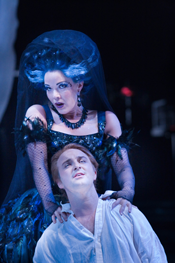
28 Oct 2007
The Magic Flute — English National Opera
Despite rumours to the contrary, English National Opera’s advertising material claims that this 12th revival of Nicholas Hytner’s popular production of ‘ The Magic Flute’ will be the last. Though it’s arguably better to get rid of a production in...
Despite rumours to the contrary, English National Opera’s advertising material
claims that this 12th revival of Nicholas Hytner’s popular production of ‘
The Magic Flute’ will be the last. Though it’s arguably better to get rid
of a production in its prime rather than when it’s been done to death, it will be a
sad loss. The staging has been popular with all sectors of ENO’s audience, as a
result of its balance, clarity, wit and visual beauty. This staging more than any other has
given me continual pause for thought over the years, leading me to better understanding of the
piece.
The ‘ serious’ characters are well-rounded and balanced; after all, they
are all supposed to be in some way human. The Queen of the Night is drawn in particularly fine
detail; she believes that she’s acting for the good, or why would she afford Tamino
the protection of the flute and the guidance of the three boys? Heather Buck’s
threatening coloratura was like an explosion of simmering anger and frustration on top of a
soft, warm-hued centre, not an all-guns-blazing outpouring of evil. Sarastro, too, has
something to learn; as he gets to know Pamina better, he loses arrogance that he never knew he
had, and comes to respect a woman as an equal.
Andrew Kennedy was a noble Tamino with lovely tone, though his oddly distorted vowel sounds
are becoming increasingly irritating. Sarah-Jane Davies matched him well as Pamina, singing a
beautifully poised ‘Ach, ich fühls’ (‘Now I know that love can
vanish’). Brindley Sherratt’s Sarastro was perhaps a little weak on the
bottom notes, but gave an imposing, centred performance, and Matthew Rose is such a fine
Speaker that I long to hear him as Sarastro.
Roderick Williams was a congenial Papageno with considerable charm, delivering Jeremy
Sams’s English dialogue in an approximation of a Yorkshire accent. Talking of
accents, his disguised Papagena is conventionally played in this production as an elderly
Irish tea-lady, which proved a verbal challenge too great for the Swedish soprano Susannah
Andersson. Once she was out of ‘ character’ and into the duet, her diction
was perfect and she sang very sweetly.
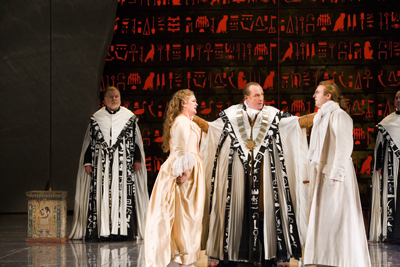 Sarah-Jane Davies (Pamina) / Brindley Sherratt (Sarastro) / Andrew Kennedy (Tamino)
The chorus were on form and Martin André conducted with delicacy and lyricism, but the
greatest joy of this production remains the staging. The live doves summoned by
Papageno’s pipes; the flood of green light when Tamino is wandering in the woodland;
the bears tamed by the flute; the majestic white pillars of the Temple of Wisdom and its
glorious interior golden screens with cut-out hieroglyphics; Papageno’s marital nest
full of baby birds. Given ENO’s tendency to replace serviceable and popular stagings
of core repertoire with misguided ‘concept’ productions, could they not
be persuaded to keep this lovely piece of musical theatre for a few seasons longer? I hope so.
Ruth Elleson © 2007