Recently in Performances
English Touring Opera are delighted to announce a season of lyric monodramas to tour nationally from October to December. The season features music for solo singer and piano by Argento, Britten, Tippett and Shostakovich with a bold and inventive approach to making opera during social distancing.
This tenth of ten Live from London concerts was in fact a recorded live performance from California. It was no less enjoyable for that, and it was also uplifting to learn that this wasn’t in fact the ‘last’ LfL event that we will be able to enjoy, courtesy of VOCES8 and their fellow vocal ensembles (more below …).
Ever since Wigmore Hall announced their superb series of autumn concerts, all streamed live and available free of charge, I’d been looking forward to this song recital by Ian Bostridge and Imogen Cooper.
Although Stile Antico’s programme article for their Live from London recital introduced their selection from the many treasures of the English Renaissance in the context of the theological debates and upheavals of the Tudor and Elizabethan years, their performance was more evocative of private chamber music than of public liturgy.
Evidently, face masks don’t stifle appreciative “Bravo!”s. And, reducing audience numbers doesn’t lower the volume of such acclamations. For, the audience at Wigmore Hall gave soprano Elizabeth Llewellyn and pianist Simon Lepper a greatly deserved warm reception and hearty response following this lunchtime recital of late-Romantic song.
For this week’s Live from London vocal recital we moved from the home of VOCES8, St Anne and St Agnes in the City of London, to Kings Place, where The Sixteen - who have been associate artists at the venue for some time - presented a programme of music and words bound together by the theme of ‘reflection’.
'Such is your divine Disposation that both you excellently understand, and royally entertaine the Exercise of Musicke.’
‘And there was war in heaven: Michael and his angels fought against the dragon; and the dragon fought and his angels, And prevailed not; neither was their place found any more in heaven … that old serpent … Satan, which deceiveth the whole world: he was cast out into the earth, and his angels were cast out with him.’
There was never any doubt that the fifth of the twelve Met Stars Live in Concert broadcasts was going to be a palpably intense and vivid event, as well as a musically stunning and theatrically enervating experience.
‘Love’ was the theme for this Live from London performance by Apollo5. Given the complexity and diversity of that human emotion, and Apollo5’s reputation for versatility and diverse repertoire, ranging from Renaissance choral music to jazz, from contemporary classical works to popular song, it was no surprise that their programme spanned 500 years and several musical styles.
The Academy of St Martin in the Fields have titled their autumn series of eight concerts - which are taking place at 5pm and 7.30pm on two Saturdays each month at their home venue in Trafalgar Square, and being filmed for streaming the following Thursday - ‘re:connect’.
The London Symphony Orchestra opened their Autumn 2020 season with a homage to Oliver Knussen, who died at the age of 66 in July 2018. The programme traced a national musical lineage through the twentieth century, from Britten to Knussen, on to Mark-Anthony Turnage, and entwining the LSO and Rattle too.
With the Live from London digital vocal festival entering the second half of the series, the festival’s host, VOCES8, returned to their home at St Annes and St Agnes in the City of London to present a sequence of ‘Choral Dances’ - vocal music inspired by dance, embracing diverse genres from the Renaissance madrigal to swing jazz.
Just a few unison string wriggles from the opening of Mozart’s overture to Le nozze di Figaro are enough to make any opera-lover perch on the edge of their seat, in excited anticipation of the drama in music to come, so there could be no other curtain-raiser for this Gala Concert at the Royal Opera House, the latest instalment from ‘their House’ to ‘our houses’.
"Before the ending of the day, creator of all things, we pray that, with your accustomed mercy, you may watch over us."
The doors at The Metropolitan Opera will not open to live audiences until 2021 at the earliest, and the likelihood of normal operatic life resuming in cities around the world looks but a distant dream at present. But, while we may not be invited from our homes into the opera house for some time yet, with its free daily screenings of past productions and its pay-per-view Met Stars Live in Concert series, the Met continues to bring opera into our homes.
Music-making at this year’s Grange Festival Opera may have fallen silent in June and July, but the country house and extensive grounds of The Grange provided an ideal setting for a weekend of twelve specially conceived ‘promenade’ performances encompassing music and dance.
There’s a “slide of harmony” and “all the bones leave your body at that moment and you collapse to the floor, it’s so extraordinary.”
“Music for a while, shall all your cares beguile.”
The hum of bees rising from myriad scented blooms; gentle strains of birdsong; the cheerful chatter of picnickers beside a still lake; decorous thwacks of leather on willow; song and music floating through the warm evening air.
Performances
![Ekaterina Siurina (Susanna) and Simon Keenlyside (Count) [Photo copyright Ken Howard courtesy of Metropolitan Opera]](http://www.operatoday.com/Siurina_and_Keenlyside_5666.png)
12 Nov 2007
Le Nozze di Figaro – Metropolitan Opera
Le Nozze di Figaro, in 1786, was the longest and most elaborate opera buffa ever composed and (though it is seldom given complete) is still the longest you are likely to see in the regular repertory.
There are so many
variables that a critic can easily find something to object to. A Countess
short of breath in “Porgi amor,” with which (no warm-up) she opens Act
II; a Cherubino too feminine for adolescent male outpourings; a Count
insufficiently virile for his masculine vanity (the engine that drives the
plot) to be credible; a Marcellina too young to be Figaro’s mother
(Beaumarchais turns Oedipus into farce here, showing how close
tragedy and comedy really are); a lackluster conductor; a “concept”
staging that ignores half the plot; an ugly set; an incompetent fandango or
leap from the window – there is always (as Gilda Radner would say)
something. Attending the Met’s Figaro in a year when few
world-famous names have signed on for it, the manipulator of the poison pen
whets his fangs in malicious anticipation.
At the matinee of November 10, the Met fooled me: until the last two
minutes of the staging (and then it was Jonathan Miller’s unaltered
original direction that let me down, not anything the performers did), Le
Nozze was as near perfect as you are likely to get, and none of those
obvious lapses occurred. Anja Harteros sang both the Countess’s arias
flawlessly and was, in addition, a radiant beauty whose neglect by any
husband puzzled everyone and made him look an oaf. She won the
ovation of the afternoon – even for one who missed the angelic quality Kiri
Te Kanawa brought to the Countess’s final lines of forgiveness. (The opera
– and buffo in general – is primarily about forgiveness for everybody’s
human imperfections – which is why the original, imperial audience found it
easy to overlook the revolutionary subtext.) Ekaterina Siurina, a plump
Russian tidbit, as Susanna sang a radiant “Deh vieni non tardar” and a
“Venite, inginocchiatevi” with the proper giggly bounce. Kate Lindsey is
a real find – her Cherubino looked like an adolescent boy, a very pretty
one to be sure but with an arrogant chin and a “street” sort of strut
that made this cocksure kid a credible threat to the older males. She sang
gloriously too. Marie McLaughlin made an ardent but not preposterous
Marcellina – for once one regretted the omission of her aria – and
Anne-Carolyn Bird, though a bit tall, sang a sweet Barberina.
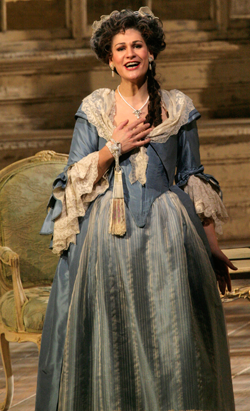 Anja Harteros as the Countess
Among the men, Bryn Terfel naturally stood out in the title role. I did
not like his Figaro when the production was brand new – he seemed so
anxious to show what an actor he was that he huffed and puffed and groaned
and grimaced instead of singing; Mozart took a back seat to Beaumarchais. He
has calmed down considerably over the years, and though still a bouncing
buffo-man with plenty of time for comedy (if his pretence of jumping off the
balcony is not quite believable), he now sings the arias at a less frenetic
pace, with more of the elegance they require and reward. Simon Keenlyside
played the Count as an elegant fop, forever tossing his curls and pratfalling
on the polished floors, but this never interfered with his musical authority.
Maurizio Murano’s blowhard Bartolo, Greg Fedderly’s slithy Basilio, and
Patrick Carfizzi’s lumpish Antonio earned most of the day’s laughs.
Philippe Jordan is a young Swiss who conducts with zest and delight, as if
he wanted to grab you by the ears and prove this is a masterpiece with charms
you never suspected – hardly necessary with Figaro, but what I
mean is, he takes none of it for granted, he is thrilled by the music and
eager to share.
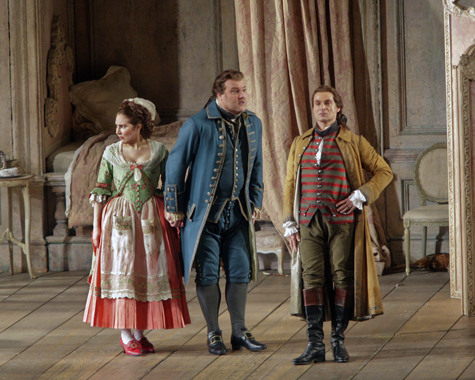 Ekaterina Siurina (Susanna), Bryn Terfel (Figaro) and Simon Keenlyside (Count)
And what did I object to about the conclusion? In the Met’s rush to get
the Countess into a new and glittery gown for the finale, no one has thought
(and Mr. Miller years ago did not think) to have her show the ring to the
Count, revealing to him that she is the mysterious lady he made love to in
the dark. The audience knows this, and Figaro and Susanna know it, but the
Count does not, and his heartfelt, aristocratic apology is inexplicable if he
doesn’t. The laws of farce are immutable: If you do not tie all the knots,
the machine unravels. It’s such an easy piece of business to fix – and so
satisfying when it’s fixed. Patch it up, Met.
John Yohalem